Supreme Court Reaffirms 65-Meter Standard for Fewa Lake Amidst Local Opposition


Pokhara. On April 29, 2018, the Supreme Court first issued a mandamus to designate the area within 65 meters of the Fewa Lake shore as a conservation zone for the protection of the lake.
Another point added to the same verdict was that the local government has the authority to set the lake's standard. As per the verdict, the Pokhara Metropolitan City set the standard at 30 meters in 2021, deeming it impractical, and another writ was filed against this decision in the Supreme Court.
In June 2023, in another verdict, the court ordered that the standard must be 65 meters, stating that Fewa Lake is a national asset and local levels cannot set its standard. Although an order was given to implement the lake's standard and beautify the buffer zone within six months, the order has not been implemented due to opposition from local landowners.
When did the standard begin?
The first decision to implement a standard for Fewa Lake was made in 1973. Over this 50-year period, there has been a series of decisions to set standards, followed by reductions due to opposition. Although the state set standards, the inability to pay compensation led to repeated reductions in the standards.
The then government, on December 1, 1973, formed the Town Planning Implementation Committee and prepared the Physical Development Plan for Pokhara. The planner was Padambahadur Chhetri and the administrator was Shankarraj Pathak. This modern plan for Pokhara was prepared under the leadership of Pathak, the Zonal Administrator of Gandaki.
The plan declared Fewa Lake a green and protected area. Subsequently, decisions on March 26, 1980, and September 12, 1980, implemented a standard prohibiting any construction work towards the lake from the center of the road in the Baidam area up to 200 feet. Although the 200-foot standard was decided, the state lacked the capacity to acquire land by paying compensation to landowners. As a result, hundreds of houses and structures were built in violation of the standard.
Due to widespread protest and public pressure, a cabinet meeting in 1981 reduced the 200-foot standard, allowing house construction up to 45 feet, leaving 30 feet from the center of the road. By 1989, more than 160 structures had been built in this area. Following this, locals began demanding that the standard be set at only 80 feet. The committee, unable to provide compensation, proposed the option of setting it at 80 feet accordingly. Subsequently, in 1990, different standards were set for the same lake. A standard of only 40 feet was set towards the dam side, a total of 36 feet from Phirke Bridge to Himagriha, and only 66 feet up to Barahi Chowk thereafter.
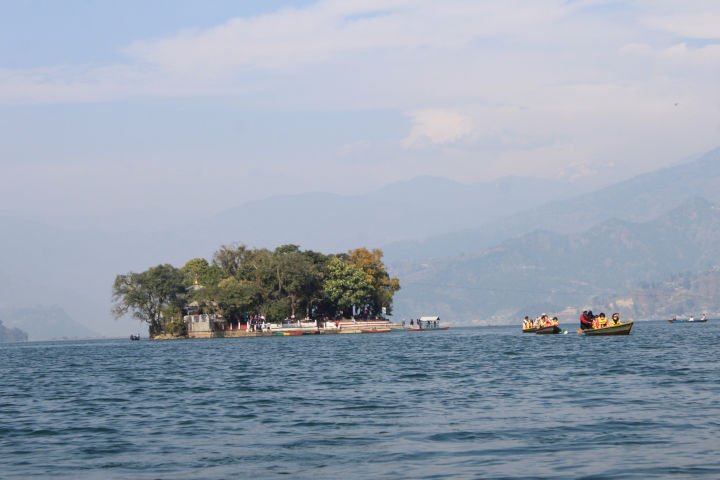
In 1991, the decision from 1981 was revived, allowing 45 feet for construction, leaving 30 feet from Barahi Chowk to Khahare.
When did the 65 meters start?
As the standards set based on roads led to further encroachment on the lake, standards began to be set based on the lake's shore. The call to set a 65-meter standard first began at the administrative level in 1997. The 2001 JICA report first suggested implementing a standard of 65 meters in urban areas and 30 meters in rural areas, and the 15th District Council in 2007 first decided to set a 65-meter standard by a government body. Subsequently, the Town Development Committee also recognized this standard as official. However, the standard could not be implemented.
A task force led by Girija Prasad Gorkhali, a technician from the Urban Development Department, was formed to provide technical suggestions for addressing grievances related to the lake's standard compliance and conservation. The committee submitted a report in 2010 concluding that while the 65-meter standard was correct, it would be impractical. The committee's conclusion was that creating a zero-construction zone within this standard would be impractical.
The committee then suggested designating the 20 meters from the lake shore as a completely prohibited zone. It was suggested that decisions should be made to allow temporary structures of up to one story within 20 to 45 meters and permanent structures of up to two stories from 45 to 65 meters.
Local landowners allege that the Supreme Court made its ruling without considering old documents and practical problems. Currently, within 65 meters of the Fewa Lake shore, there are permanent structures worth billions of rupees and land with private titles. The 2009 then-District Development Committee report itself suggested land pooling as an alternative, stating that the state could not provide compensation.
"If compensation is provided, we are ready to give our homes and land to the state, but the state is treating us as criminals and making us homeless, which is unjust," says local Bhimsen Bhujel. "This is our ancestral land. Many discussions and decisions were made about the standard in the past, but they were not implemented."
It is not yet clear exactly how many structures fall within the standard as per the mandamus, but according to a study conducted by the Pokhara Metropolitan City in 2020, approximately 500 structures fall within the 65-meter standard.
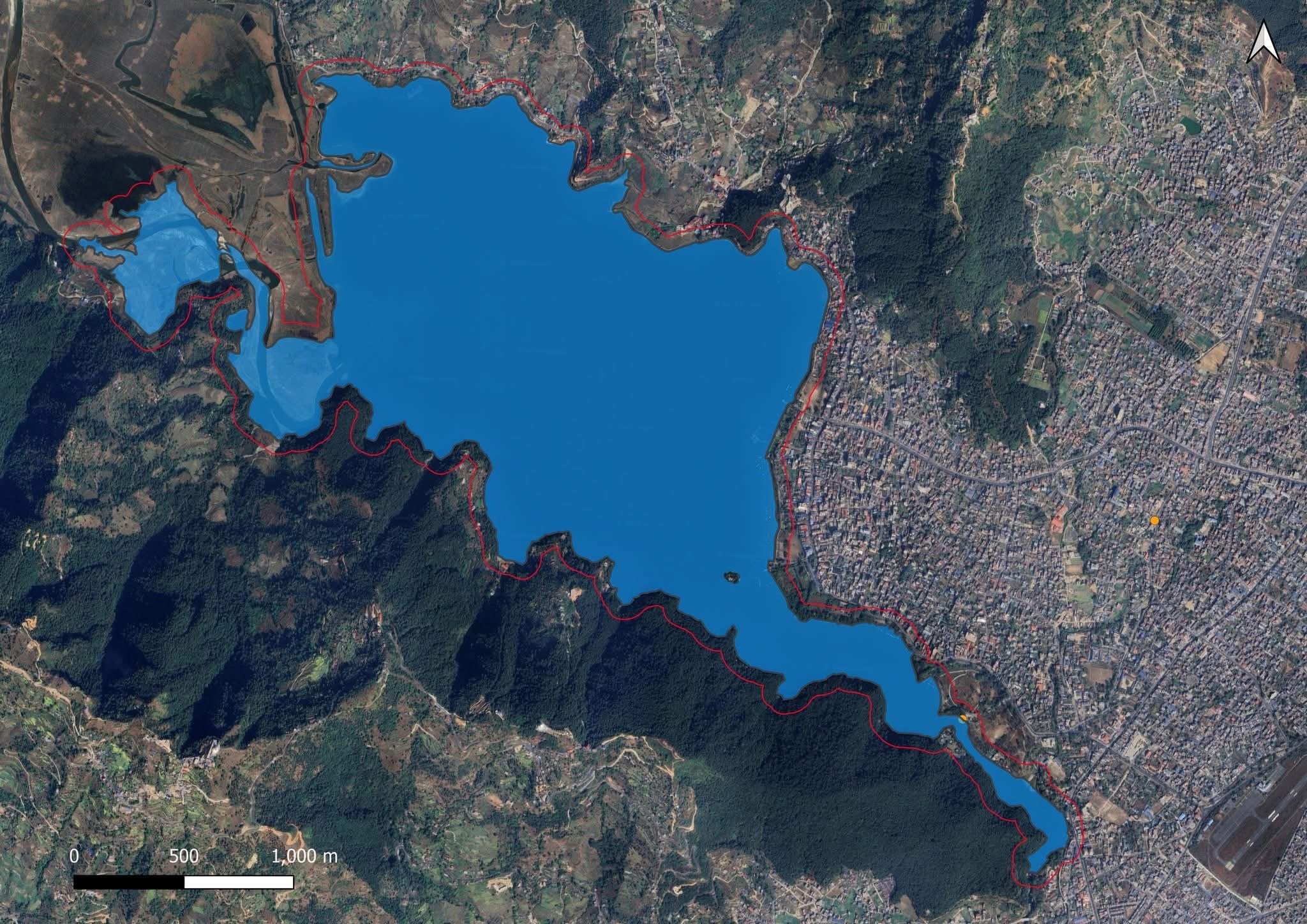
The report, which includes 493 permanent and temporary structures, was submitted to the Prime Minister by Mayor Man Bahadur GC at the time. According to that report, the land within 65 meters amounts to 1200 ropanis. At the price at that time, it was concluded that at least 10 billion rupees would be required for compensation to remove the 1200 ropanis of land and structures.
It is said that this land will increase further if the high flow area is considered the boundary of the lake, but the exact details of how much land is in private names have not yet been ascertained. With the high flow defining the boundary, the 65-meter standard limit has also extended much further, which will certainly increase the compensation amount.
Seeing the difficulty in removing structures and acquiring land within 65 meters, the Pokhara Metropolitan City reduced the standard of Fewa Lake to 30 meters through a meeting of its executive board in 2021. The metropolis has the authority to make this decision as per the court's initial order, but another writ was filed against the metropolis's decision in the Supreme Court. And in 2023, the order came that the lake's standard would be 65 meters.
Also
This specific news has been automatically translated by AI. As a result, there may be some inaccuracies or language errors.

_cvUCBlwFTZ.jpg)