Nepal Evicts Informal Settlements, Relocates Residents to New Housing

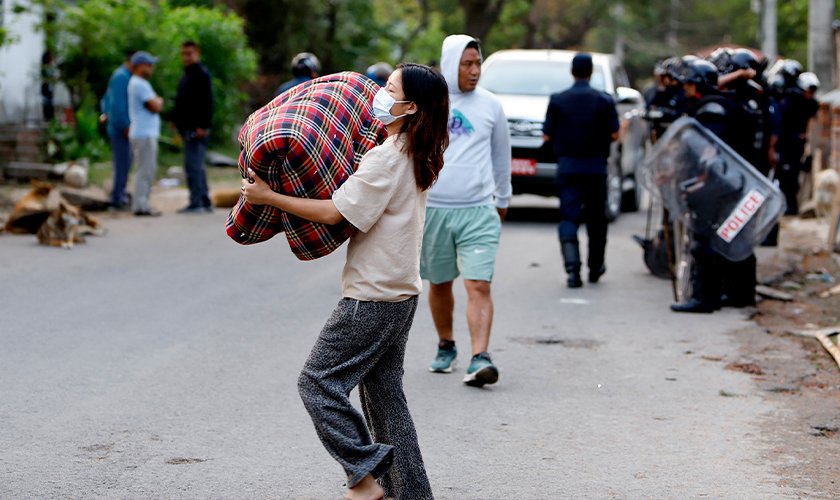
Kathmandu. The government has removed informal settlements in Thapathali, Gainri Gaun, and Manohara. For two consecutive days, Saturday and Sunday, bulldozers have been clearing disorganized structures built around various rivers in the Kathmandu Valley since early morning.
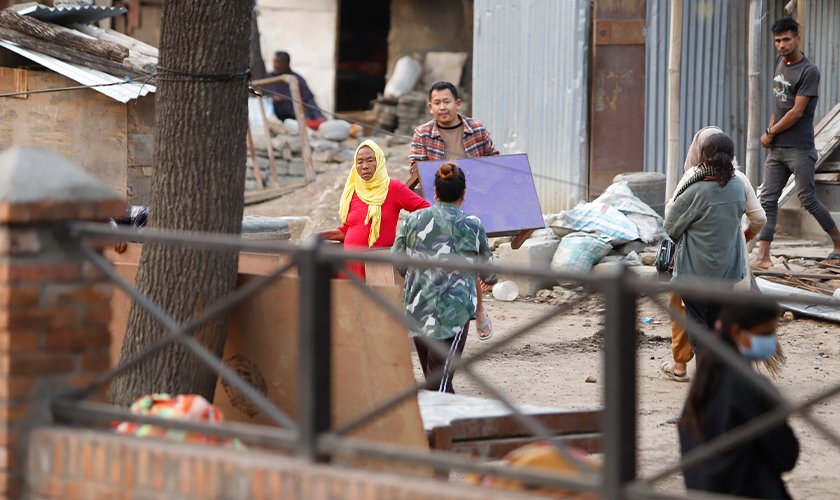
Following the government's demolition of informal settlements, or disorganized structures, residents have begun to come into contact with the government. Those who have reached the government are being screened as informal settlers at a holding center established at Dashrath Stadium in Tripureshwor.
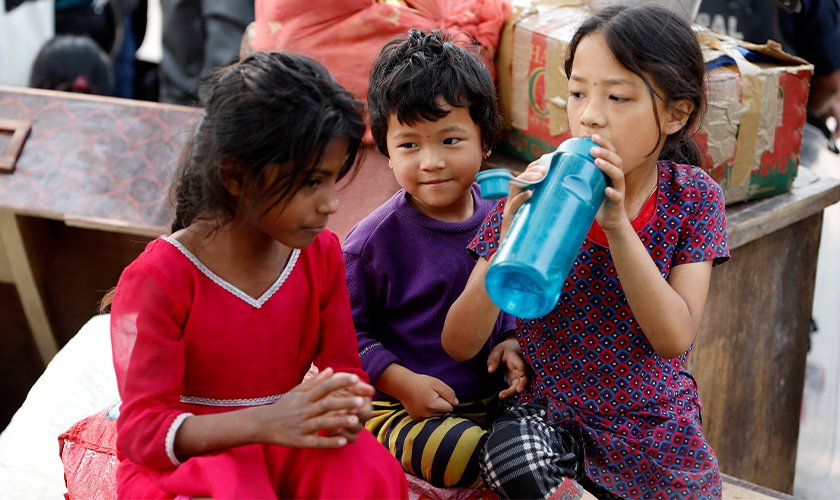
With the demolition of disorganized structures built around various rivers in the Kathmandu Valley, over 200 families have been rendered homeless so far. Their names are being registered at the holding center in Dashrath Stadium.
_1wOaoyTkf6.jpg)
The government is preparing to manage them after screening. The government has prepared to manage the genuinely homeless informal settlers, who have been displaced by the bulldozing of settlements, in apartments in Ichangunarayan, Ward No. 1 of Nagarjun Municipality.
The government is preparing to relocate genuine informal settler families to government apartments in Nagarjun within two weeks. According to the Prime Minister's political advisor, Asim Shah, they will be housed there for permanent management after the identification process is complete. Currently, displaced families are being temporarily housed at Dashrath Stadium for data collection, and if necessary, they will also be managed in hotels.
This building was constructed about 12 years ago during the tenure of former Prime Minister Baburam Bhattarai for the management of informal settlers, but due to the inability to manage them, the building remained unused for a long time.
There are three buildings that can accommodate 135 families, but currently, one building houses the Manav Sewa Ashram, and another houses the Ward No. 1 office of Nagarjun Municipality, a community police post, and a urban health center. The government is intensifying repair and cleaning work to make the buildings habitable.
The work is currently being carried out by the Department of Urban Development and Building Construction under the Ministry of Urban Development. The department has deployed engineers to complete tasks such as repairing windows and doors, painting, and managing drinking water within a week.
_nX0BNHnzvh.jpg)
According to an engineer working on the building's repair, the work on repairing windows and doors in the rooms within the building is in the final stages. He informed that many items have been damaged due to disuse, and they are currently being inspected.
45 Rooms in One Block, Each with an Attached Bathroom
The building where informal settlers are to be housed has 45 rooms. The building can accommodate 45 families for the time being. The five-story building has nine rooms on each floor from the ground to the fifth floor, all of the same size. All 45 rooms are divided into three sections internally, with a kitchen, toilet, and bedroom arrangement within the same room.
While it appears comfortable for families of up to five people, it may be inconvenient for families with more than five members. A team including the acting mayor of Kathmandu Metropolitan City, Sunita Dangol, and the deputy mayor of Nagarjun Municipality has inspected the building. During the inspection, they noted that the rooms appeared small. However, Deputy Mayor Dangol stated that it seems possible to temporarily accommodate informal settlers.
_HZXjxfD5yq.jpg)
During the inspection, she said, "The building needs to be made habitable. We have intensified that work. After managing drinking water and electricity and completing the painting, identified informal settlers will be housed."
Nagarjun Municipality's acting mayor, Sushila Adhikari, stated that the municipality is taking necessary initiatives to implement the government's decision. Inspecting the building, she mentioned the need for managing drinking water and electricity. "Although the municipality used to conduct yoga in three rooms on the ground floor, we have now removed it. The municipality operated an isolation center during COVID, and we will provide other necessary support," she said.
Managerial tasks such as painting, clearing overgrown vegetation, and cleaning water tanks have begun for the apartment built for informal settlers who have been displaced for a long time.
_dTZrJwtoGi.jpg)
One of the Three Buildings Houses Manav Sewa Ashram, Another the Ward Office
Out of the three buildings constructed in Nagarjun Municipality Ward No. 1, only one is vacant. One block of the well-equipped apartment, which has fallen into disrepair without full use, houses the Ward No. 1 office of the municipality and a temporary post.
One block has been in use by the Manav Sewa Ashram for some time. The vacant building in the middle is now being prepared to house informal settlers, but the acting mayor, Adhikari, stated that the government is ready to remove the municipality's ward office. She said that the municipality would remove the ward office and urban health center to operate the three buildings arranged for informal settlers, but the government has not asked for it yet. "If necessary, we will remove it," she said.
Preparations Made, But Roads and Drinking Water Are Major Challenges
Although preparations are underway to make the building presentable for informal settlers, the municipality has indicated that the basic infrastructure in the area is very weak. The acting mayor of the municipality, Adhikari, stated that the main problem in this area is drinking water, but necessary management will be done.
A tank with a capacity of only 800 liters has been arranged for drinking water for 45 families. However, as this will be insufficient, the government is arranging for additional tanks. Not only drinking water but also sewage is a problem here. The acting mayor, Adhikari, stated that the municipality would provide necessary support to solve this problem.
Bharat Regmi, chairman of the Ichangunarayan Housing Scheme Consumer Committee, said that there is a lack of drinking water and road access in the area, which has over 900 households. "A tender of about 10 crore rupees has been issued for drinking water, but with the increase in population, that source alone will not be enough. Even now, water comes only once or twice a week," Regmi said.
However, locals say that the apartment, which has been unused for a long time, has become like a 'haunted house' due to lack of maintenance. They argue that bringing people to live there without proper maintenance will create disgust among the residents and lead to further problems.
Curiosity Among Locals
This apartment was built in 2069 BS (2012 AD) with an expenditure of 12 crore rupees during the tenure of former Prime Minister Baburam Bhattarai. Although a plan was made to house informal settlers from the banks of the Bagmati, Bishnumati, and Manohara rivers in the apartment built with crores of rupees, the locals did not agree. They protested, citing increased insecurity in the apartment.
_L4gCZYiHsO.jpg)
Local residents around the apartment are feeling some discomfort with the arrival of informal settlers. Their curiosity has increased with so many people being brought to live in the middle of the settlement.
Although locals who protested the news of bringing informal settlers to this apartment in the past are silent this time, they harbor fear in their hearts. Bharat Regmi, chairman of the Ichangunarayan Housing Scheme Consumer Committee, says that the current situation does not allow for protests against the government. "There is a fear of how the informal settlers who have come to the 'haunted house' will live among the community. Locals who have lived without fear so far are showing inner fear," he expressed concern. However, he said there is no alternative but to welcome the government's decision. He also mentioned the problems of drinking water and infrastructure, stating that the arrival of a large number of families would create further problems.
Similarly, local Baburam Chhatukuli also said that it is not possible to go against the government. However, he said that all locals are afraid of how the informal settlers will behave. "In the past, there was a protest against the decision to house informal settlers. But now there is no situation to protest. We want to welcome everyone. But the government must commit to strengthening peace and security in this area," he said.
Likewise, another local, Kamala Pandey, said that the news of informal settlers coming into the community has made her curious. While she appreciates the government solving the informal settler problem, she expressed some fear as it is her area. She said, "We have no choice but to welcome the government's decision. But the government must work to ensure peace, security, and order in this area for management. No one can speak out, but many are fearful. That environment should not be allowed to develop."
Similarly, local Dinesh Pokharel said that bringing a large number of informal settlers at once has created fear among the people here. He stated that locals fear that the group of outsiders will be strong, and they might be attacked or mistreated. "Right now, there is a state of dead silence here. People are murmuring amongst themselves but cannot speak out," he said, adding, "They talk about scary things like cutting vegetables, which makes us feel unsafe."
However, former Prime Minister Dr. Baburam Bhattarai has stated that informal settlers living on the riverbanks should be immediately moved to the apartment constructed in Ichangunarayan. He claimed that land mafias and the self-interest of local political parties' vote banks are involved in preventing informal settlers from being housed in the government-funded building. Bhattarai argues that the local narrative created has been responsible for the apartment, initiated during his government and completed later, remaining unused. He accused mafias of instigating locals out of fear that their land value would decrease with the arrival of informal settlers.
"A narrative was created that informal settlers are thieves and vagrants, and they should not be brought here," Bhattarai said. "Local leaders of political parties supported it for their vote bank interests and left the informal settlers in limbo, which is completely wrong."
He emphasized that the poor and children should not be kept in the unhygienic and unsafe environment of the riverbanks in an inhumane manner. Mentioning that a building capable of housing about 300 families has been constructed in Ichangunarayan, Bhattarai said that they should be managed there immediately and the remaining ones should be relocated with similar alternatives.
Concerns About Employment
Even though efforts are being made to repair and accommodate them, the apartment flats are quite small (barely accommodating a family of 3-4 people). Furthermore, the location being far from the city center has created uncertainty about the employment and daily livelihood options for the informal settlers once they are relocated.
_w5N0Rr0iQ3.jpg)
This specific news has been automatically translated by AI. As a result, there may be some inaccuracies or language errors.