Locals challenge Phewa Lake setback rule in Supreme Court

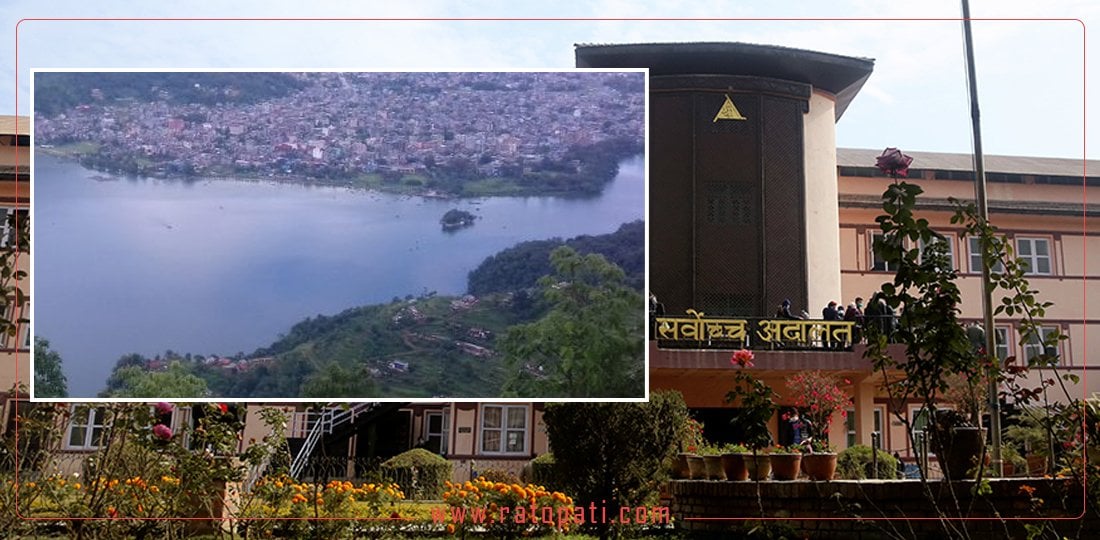
Kathmandu. Locals have filed a review petition against the 65-meter setback rule set by the Supreme Court in the name of Phewa Lake conservation. The affected locals, facing complete displacement of three indigenous communities who have been residing there for generations, have approached the Supreme Court again seeking justice.
Previously, on Chaitra 21, the Pokhara Metropolitan City had bulldozed 32 structures. As these structures were supposed to be removed only after receiving compensation as per the order, the midnight demolition has caused fear among locals and business owners within the 65-meter zone.
The petitioners include residents living between Ratna Mandir Durbar and Himagriha. They argue that the verdict was issued without making them respondents or informing them, and that the 65-meter rule is being applied everywhere, disregarding the setback standards set by previous study reports. Therefore, they demand a review based on the principles of natural justice.
In 2069 BS, a commission led by Bishwaprakash Lamichhane had recommended a setback of only 30 meters in that area. However, locals like Surya Bhujel state that they have approached the Supreme Court against the order that established a universal 65-meter setback. "Our belief is that no one should be displaced unjustly. However, a review has been sought because the commission led by Bishwaprakash Lamichhane had made a different provision for our area, which was not addressed. The implementation of this setback rule has created a situation where three indigenous communities face displacement."
What is the Phewa Lake setback dispute?
A joint bench of Supreme Court Justices Sapana Pradhan Malla and Om Prakash Mishra had issued a mandamus in the name of the government to remove all structures built within 65 meters of the Phewa Lake shore, in response to a writ petition demanding the removal of settlements causing pollution to the lake.
On Asar 4, 080 BS, another verdict by a bench of Justices Kumar Regmi and Hari Prasad Phuyal ordered the immediate removal of structures, cancellation of illegally registered land, and bringing those lands back under the lake's name. It was also stated that if compensation was deemed necessary, the lake area should be cleared after providing compensation.
Even according to this order, most land in this area is supposed to be demolished only after providing compensation.
Before 2018 BS, Phewa Lake existed in various pond forms. The lake's area expanded after the construction of the first dam during King Mahendra's reign. After the dam broke in 2031 BS, the lake's water dried up, and cultivation began in a large part of the area. The government itself distributed land ownership certificates for these lands between 2031 and 2039 BS.
In 2039 BS, a new and higher dam was constructed, increasing the water level and giving Phewa Lake its current shape. However, the government has now set a 65-meter setback based on the flood level created after 2039 BS. Locals question how land ownership certificates and building approvals granted by the government in 2031 BS can be deemed illegal today.
They argue that instead of demolishing hundreds of structures and displacing thousands of people in the name of the 65-meter setback rule, the rule should be reviewed. They contend that if managed through a land pooling system, compensation would not even be necessary.
Compensation Liability and Banking Risk
If all structures are demolished as per the Supreme Court's order, the initial estimate suggests the state would have to pay 30 to 40 billion rupees in compensation, a plan for which the government has no provision.
On the other hand, banks have billions invested in Lakeside hotels and tourism businesses. Business owners are concerned that the significant gap between the government's valuation and market prices would mean that compensation would not even cover the principal and interest of bank loans, potentially collapsing Lakeside's economy.
Locals also suspect a conspiracy to remove small businesses and indigenous people in the name of lake conservation and hand over the area to large corporate houses. Asserting that they are not squatters or land mafias but children of the lake, they hope to receive justice with human sensitivity from the Supreme Court this time. The case is currently sub-judice in the Supreme Court.
This specific news has been automatically translated by AI. As a result, there may be some inaccuracies or language errors.