Nepal Proposes New Civil Service Act with 48 New Provisions

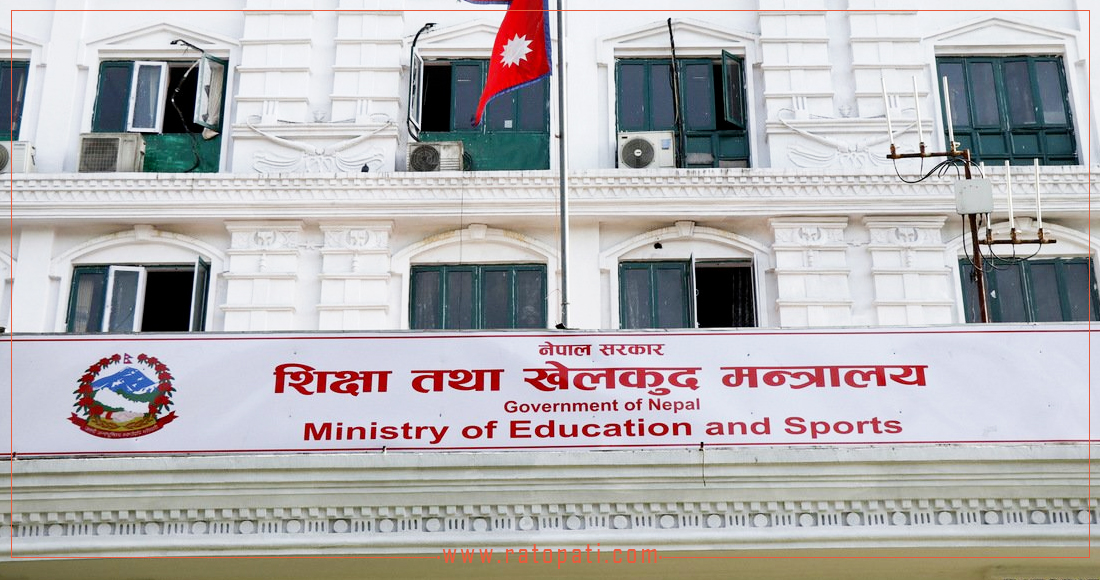
Kathmandu. The 'Bill to Make Provisions Regarding the Formation, Operation, and Service Conditions of the Federal Civil Service,' made public on Friday for feedback, includes most of the provisions that the previous House of Representatives attempted to introduce in 2079 but failed to pass. The draft, published by the Ministry of Federal Affairs and General Administration, proposes 48 new provisions.
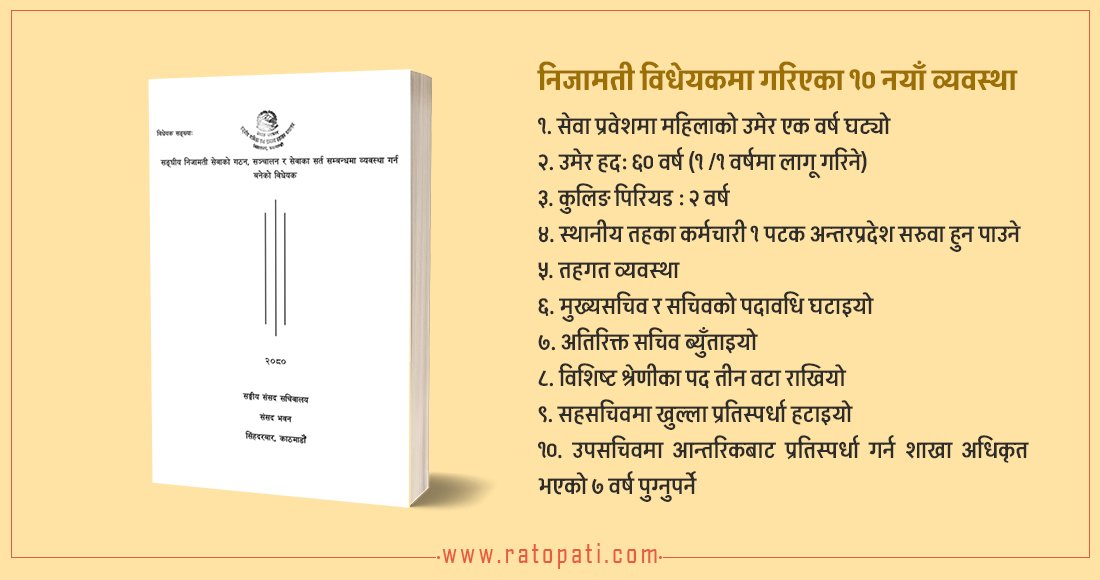
Most of the provisions included in the act passed by the previous House of Representatives are present in the draft of the Civil Service Act. Key issues such as the cooling-off period, retirement age of 60, and entry into civil service were passed by the previous House of Representatives but did not become law as the National Assembly did not pass them. These issues are still included.

The draft of the act, prepared and published by a team including the Minister for Federal Affairs and General Administration, Pratibha Rawal, the ministry's secretary, joint secretaries, and other staff, includes a provision stating that 'employees who resign or retire from a gazetted special or first-class position in the federal civil service or other government service will not be appointed to any constitutional, diplomatic, or other government position until two years have passed since their resignation was accepted or they retired.' This provision was also included in the previously failed bill. The current Civil Service Act of 2049 does not have a cooling-off period.
The draft bill stipulates that Chief Secretaries, Secretaries, and Joint Secretaries will not be eligible for appointment to constitutional, diplomatic, and other government positions for two years after leaving their posts. This provision will apply to both employees who have reached mandatory retirement and those who have resigned.
The draft introduces a new provision setting the tenure for civil servants at the 14th level (Chief Secretary) at two years and for civil servants at the 13th level (Secretary) at two years, with the government having the option to extend the tenure of a 13th-level civil servant by up to one year based on performance.
A two-year cooling-off period is also imposed on employees below high-ranking positions. They will not be allowed to work as employees or consultants in projects operated by entities other than inter-governmental bodies or international development partners.
The provision states that employees will not be allowed to work for organizations related to their employing agency or for organizations regulated by such agencies within one year prior to their retirement. It is also mentioned that employees who violate this will not receive service benefits according to the act.
The draft bill sets the tenure for civil servants at the 14th level (Chief Secretary) at two years and for civil servants at the 13th level (Secretary) at two years, with the government having the option to extend the tenure of a 13th-level civil servant by up to one year based on performance. The failed bill proposed a two-year term for the Chief Secretary and a four-year term for the Secretary. The current act has a three-year term for the Chief Secretary and a five-year term for the Secretary.
Similarly, regarding age limits, the current provision is mandatory retirement at 60 years. The draft states, 'Civil servants will remain in service until 60 years of age.' Currently, civil servants retire mandatorily at 58 years, and the previously failed bill also proposed raising the mandatory retirement age to 60.
The draft also proposes changes to the age limit for entering civil service. The draft states, 'The maximum age limit for entering civil service will be set at 32 years for males, 35 years for females, and 39 years for persons with disabilities.' Currently, males can enter civil service up to 35 years and females up to 40 years. The bill that failed to become law proposed reducing the age for women by one year while keeping the entry age for men the same. The current proposal is to reduce it for both.
'Any person who has taken membership in a political party, its affiliated organization, engaged in political activities, or become a candidate in an election for a political post will be dismissed and deemed disqualified for future government service,' the provision states. This provision is not present in the current act.
The new bill draft includes a provision that there will be no trade unions in the civil service, a provision that was not present in the current act or the failed bill. The draft mentions the establishment of various other mechanisms to ensure the rights and welfare of employees.
The draft prohibits any civil servant from providing training for competitive examinations conducted by the Public Service Commission or public bodies. Currently, serving employees often provide training at 'Loksewa Coaching Centers,' sharing their experiences and study tips. The new act aims to prevent employees from providing training while in government service, even if it means taking leave from their official duties.
The draft also proposes changes to the age limit for entering civil service. The draft states, 'The maximum age limit for entering civil service will be set at 32 years for males, 35 years for females, and 39 years for persons with disabilities.'
Reservations are provided for various ethnic groups upon entry into civil service. Currently, there is no limit on how many times this reservation can be used. However, the draft act specifies that a person can avail the reservation facility only once for a non-gazetted position and once for a gazetted position. This means an individual can use the reservation benefit once for a non-gazetted post and once for a gazetted post. Currently, many individuals have been promoted using reservation from Branch Officer to Joint Secretary in the civil administration.
The draft includes provisions for chief administrative officers to be collectively sent to the Chief Minister's office on a regional basis and to be posted at the local level. It also states that failure to go to remote geographical areas or designated chief administrative officer positions may result in not being considered for promotion. Poor performance or personal irregularities will also lead to being placed on a negative list, and promotions or nominations will be halted. Provisions are also made for inter-local or inter-provincial transfers based on mutual agreement between provinces, allowing provinces to enact laws accordingly.
The government has also included a provision in the draft for a Civil Service Board to ensure accountability in the transfer, posting, and career management of civil servants up to the Gazetted Second Class.
The act includes new provisions such as not transferring or initially posting officers of the Gazetted Third Class to the responsibility of office chief without completing a minimum term of service; not transferring Gazetted Electrical and Third Class civil servants before completing three years; not transferring assistant level employees between ministries before completing four years; and not keeping any employee in the same position with the same responsibilities in the same office for more than four years.
These are the 48 new provisions to be made in the act-
This specific news has been automatically translated by AI. As a result, there may be some inaccuracies or language errors.