National Assembly Members Express Frustration Over Budget Formulation and Border Restrictions

Kathmandu. As the government prepares the budget for the upcoming fiscal year, lawmakers in the parliamentary committee have begun expressing extreme frustration and outrage.
Lawmakers, who are representatives of the people, have voiced their anger, claiming they are being bypassed in the budget formulation process. Members of the National Assembly have complained that they are unable to include projects in their constituencies due to a lack of access to the project bank. They demanded that National Assembly members be given equal status in the budget-making process.
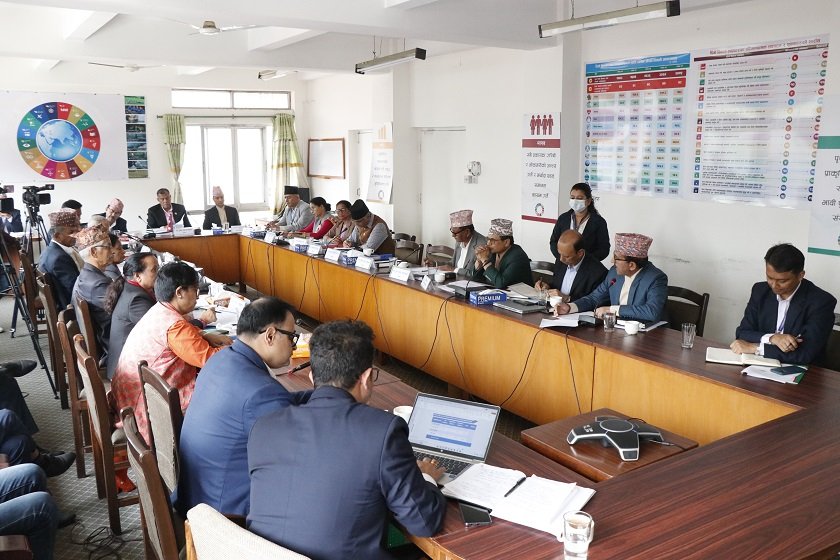
Most lawmakers expressed these views during a discussion on the upcoming fiscal year's budget held by the Development, Economic Affairs, and Good Governance Committee under the National Assembly on Wednesday. They argued that the budget formulation process is ritualistic and controlled solely by a handful of people with access. They demanded that National Assembly members, as representatives of the people, be granted access and the right to include necessary projects.
The most contentious issues in the discussion were the project bank and the lack of a role for lawmakers. Despite the government introducing the project bank concept for planned development, they expressed intense dissatisfaction over their lack of access to it.
National Assembly member Urmila Aryal spoke about policy corruption, budget allocation contrary to the spirit of federalism, and the need for transparency in the project bank. She demanded that National Assembly members also have access to the project bank.
Similarly, lawmaker Tul Prasad Bishwakarma shared the bitter reality that he has been unable to allocate even a single penny to his constituency for four years. He complained that the government is discriminating between members of the House of Representatives and the National Assembly. 'It has been four years since I won the election, but I have not been able to distribute a single project in my area,' he said, 'Who holds the key to this project bank? We, the elected representatives, are not even given the password or the process on how to enter projects into that system.'
Lawmaker Narayan Datta Bhatta agreed with his statement. He remarked that the project bank has become like a pocket bank for a few employees and influential ministers. He complained that the practice where elected representatives recommend projects based on public needs, but those projects are never entered into the project bank, is proving lawmakers incompetent in the eyes of the public.
Lawmaker Kamala Devi Pant stated that the discussions on the budget in the committee are merely ritualistic. 'We talk about the budget and principles here, but the government does not listen to us. The suggestion process has become just a drama,' she said.
She drew the government's attention to the continuous increase in financial indiscipline and arrears. 'We have so many theoretical arrears that could be settled through normal processes, but there is no readiness to sit with the Office of the Auditor General to resolve them,' she said.
She noted that the concept of gender-responsive budgeting, which started in the fiscal year 2052/53, is fading away. She expressed concern over budget cuts in women's empowerment and the health sector.
Lawmaker Ghanshyam Rijal said that the central government is attacking the spirit of federalism in budget allocation. He stated that the tendency of the federal government to keep even projects smaller than 30 million rupees under its control is stripping local and provincial governments of their rights.
'The practice of the federal government interfering in provincial work, and the province interfering in the work of the municipality, has shattered the development model,' Rijal said, 'Unless clear standards are set regarding which level of government should handle projects of what size, this duplication and misuse of the budget will not stop.'
Meanwhile, Vice-Chairman of the National Planning Commission, Dr. Gunakar Bhatta, informed that there is a resource pressure on the upcoming budget, stating that one-third of the budget goes toward debt repayment and social security. He mentioned that the government faces serious pressure on resource mobilization while formulating the budget for the upcoming fiscal year. Dr. Bhatta pointed out that the budget formulation is challenging due to increasing liabilities and shrinking resources.

He said, 'Economic activities worldwide are being affected due to international circumstances, including fuel and energy crises. We are not untouched by the impact of projections made by agencies like the International Monetary Fund,' he said. He stated that it is the responsibility of the respective ministries to enter projects into the project bank after reviewing environmental impacts, cost-benefit analysis, and social returns.
'The National Planning Commission only checks whether the projects sent by the respective ministries to the project bank meet the standards,' he said. In the committee meeting, the lawmakers also committed to taking the suggestions to the respective ministries, ministers, and secretaries for discussion.
What should the upcoming budget be like?
Lawmakers said that the government must change its traditional style in formulating the budget for the upcoming fiscal year. They suggested that a mechanism must be developed to make it mandatory to enter people-oriented projects brought by lawmakers into the project bank.
The lawmakers' suggestions include selecting projects based on needs rather than the whims of the bureaucracy, ensuring clear computer coding for every project mentioned in the budget, and completely prohibiting projects that lack coding, preparation, or are pulled out of pockets based on influence.
Lawmaker Urmila Aryal also stated that inhumane treatment of people at the border needs to be stopped immediately. She said that while smuggling at the border should be stopped, people should be allowed to bring goods worth 100 rupees.
They demanded that small and fragmented projects (e.g., under 30 million rupees) should be transferred to provincial and local levels, the federal government should focus its budget only on large projects of national pride and strategic importance, and a realistic budget should be introduced that reduces the distance between Karnali and Kathmandu and is directly linked to public health, education, and employment.
Lawmaker Pant said that the fading gender-responsive budget should be revived with priority in the upcoming budget. They stated that there is no other option now but to make the budget system people-oriented.
Discretionary power at customs, concern over hardship for the poor
The meeting also discussed issues other than the budget. Chairman of the Loktantrik Samajwadi Party (LOSP) and lawmaker Mahantha Thakur first expressed opposition to the strictness imposed by the government on the Nepal-India border area. He drew the government's attention to the fact that unnecessary strictness at the border is causing daily hardship for the citizens of Madhesh and those living near the border.
Thakur emphasized that the open border between Nepal and India and the centuries-old social, cultural, and 'roti-beti' (bread and daughter) relationship should not be affected in the name of security or customs. He said that the rule requiring customs duty on goods worth more than 100 rupees is causing extreme hardship for the poor who work for daily wages and go across the border to bring salt and oil.
'When the poor bring a kilo of salt and oil, they are humiliated at customs by having their clothes pulled. But big businessmen and smugglers bring truckloads of goods through settings,' Thakur said with outrage, 'The discretionary power given to customs officials is the main root cause. A system that does not speak clearly through law and leaves things to the discretion of employees is hollowing out the country's economy.'
He gave an example from the Mahabharata. Just as everyone was silent when Draupadi was being disrobed in the court of the Kauravas, he made a serious accusation that the state mechanism is silent today while the poor are being humiliated. Similarly, lawmaker Ghanshyam Rijal said that the committee should direct the government to facilitate. He stated that the people at the border are being treated inhumanely. Likewise, lawmaker Urmila Aryal also stated that inhumane treatment of people at the border needs to be stopped immediately. She said that while smuggling at the border should be stopped, people should be allowed to bring goods worth 100 rupees.
Similarly, lawmaker Narayan Datta Bhatta said that the work of harassing people at the border needs to be stopped immediately. He said that the government should be able to implement policies only after looking at the practical aspects of the situation. Committee member Samjhana Devkota also said that it is necessary to ease the border restrictions. She said that the committee should direct for facilitation.
As per the demands of the lawmakers, the committee has directed the government to immediately stop the harassment of the public in the border area. Committee Chairman Krishna Prasad Poudel said that the government has tightened customs while ignoring the daily life and basic needs of the citizens in the border area.
'As elected representatives, we must look at the daily life and needs of the people,' Chairman Poudel said, 'Citizens in the border area often survive by bringing some goods from India at a cheaper price for their livelihood.' He said that such a directive was issued because the government ignored the basic needs and livelihood of the people by implementing the rule of paying customs on goods worth more than 100 rupees.
Photo: Krishna Khadka
This specific news has been automatically translated by AI. As a result, there may be some inaccuracies or language errors.

_TqAiZajEEB.jpg)