Nepal Government Moves to Ban Partisan Student Unions in Universities


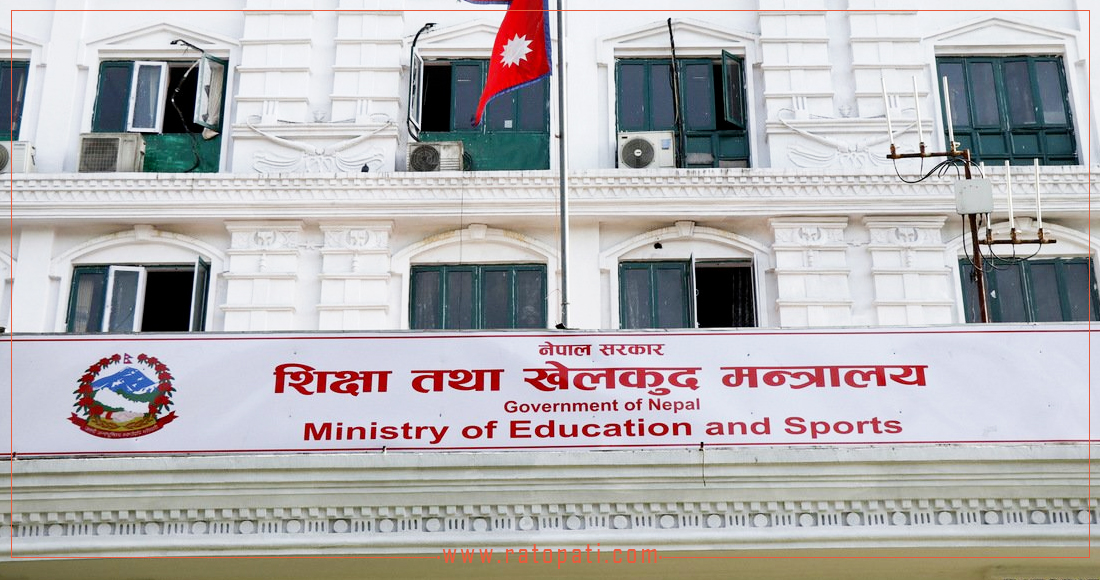
Biratnagar. On Chaitra 20, the federal government (Ministry of Education) decided to completely displace partisan student organizations from universities. While many initially expressed symbolic opposition to the decision, resistance is now gradually emerging from political parties as well.
On Chaitra 20, a meeting of the Coordination Committee, held in the presence of Minister of Education, Science and Technology Sasmit Pokharel and chaired by University Grants Commission Chairman Prof. Dr. Devraj Adhikari, announced the end of partisan politics in universities.
The meeting decided that student organizations acting as wings of political parties would be removed from university premises within 60 days, their offices (rooms/buildings) provided by the university would be reclaimed, and banners, flags, and wall writings within the campus must be removed immediately.
Similarly, the government has decided to abolish partisan student organizations within 90 days and form non-partisan 'Student Councils,' amending regulations if necessary. A strict policy has been adopted to mobilize permanent or temporary security forces (police) through the Ministry of Home Affairs if there is any obstruction in the process of removing these organizations.

Political parties have begun forming a front against this government effort. The Nepal Communist Party (NCP) issued a statement on Sunday, strongly criticizing both steps.
The NCP claimed that the attempt to ban student organizations is unconstitutional and unacceptable. Expressing serious concern, the NCP stated that an attempt is being made to snatch away the right to organize, which was enjoyed even during the difficult times of the Panchayat system, within the federal democratic republic. It also warned that the attempt to ban trade unions would violate constitutional rights and international treaties.
Immediately after the government minuted the decision to take strict action, student organizations began sporadic protests on university campuses.
Student leaders, fearing the erasure of their existence in campuses like Tribhuvan University, which have been considered nurseries for political parties and centers of political movements for decades, have started advocating against the move. They have termed it an autocratic step taken in the name of academic reform and warned of a strong movement if the decision is not revoked.
'Our organization cannot be abolished, and our faith cannot be removed,' said Rohit Yadav, Free Student Union (FSU) Chairman of Mahendra Morang Campus. 'Before removing student organizations, NGOs and INGOs should be removed.' He stated that he would proceed according to the instructions from his organization's center.
Previously, 14 student organizations affiliated with various political parties commented that the government's decision to remove the structure of student organizations from schools and universities is undemocratic.
'The right to be affiliated with an organization based on ideology is a fundamental right guaranteed by the Constitution of Nepal. Any act of restricting someone's thoughts is against democratic values and is inconsistent with international human rights standards. Such an attempt risks creating obstacles in the natural political socialization process of the young generation,' the joint statement of the student organizations said.
Experts say that completely removing student organizations, which have fought on the front lines in every major political change in Nepal (the movements of 2046 and 2062/63), based on an administrative decision could be a difficult task for the government.
However, education activist Abhishek Ghimire stated that a decision had to be made because the anarchic activities of student organizations had increased. 'Fighting for the rights and interests of students is our collective responsibility, but in recent times, anarchy had entered student politics. Purification was necessary,' he said. 'Acts like smearing soot on professors, physical attacks causing broken limbs, hanging chairs on trees, and locking offices were extremely indecent. It is a fact that Nepal's universities have become dilapidated due to such anarchic activities, leading to an increase in the trend of youth migrating abroad for higher education.' Therefore, he claims the government's latest decision is correct.
Meanwhile, Tribhuvan University Vice-Chancellor Deepak Aryal expressed the view that the government's decision points toward the path of amending the Act. 'If the FSU is to be abolished, the Act must be amended,' he said. However, he stated that he had no comment on this decision.
Decisions of the University Coordination Committee:
(a) Universities will no longer provide rooms/buildings/land to student organizations for office establishment.
(b) Physical signs of student organizations, including banners, flags, and wall writings, must be removed from university premises immediately.
(c) If there is any legal provision regarding partisan student organizations in the University Act, a proposal must be prepared to repeal those rules and submitted to the Ministry of Education, Science and Technology through the Commission immediately. If such provisions exist in university regulations/bylaws, they must be amended by the University Executive Council/Senate or the concerned body within 60 days.
(d) If there is currently a Free Student Union in the university, necessary amendments should be made to the university's regulations and bylaws to develop and establish a 'Student Council/Voice of Student' or a similar mechanism to work for the rights and interests of students. If the University Act needs to be amended in this regard, the relevant sections/sub-sections must be specified and submitted.
(e) If there is any security challenge in the process of removing partisan student organizations, the security agencies must be informed immediately. Furthermore, if it is deemed necessary to manage temporary/permanent security units on university premises, it was decided to request the Ministry of Home Affairs through the Ministry of Education, Science and Technology.
This specific news has been automatically translated by AI. As a result, there may be some inaccuracies or language errors.