Officials Who Exposed Vape Gold Smuggling Scandal Now Face Corruption Charges

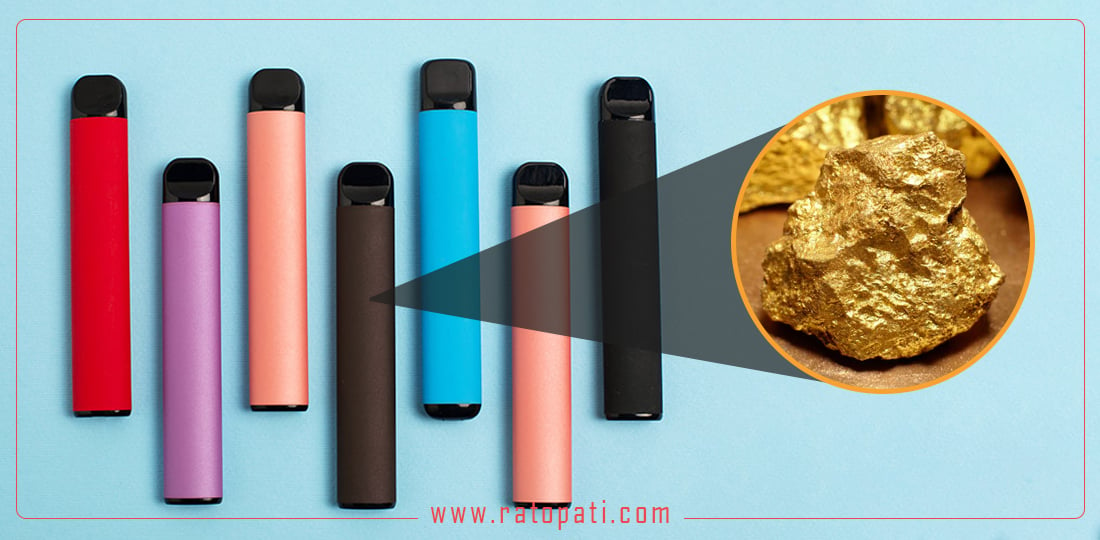
Kathmandu. On 2079 Poush 10, Chinese national Li Han Song brought 9 kg of gold into Tribhuvan International Airport, hidden inside electric cigarettes known as 'vapes'.
Suspecting that gold was concealed within 730 vapes across two suitcases, the then-Chief Customs Administrator at the airport, Arun Pokharel, wrote to the Central Investigation Bureau (CIB) of the police to request an investigation. Pokharel personally met with the then-CIB chief to report his suspicions regarding the vapes.
Prior to this, the bureau had investigated and arrested several suspects, including non-gazetted officer Revanta Khadka of the Tribhuvan Airport Customs Office, charging them with organized gold smuggling. The defendants arrested at that time remain in custody pending trial.
Three years after the vape gold smuggling incident, the Commission for the Investigation of Abuse of Authority (CIAA) has filed a charge sheet in the Special Court against the then-Chief Customs Administrator Arun Pokharel for corruption. According to the charge sheet filed on Chaitra 26, the then-Chief Customs Officers Mukti Prasad Shrestha and Ambika Prasad Khanal have also been named as defendants. An internal investigation committee led by Deputy Secretary Ambika Khanal had submitted a report suspecting that the vapes in the suitcases had been swapped.
The committee concluded that storekeeper and section officer Revanta Khadka was involved. Based on this report, the CIB arrested Khadka and proceeded with the investigation. The CIB's investigation confirmed that the storekeeper had moved the suitcases on his own and profited from selling the smuggled gold.
If Joint Secretary Arun Pokharel and Deputy Secretaries Mukti Prasad Shrestha and Ambika Prasad Khanal had not taken an interest, the vape scandal would never have come to light. It was their internal investigation and information that exposed the case. Now, they themselves are forced to face corruption charges.
The officials forced to face corruption charges in the vape case are also set to provide testimony as witnesses in the Kathmandu District Court. They are required to testify as government witnesses, yet they find themselves in a position where they must defend against charges in the same case.
Former Speaker Krishna Bahadur Mahara was also linked to the vape case. Under pressure to file a case against Mahara, the CIAA filed corruption charges against 28 individuals, including the officials who provided information about the smuggling.
The CIAA has accused customs officials of colluding with gold smugglers, alleging that they released the Chinese national who brought the gold by returning his passport.
What was the incident?
Chinese national Li Han Song arrived at the international airport on 2079 Poush 10 with electric cigarettes, or 'vapes'. Upon seeing 730 vapes in two suitcases, customs officials confiscated them. The items were seized because they were brought as personal luggage despite being commercial goods. The vapes were brought on Christmas Day. On the day the vapes arrived from Dubai, Joint Secretary Arun Pokharel was in Indonesia for a customs organization program.
After the goods were confiscated, the suitcases were kept near the office of Deputy Secretary Mukti Prasad Shrestha. Customs non-gazetted officer Saroj Shrestha took photos of the vapes in the suitcases. On Magh 29, the vapes were sent to the warehouse. However, the airport customs report stated that the suitcases were at the passenger branch counter.
According to customs officials, they were initially unaware that gold was hidden in the vapes. After the vapes were seized, a valuation committee meeting was held to auction them. The committee valued the total at 511,000 rupees, at a rate of 700 rupees each.
Even before the valuation, former Speaker Krishna Bahadur Mahara was pressuring Chief Customs Administrator Arun Pokharel to auction the vapes quickly. When Mahara's son, Resham Mahara 'Rahul', showed unnecessary interest, customs officials became suspicious.
The incident came to light after the then-Customs Chief Arun Pokharel became suspicious of his 'unusual interest'. Customs Chief Pokharel wrote to the Central Investigation Bureau to investigate the incident after an 'internal investigation'.
According to the incident report Pokharel provided to the bureau, Krishna Bahadur Mahara had urged him to auction the vapes. However, due to 'legal complexities' regarding the auction of tobacco products, the 730 vapes remained in the customs warehouse. Investigation revealed that after receiving a tip that there was gold inside, non-gazetted officer Revanta Khadka of the airport customs office, in collusion with a smuggling group, stole the vapes and sold them.
When the security guard 'tested' it
Customs security guard Nirmal BK was involved in moving the vape suitcases. While helping to move them from the airport terminal, BK took one vape to test it. When he took it home and tried to use it, no smoke came out, so he broke it open. After finding a yellow piece, he took it to a gold shop in Koteshwor to show it. The shopkeeper confirmed it was gold, and police investigation revealed he had a necklace made from it.
BK told Bablu Gupta, who buys and sells customs goods, about this. Then, storekeeper and non-gazetted officer Revanta Khadka found out. Khadka, in collusion with a group including Gupta, replaced the old vapes with new ones.
Investigation revealed that the gold taken from the Tribhuvan Airport Customs warehouse was purchased by Maharashtra-based businessman Nandukumar Randuram Margale. Nandukumar operated a gold testing office called a 'Touch House' in Batuk, New Road. Police investigation concluded that the gold was traded for approximately 60 million rupees. Police only recovered 100 grams of gold in the vape case.
The main roles in 'setting' the passage of smuggled gold through the airport were played by Dinesh Basnet, a resident of Sindhupalchok, and non-gazetted officer Revanta Khadka. Dinesh Basnet is a customs 'agent'.
This specific news has been automatically translated by AI. As a result, there may be some inaccuracies or language errors.
_cvUCBlwFTZ.jpg)