Ram Krishna Dhakal on 'Talk Forward': From Musical Heights to Film Production

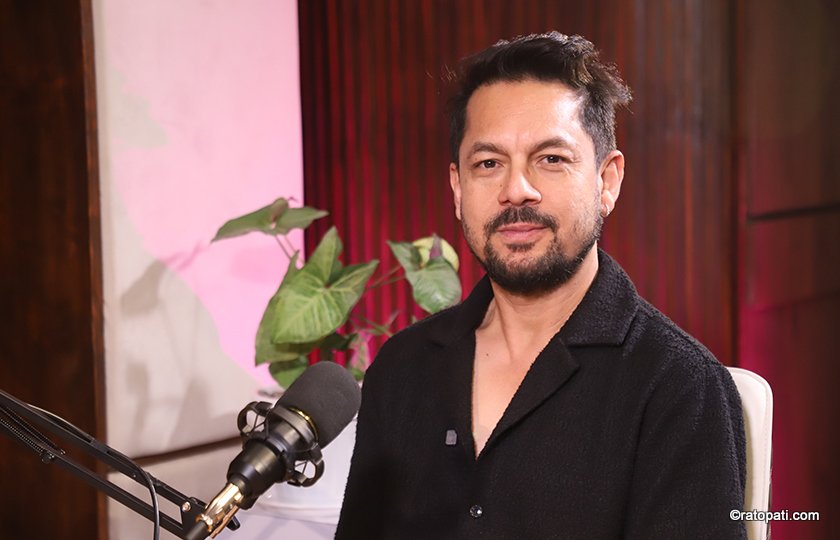
Kathmandu. Reaching the pinnacle of success and maintaining that position are two different things. However, one name that has set the standard for success in both is Ram Krishna Dhakal.
Ram Krishna Dhakal is a brand in himself within the Nepali music industry. He needs no prefix or suffix to his name. Let's just say he is a renowned Nepali singer. Actively involved in Nepali sugam sangeet and playback singing for over three and a half decades, he has thousands of popular songs to his credit, is honored by listeners with the title of the 'second Narayan Gopal', and has released nearly two dozen solo albums.
Beyond his vocal prowess, Ram Krishna is also adept at acting. Two decades ago, he played the lead role in the film 'Aashirwad', which was based on his own musical journey. He often acts as a model in his own music videos.
As the journey progresses, turns are inevitable, but for most of his career, Ram Krishna's musical life and success followed a straight line like the East-West Highway. This time, however, the journey is taking a slight turn as he has ventured into film production. He has become the producer of a film titled 'Malati Mangale'.
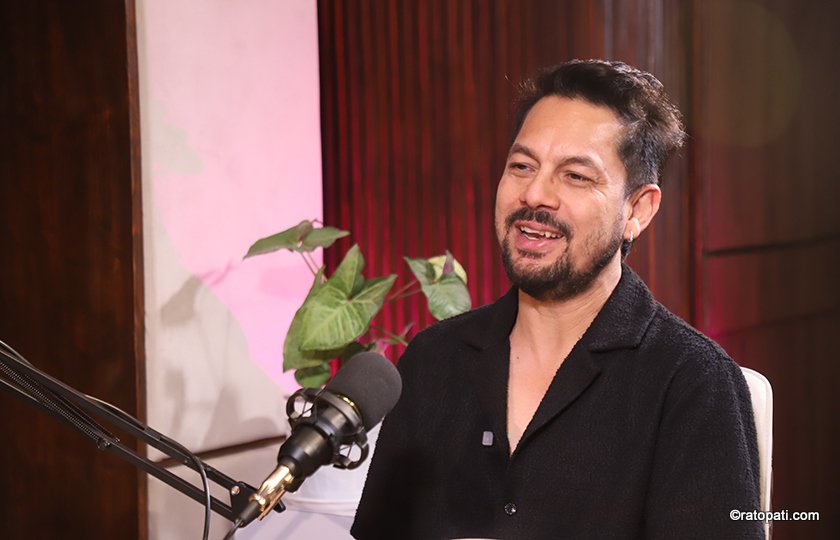
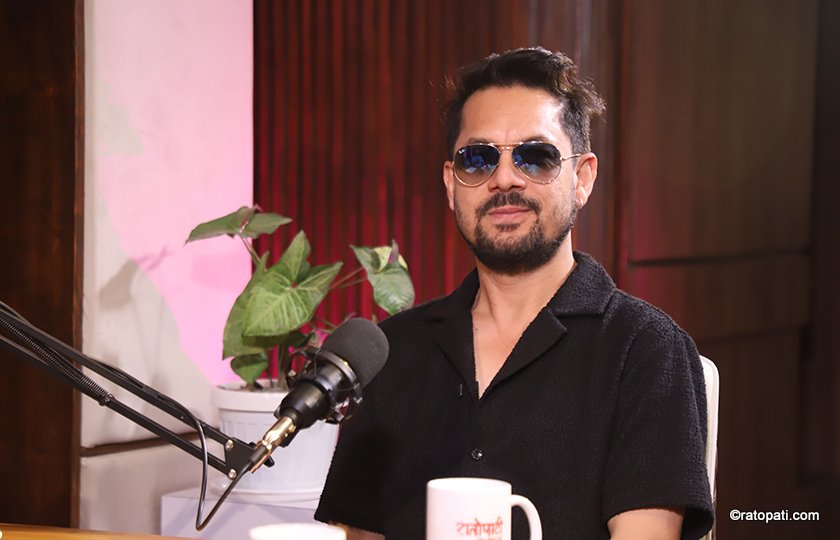
In an interview on the Ratopati podcast 'Talk Forward', Ram Krishna shared many aspects of his career, music, and personal life. He expressed concern over the natural necessity of descending from the peak over time and the current era where good songs are being overshadowed. He discussed why he 'missed' the 'golden period' where artists found success by entering politics, or whether he has any interest in politics? What is the reason behind his foray into film production? Why are songs not coming out like before, or why are they not succeeding even after release? How is AI affecting music? These and other topics were discussed with singer Ram Krishna Dhakal (the full conversation can be watched/heard in the video):
There is a time when many artists are jumping into politics, but you suddenly turned towards film production. Why did you shift your focus while sitting at the peak of musical success?
Politics or social service is a matter of everyone's own freedom and interest. Perhaps the current season and narrative have drawn many towards politics, but I want to work in music as long as I am active.
We are all aware of Nepal's politics; that is also a form of social service. But I have been busy with the film 'Malati Mangale' project. It is not just my investment; my dreams are also attached to it. Therefore, my focus is currently entirely on creation. Instead of calling it a turn, one can call it expanding the path. Music and film are complementary to each other.
Your close friend Rabi Lamichhane is currently leading the ruling Rastriya Swatantra Party. Your famous song 'Timro Aagamanle Pheri' was written by him. Did such a close person not propose you to join politics?
Rabi-ji and my friendship is very old. He also has a great talent for writing. He has also helped a lot in my musical journey. As far as politics is concerned, I think everyone wants to see an artist remain an artist. I have my own plans. Politics is a field where, as a film dialogue goes - 'There is a way to get in, but no way to get out.' Rather than getting trapped in that web, I want to do something new in my own field. Taking old songs to the new generation and presenting new creations is my priority.
This is your 'debut' in film production. You were a hero in 'Aashirwad' two decades ago, and now a producer. People say that investing in the film sector is like pouring water into sand, looking at the current trend. Why did you take the risk?
There is risk in every business. But there is no progress without taking risks. A distinct and mature audience has been created to watch Nepali films. Previously, when Hindi films played, Nepali films were overshadowed; now, Nepali films have created their own market. 'Malati Mangale' is not just a hobby for me, but a professional project. If I wanted, I could have played the hero myself, but I cast Bijay Baral according to the demands of the story. Because I want to be honest as a producer. I am confident that if we give good content to the audience, they will come to the theaters to support us.
Hearing the film's name 'Malati Mangale' reminds one of the play by National Poet Madhav Prasad Ghimire. Is the story related to that?
Many might think so upon hearing the name, but this story is completely different. This is Praku Pandey's story, and he has directed this film himself. It depicts a period from the 50s to 65 BS.
This is a story of struggle, which connects with common Nepali families. It features Bijay Baral, Barsha Raut, and Maxam Gaudel in lead roles. This film is both informative and entertaining.
You are called the 'second Narayan Gopal' of Nepali music. How proud does this tag make you feel, or do you sometimes feel that your own originality is overshadowed? From which song do you consider the Narayan Gopal tag to have been removed from you?
This tag never became a burden for me. I reached here by singing Narayan Gopal-ji's songs; he is my source of inspiration. It was natural for his influence to be present in my early songs like 'Hamro Sundar Sansar', 'Maya Garneko Chokho Maya', and 'Yatra Rahechha Jindagani'. But songs like 'Orali Lageko Harinko Chaal Bho' and 'Risaunda Ni Aafnai' established my own original identity. I think an artist learns from others initially, but later must create their own style. It is a matter of good fortune that my name is associated with Narayan Gopal.
The use of 'AI' in music has increased. An AI version of your song has also appeared. How do you view this?
AI is a part of technology. It helps speed up work in composition and arrangement. It is good for taking references. But music is emotion. A machine cannot provide the depth and feeling like a human. AI can never replace the 'feel' that comes when a human sings and creates. It is a tool, but not a complete substitute for creation.
What was your relationship and competition like with your contemporary singers Yam Baral and Rajesh Payal Rai? Has the distance between you increased these days?
We are friends from the days of struggle. We used to go to Radio Nepal together, drink tea together. We grew up musically together. It is true that meetings have decreased after getting busy with our own families and careers.
Media sometimes makes a small thing big and says 'the distance has increased', but that is not the case. Both Yam and Rajesh are very kind-hearted and 'frank' people. We always had healthy competition. There are also examples where a song made for one singer was sung by another.
There have been many changes in the music market recently. Old songs are still heard as much, but new songs disappear quickly. What could be the reason for this?
Times have become very 'fast' now. People have less patience. In the race to be a hit in a 30-second TikTok video, the depth of content is being lost. Previously, it took years for a song to become a hit, and it would last for generations. There is a difference between being viral and being a hit. I think the influence of old songs is still strong because those songs had the right balance of lyrics and music. In 'Malati Mangale' too, we have tried to preserve that melody.
What are the expectations of the music sector from the current government and especially the new generation of leaders?
Our music is very rich. We are wealthy in 'beat' and melody. There is participation of educated and young people in the current government. We have been raising the issue of copyright and royalty for years. The situation where artists have to stretch their hands for treatment after spending their whole lives in music must end. There is a need for concrete laws and implementation for the proper management of music and respect for artists. The government should pay attention to music literacy and developing it as an industry.
Video/Photo: Manoj Khadka/Ratopati
This specific news has been automatically translated by AI. As a result, there may be some inaccuracies or language errors.