Dr. Akhanda Upadhyaya: The Doctor Who Became a Beacon of Hope in Remote Dolpa
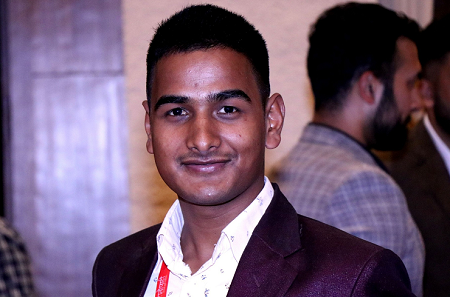

Surkhet. Dr. Akhanda Upadhyaya is a medical officer by profession. Working at the District Hospital in Dolpa, he does not just treat patients in his apron; he is equally active in social work. He is known as a humanitarian doctor.
Whether it is rescuing children from weak economic backgrounds or helping patients who face financial difficulties while seeking treatment outside the district, he is always on the front lines.
Dr. Upadhyaya has a collection of many such stories. While participating in the Karnali Festival in Surkhet a few days ago, he shared an incident: A woman brought her child to the hospital for treatment, but since the treatment was not possible in Dolpa district, we referred them to Nepalgunj. The woman had financial problems reaching Nepalgunj for treatment.
Upadhyaya recounted that the woman said, 'Doctor, I don't have money to go to Nepalgunj, I don't have a single rupee in my pocket, I will take him home. Even if he dies, let him die at home, I cannot bear to see the suffering if I go to Nepalgunj.'
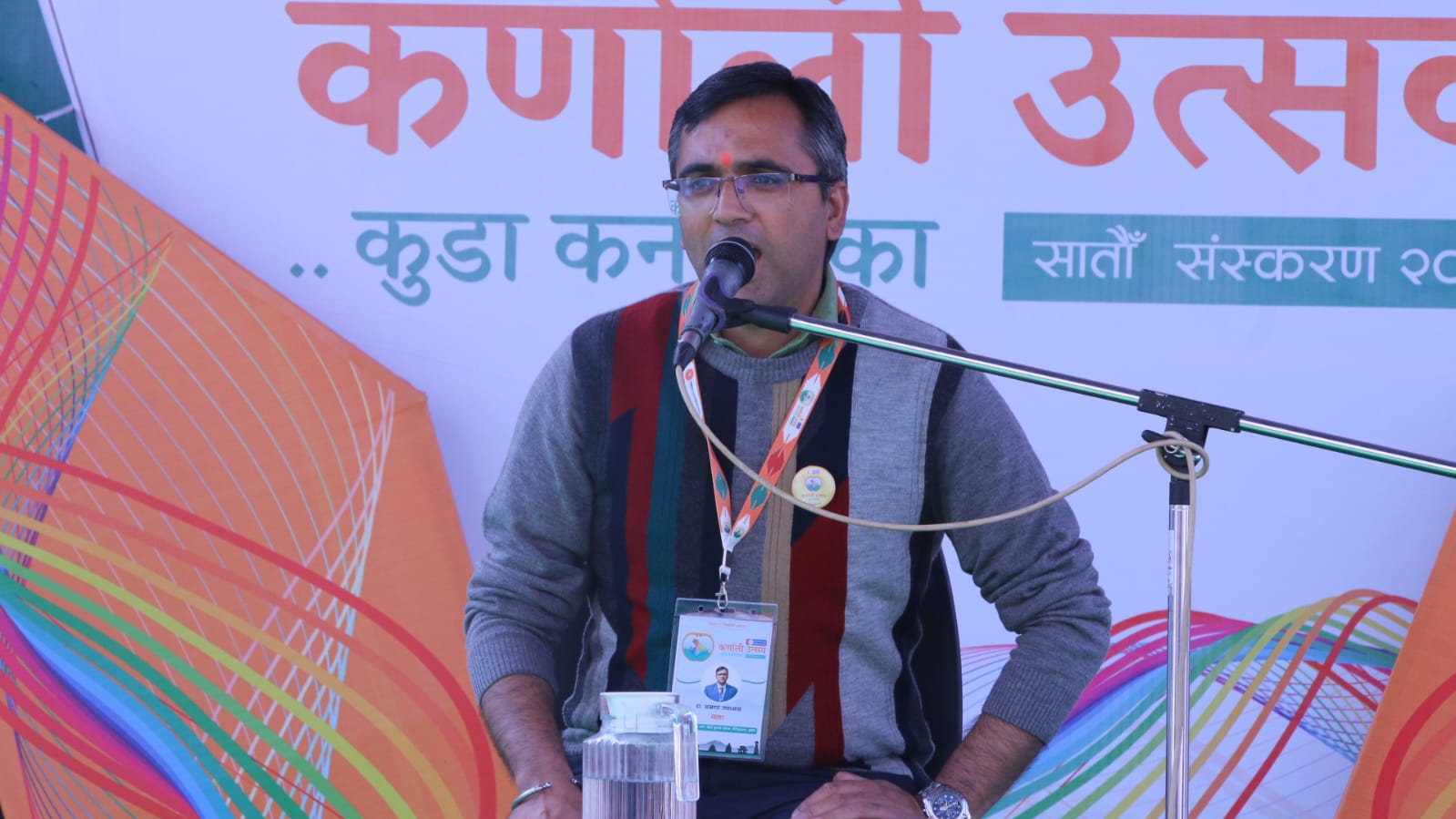
'She was about to return with her child on her back,' Dr. Upadhyaya said, 'My heart ached.'
He then shared that they raised some money through donations, saying 'We are here for you,' and sent them to Nepalgunj for treatment.
He has countless stories of sending patients for treatment who were otherwise deprived due to lack of money. He has become a sanctuary for the people of Dolpa to unload their burdens of sorrow.
According to Dr. Upadhyaya, while in the district, he rescued a teenage girl who was raped by her own brother-in-law and could not get justice. 'Such stories keep piercing me repeatedly,' he said.
- Those who chose the remote
Usually, doctors do not like to go to remote areas to serve. But Dr. Akhanda Upadhyaya chose his home district and went to Dolpa. After completing his MBBS, the Health Department wanted to send him to Dullu Hospital in Dailekh, but he requested to be sent to Dolpa.
He requested to be sent to Dolpa, stating that he studied medicine for the sake of Dolpa. Accordingly, he was sent to Dolpa. He joined the District Hospital, Dolpa, in Bhadra 078.
Born in 049 in Thulibheri Municipality-3, Dunai, Dolpa, he is the middle son of the family. He had seen the sorrows and pains of his village closely in his childhood.
Having completed his school life from a government school in Dolpa district, he went to Kathmandu after taking his SLC in 066. He finished his plus two in 068 and his MBBS in 077.
'Then, from Bhadra 10, 078, I went to work as a medical officer at the District Hospital, Dolpa,' he said, 'I considered it my luck to return to the same place I came from as a doctor and work there. Thinking that, I went to Dolpa District Hospital with a vow to spend my two-year tenure there.'
According to Dr. Upadhyaya, there are no opportunities in backward places like Dolpa and Jumla, and the general public is living in piles of various problems.
He said, 'But you and I have heard that we are people who look for salt while sitting on a bed of gold. We just haven't received opportunities. If we get opportunities, we can show that we are excellent wherever we are.'
He said that he returned to Dolpa with that sentiment in his heart. Since childhood, he had the idea of becoming a doctor and serving the poor and needy of his place. 'The day I left for the capital to become a doctor from that place, I felt that when I return to that society, I should not just be a doctor, but I should solve the problems of this society as much as I can or provide as much help as I can,' he said.
Therefore, even outside the medical profession, he strives to help children or patients by collecting donations or through any other means.
Because of this, he has built an image of a humanitarian doctor in Dolpa. He is active in treatment 24 hours a day when patients arrive.
Dr. Upadhyaya has become a place for the people of Dolpa to unload their various burdens of sorrow. 'How many times I have easily lifted those burdens and provided them comfort, and how many times I might not have been able to do that,' he says somberly.
If there is a situation where a patient needs to be referred out of the district, he calls the relevant health institution and provides facilitation by saying, 'Such a patient is coming from our side, please help them.'
Dr. Upadhyaya says he reached this point due to the capability of his parents. 'Those who worry about what to eat in the evening after eating in the morning, we should be able to become their voice,' he said, 'It is not just our profession, there is a big society outside of it. We should work with the feeling that we must look after that society too.'
He continues to inspire his colleagues with similar thoughts. He also revealed another reason for choosing a remote place.
Dr. Upadhyaya was studying MBBS at Patan Academy of Health Sciences. A teenage girl from Mugu with a weak economic background needed a spleen operation. However, it was very difficult to take her to the capital for treatment.
'With our help, we brought the sister from Mugu to Patan Hospital in Kathmandu and operated on her,' he said, 'Now that sister is studying for her bachelor's degree.' He mentioned that the young woman still calls him from time to time to remember him. He finds happiness in such things.
Not only that, while staying in Kathmandu, when he heard that children in his home district were sick due to the cold, he used to collect donations to send gas and heaters to the district hospital.
For this reason, he is in everyone's eyes. He says, 'Maybe I am a doctor, if I sit and write a prescription for someone or if that patient leaves my OPD, my responsibility ends, but I never feel that my responsibility ends there.'
In his understanding, when he sits in the OPD and examines a patient and says, 'Look, your treatment is not possible here, you go to Kathmandu,' that patient does not reach Kathmandu. Those patients get lost on the way.
'Those patients either go home and wait for death or go to a temple and bang their foreheads on the deity's pedestal,' he described the situation in Dolpa, 'And they are forced to face untimely death.'
He said that they should be able to feel that this is our state as much as possible. His argument is that one should become their support so that they feel that people live here, and helpful hearts live here.
He has also received many awards due to his contribution to society along with his work as a doctor.
This specific news has been automatically translated by AI. As a result, there may be some inaccuracies or language errors.