Debate Intensifies Over Ministers' Gold Holdings and Asset Limits in Nepal


Kathmandu. The property details of ministers are currently a subject of intense discussion. With all ministers in the government appearing to be millionaires, public criticism has begun. Some are defending the ministers, arguing that 'earning and saving wealth' is not illegal, provided it is not acquired through illicit means.
Among the assets, the most criticized subject is gold. The property details reveal that the current government ministers alone hold over 800 tolas of gold. The wife of Prime Minister Balendra Shah alone is reported to hold 190 tolas of gold.
Even Sita Badi, who is said to have grown up in a poor family, is shown to possess 18 tolas of gold. The average gold holding per minister comes to 49 tolas.
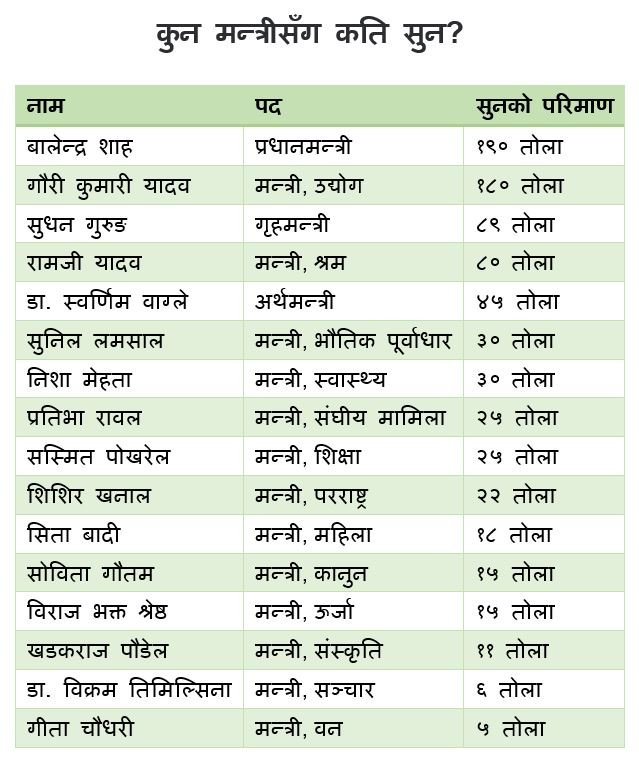
This disclosure has heated up social media. Voices are being raised to impose limits on gold holdings, with many claiming it has become a medium for hoarding wealth. However, the government has not officially responded to this. Instead, it has urged patience, noting that a commission has already been formed to investigate assets.
While announcing the cabinet's decision on Wednesday, government spokesperson Sasmit Pokharel urged patience, stating that a commission has been formed to investigate the assets of those in high positions since 2062/63, and that the assets of current ministers fall under its jurisdiction. However, he also claimed that the sources of all the ministers' assets are transparent.
The most discussed topic here is gold. Finance Minister Swarnim Wagle even had to delete an old status after being trolled for his 'Golden Cabinet' post made during the government's formation.

But, is a limit on gold possible as discussed on social media?
To understand this, one must look at the country's economic system.
The issues of earning, saving, and taxing wealth are linked to a country's economic system. A country represents a capitalist, socialist, or mixed economy. Generally, capitalist countries are liberal in this regard, while socialist countries are strict.
However, no country in the world has banned the accumulation of personal wealth. Even in countries practicing communist rule like Cuba and North Korea, there are provisions for holding personal property.
On the other hand, even in so-called capitalist countries, limits on wealth are maintained through various means. Even in the United States, which has the most capitalist economy, there are practices of regulation through progressive taxes and usage laws.
In countries with mixed systems, there is a tradition of imposing limits based on the nature of the property. This is done specifically to prevent unlimited individual use of natural resources. Many countries in the world have imposed limits on land ownership. There are also provisions where businesses operating using natural resources like rivers and forests become government property after a certain period.
_ufmo8stvl7_xYCEYxRbF6.jpg)
However, in countries that believe in a free-market economy, there is no limit on gold hoarding. While gold cannot be bought in Cuba and North Korea, it can be bought and sold freely in other countries. However, there is a provision that the holder is responsible for disclosing the source when holding gold beyond a certain limit.
In neighboring India, married women do not need to carry proof of source for up to 500 grams (approx. 42.88 tolas), unmarried women for up to 250 grams (approx. 21.44 tolas), and men for up to 100 grams (8.57 tolas). However, this is not a limit but is implemented for the purpose of preventing money laundering and tax evasion.
In the US, there is a provision to report suspicious transactions in gold trading, and there is a capital gains tax provision on transactions.
In the United Arab Emirates (UAE), considered a hub for gold trading, there are strict provisions regarding Suspicious Transaction Reporting (STR) in gold trading. However, there is no limit when buying with legitimate wealth, and there is no capital gains tax on gold trading here.
In Nepal, limits have been set on whether customs duty must be paid or if it is prohibited to bring gold individually. However, there is no provision regarding the limit of accumulation.

Officials at the Rastra Bank and the Ministry of Finance also say that there is no need to set a limit on holding gold. While there is no doubt that illegal transactions, money laundering, and tax evasion should be discouraged, they argue that setting a limit is not appropriate. A high-ranking official at the Rastra Bank suggests that a commodity market should be established to promote this. The official believes that if a commodity market is arranged, the tendency to keep gold at home will automatically decrease.
'Our law was built on the assumption that people only use gold to make and wear jewelry, but people have already made it a medium for wealth accumulation. They buy gold for both future security and capital gains,' the official says, 'However, there is currently a compulsion to pay making charges and wastage to keep it as jewelry. If the market is organized, investment in fine gold will increase, and the practice of keeping it as jewelry will decrease on its own.'
Senior Advocate Baburam Dahal says that the government can and should set a limit on gold hoarding by making laws. He states that since there is a practice of limiting the holding of precious metals and stones in various countries of the world, this arrangement can be made for gold in Nepal as well.
However, he says that since there is no law yet, it cannot be called illegal regardless of how much gold one has.
'Just because there is a lot of gold, it cannot be said to be illegal or illicit; one can keep as much gold as they want right now,' says Senior Advocate Dahal, 'But, there should be an investigation into where that wealth came from and whether it is a legitimate source or not.'
This specific news has been automatically translated by AI. As a result, there may be some inaccuracies or language errors.