Nitish Kumar's Political Legacy: From 'Sushasan Babu' to a Shifting Ally


Bihar. Farida Khatun, who works for an NGO in Phulwari Sharif near Patna, is the most educated woman in her entire family. She holds a postgraduate degree.
Farida's family, who worked as daily wage laborers, enrolled her in the Kasturba Gandhi Residential School in Araria in 2007. Farida is originally from the Muslim-majority district of Araria, where the Muslim population exceeds 40 percent.
Farida told the BBC, 'We come from a region where girls were only given Islamic education. But I was enrolled in school. After that, I benefited from many schemes including uniforms, sanitary pads, bicycles, and the Kanya Utthan Yojana, which enabled me to complete my postgraduate studies from Patna University.'
'At that time, it felt like Nitish Kumar was a leader for girls, but for the past few years, it has started to feel like he is just playing politics. He has become a part of the politics being played in the name of religion.'
What Farida said can actually be called the 'roadmap' of Nitish's politics.
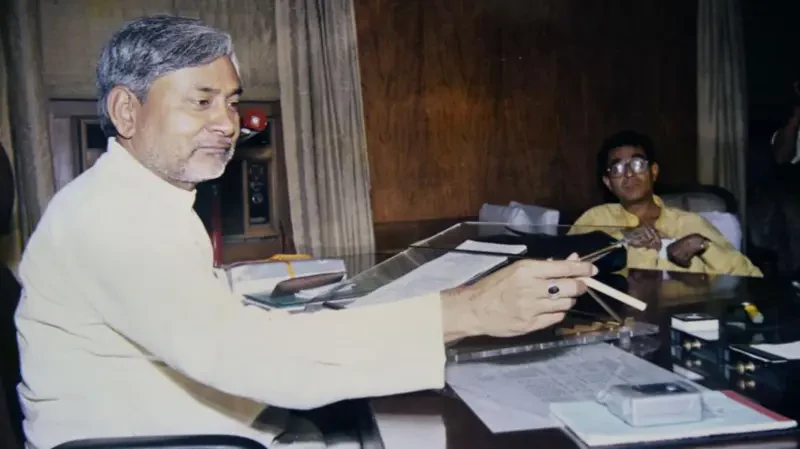
Currently, Nitish Kumar has resigned from the post of Chief Minister of Bihar. He went to Lok Bhawan and submitted his resignation to Governor Lieutenant General (Retd) Syed Ata Hasnain.
In fact, Nitish Kumar became Chief Minister for seven days in 2000. But his permanent journey as Chief Minister began in November 2005.
He earned the tag of 'Sushasan Babu' (Good Governance Man). But in recent years, he began to be called a 'turncoat'. Memes were made about him, and a section of analysts questioned his ideological commitment.
- 'There will be no one like him'
After the decision for Nitish Kumar to go to the Rajya Sabha, there was a stir when his son Nishant Kumar arrived at the JDU office located at Beerchand Patel in Patna.
Amidst the rising heat, Nishant Kumar seemed like a relief for JDU workers. However, they do not see a 'second Nitish' in Nishant.
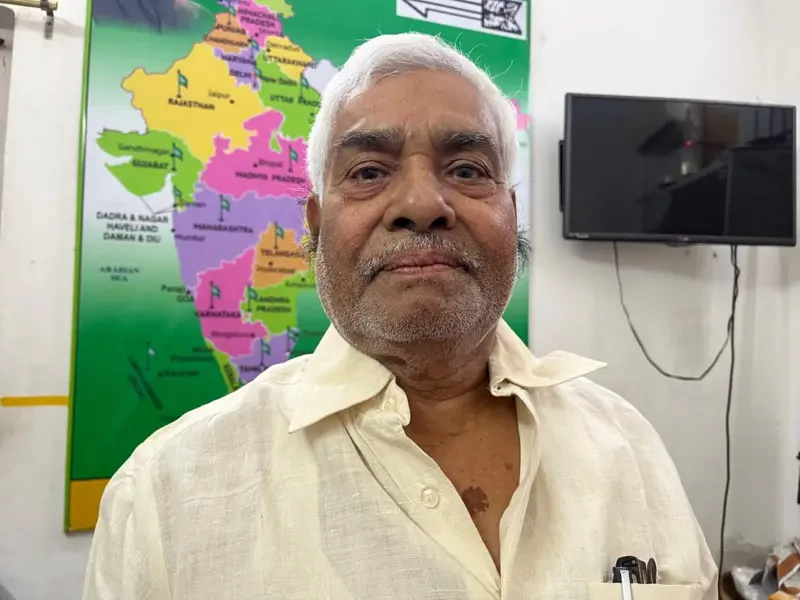
Ashok Kumar, who has been with Nitish since his first election in 1977, says, 'There will be no one like him.'
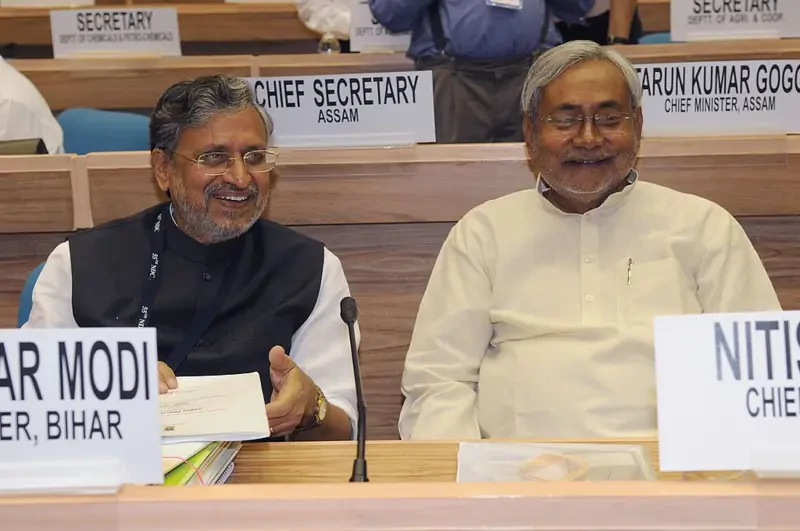
Bringing Bihar's offices from the world of typewriters to computers was Nitish's first major challenge. He was supported in this by BJP leader Sushil Kumar Modi, who himself used to carry a tablet.
Sushil Modi was the Deputy Chief Minister in the Nitish government and held an important position like the Finance Ministry.
Vyas Ji, a former IAS (Retd) officer of the 1982 batch of the Bihar cadre, tells BBC News Hindi, 'Nitish Kumar and Sushil Modi were both very sharp. I also worked during Lalu Ji's time. Lalu was a leader, while Nitish was a formidable administrator; this was the main difference between the two.'
'In his meetings, he would welcome new ideas, and he remembered the instructions given in the previous meeting in every departmental meeting. A strong desire to move Bihar forward was visible in him.'
- Socialist Nitish's 'Vote Engineering'
After taking power, Nitish Kumar issued a white paper on the state of the state.
In this white paper, it was written about the state of the state, 'Bihar's condition in all development indicators is the worst among all major states.'
After taking power, the Nitish government faced challenges of working on law and order as well as infrastructure like roads and electricity.
Coming from the Kurmi caste, if Nitish Kumar wanted to remain in power in Bihar for a long time, he also had to do 'vote engineering' for himself in Bihar's caste politics.
Nitish chose women and the extremely backward classes for this.
Senior journalist Santosh Singh writes in his book 'Kitna Raj, Kitna Kaaj', 'Nitish Kumar gave 50 percent reservation to women, while on the other hand, he gave 20 percent reservation to EBC (Extremely Backward Class) Hindus and Muslims in panchayats and local bodies.'
'As soon as he did this, he had to face criticism from people of his own caste. In their understanding, they were sacrificed to benefit the EBC and other classes. But Nitish had internalized those words of Lohia where it is said that no matter what caste a woman belongs to, she is backward.'
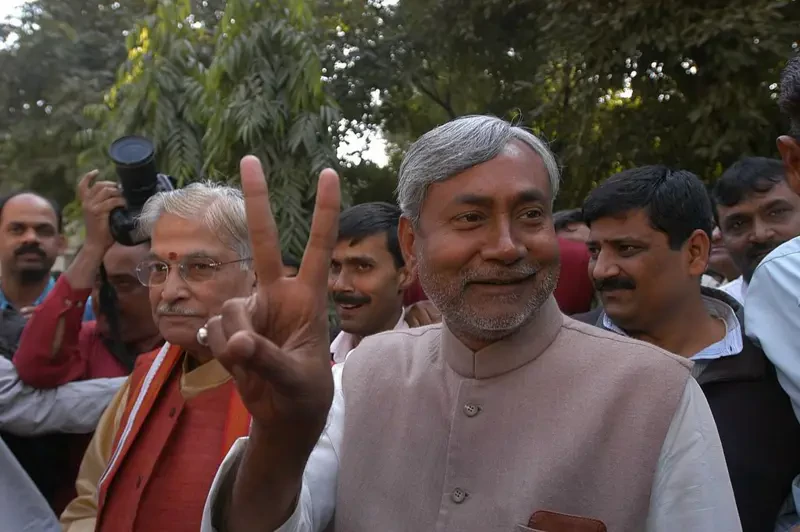
Later, the Nitish government formed the Mahadalit Commission in 2007.
If we look at Nitish Kumar's Luv-Kush (Kurmi-Koeri) equation, their population is about seven percent, but with the help of his vote engineering, it is believed that Nitish has 20 percent of the vote.
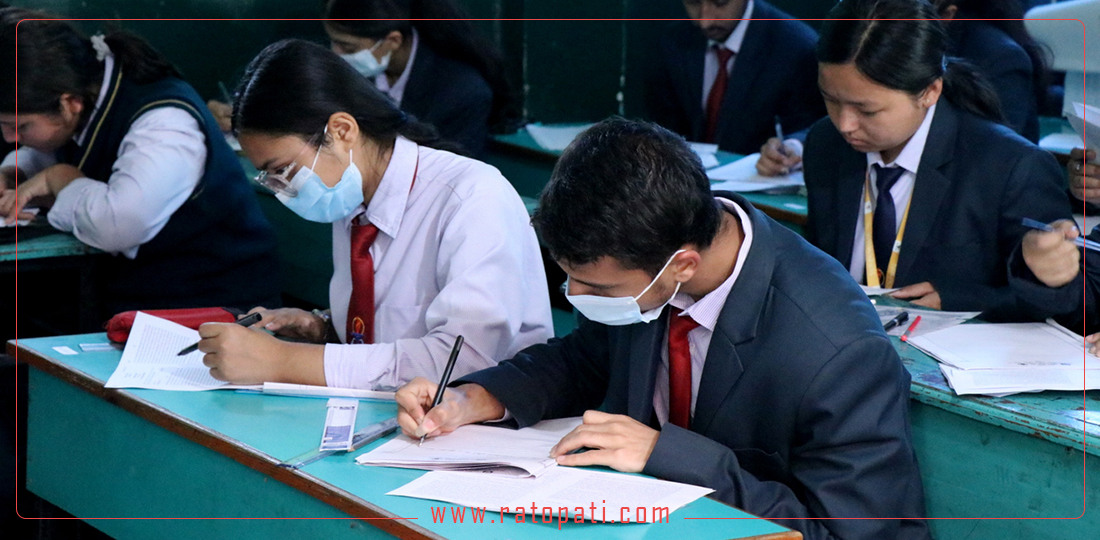
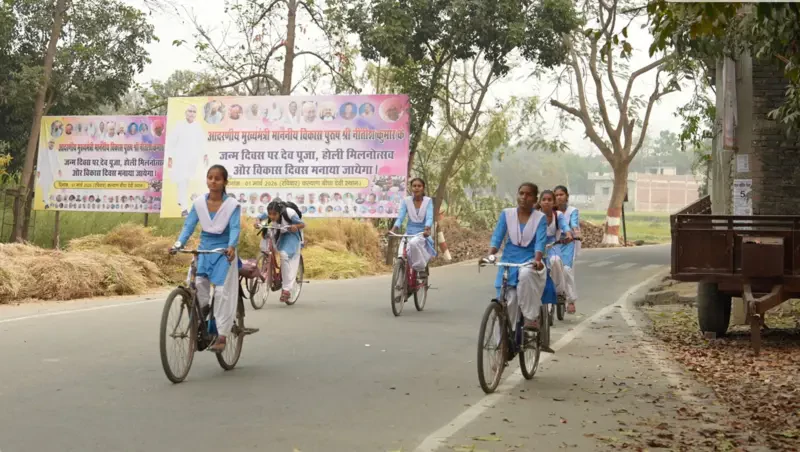
When Nitish Kumar came to power, his two schemes were seen as the face of a changing Bihar. Those schemes were the uniform and bicycle schemes.
People saw girls riding bicycles in school uniforms in rural areas as the face of a changing Bihar.
In fact, this image was working on two fronts. On one hand, it was proof of socialist Nitish's welfare state, and on the other hand, the presence of schoolgirls in public places like this was a sign of improvement in law and order.
But later, the Nitish government was also accused of focusing more on publicity instead of effectively implementing the schemes.
Social activist Sahina Parveen, who is working at the panchayat level, tells BBC News Hindi, 'The first seven or eight years of Nitish Kumar's tenure were excellent. His team of officers was good. The government also took good steps for women, but later everything became stagnant.'
'Nitish Kumar seemed to be mesmerized by the work he had done himself. In the last few days, he did performative work. That is, work that gets publicity. How sustainable it is was not a matter of concern for the government.'
She adds, 'By giving reservation to women in panchayats, there was 'politics of presence', but did these women become MLAs and ministers? Whatever was done for ordinary women was of a nature that strengthened their traditional roles. That is, if women are to be connected with employment, distribute sewing machines, give training to make papad and masyaura.'
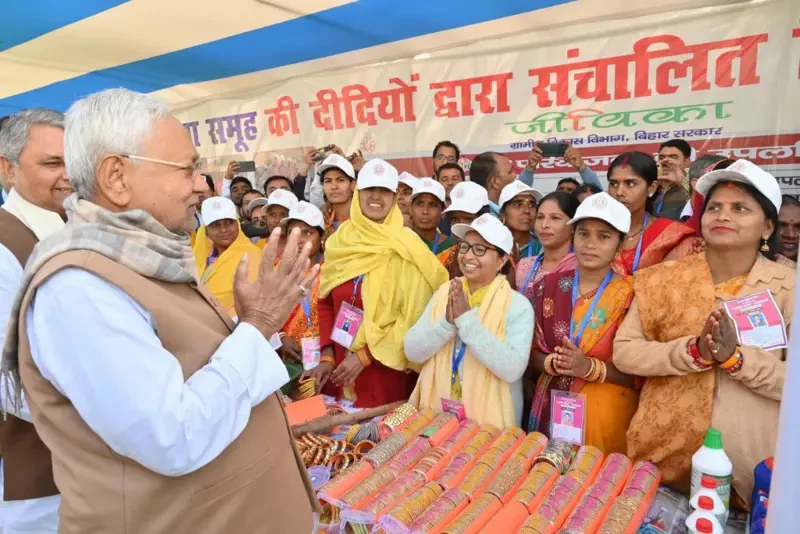
Before the 2025 assembly elections, when ten thousand rupees were distributed to Jeevika Didis to start employment, questions began to be raised from within the JDU about the change in Nitish Kumar's politics.
A JDU leader had told BBC News Hindi, 'Our leader used to bring change through policies, now he is resorting to electoral inducements.'
- Crime, Corruption, and Communalism: Nitish's 'Three Cs'
Nitish Kumar repeatedly reiterated that he would never compromise with the 'Three Cs' during his tenure. Three Cs mean Crime, Corruption, and Communalism.
Abhayanand, author of 'Unbounded: My Experiment with Law, Physics, Policing and Super 30', was the ADG in Bihar Police in 2005.
Abhayanand tells BBC News Hindi, 'After Nitish Ji took over as Chief Minister, he called me and said that they wanted the rule of police. I stated that there should be the rule of law and for this, we need moral support from the government.'
'Along with the Arms Act and speedy trials, a lot of work was also done on testimonies. Later, SAP was formed and police investigation was also modernized. All these changed the image of the police.'
But in recent days, there have been several such incidents that brought disrepute to the Nitish government.
One of those incidents happened in 2015, when a journalist from a national TV channel was held hostage at the Patna residence of Mokama MLA Anant Singh.
Similarly, after the murder of Ranvir Sena chief Brahmeshwar Mukhiya, his supporters took out his funeral procession through major places in Patna city.
On that day, there was a large amount of arson and violence in other major places including Dakbungalow Chowk, which is considered the heart of Patna city.
Social activist and lawyer Manilal says, 'Seeing the situation in Patna that day, it felt like this state was going back to the caste violence of the 90s, the good thing was that nothing like that happened.'
'But during his tenure, riots took place in Aurangabad, Chhapra, and Bihar Sharif. The state of corruption is such that no file moves without paying money. The grip that Nitish Kumar had on the administration gradually weakened.'
- Many new schemes but low success at the grassroots level
When Nitish Kumar took power, he tried to make his government accountable.
The 'Chief Minister in the People's Court' program was started to ensure that public work is completed smoothly and effectively within the stipulated time.
Programs like Information Call Center, Your Government at Your Door, and Bihar Right to Public Services were started with great enthusiasm. But later these gradually collapsed.
The Information Call Center is a call center connected to the Right to Information which was started in 2007.
RTI activist Shivprakash Rai tells BBC News Hindi, 'The Information Call Center, which was started with great fanfare, was closed. Even though RTI should be within the time limit, it takes several years to hear a single appeal. Accountability has ended, and the murder of RTI activists, threatening them, and framing them in false cases has become common.'
Sahina Parveen says, 'The government worked on education and health infrastructure, but if there are no good teachers or doctors, there is no benefit. Another thing, Nitish Kumar also started working on the PPP model, which has pushed the entire system towards privatization. All these things were different from Nitish's initial phase.'
- Improvement in electricity and roads
Per capita electricity consumption was only 60 kilowatt-hours. According to the Economic Survey 2025-26, in 2011-12, per capita consumption reached 134 kilowatt-hours, which increased to 374 kilowatts in 2025-26.
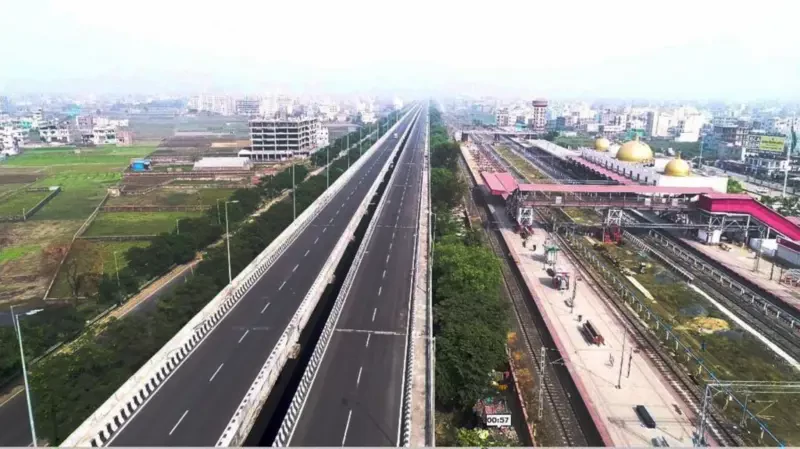
Talking about rural roads, only 835 kilometers of roads were built in 2005-06, now 1,19,067 kilometers have been built. A network of roads was laid in villages and cities. The construction of small and large bridges and flyovers gained momentum.
However, this is still far from Nitish Kumar's claim that Patna can be reached from any corner of Bihar in just five hours.
The Nitish government could not perform well on the fronts of land reform, education, health, migration, employment, and industry.
Regarding land reform, the Nitish government had formed a committee under the chairmanship of D. Bandyopadhyay. Similarly, a commission was formed under the chairmanship of Muchkund Dubey for the Common School System.
D.M. Diwakar, former director of the A.N. Sinha Institute, says, 'I do not question Nitish Kumar's intention, but he could not implement both these reports. Private institutions opened in his government and public institutions kept getting ruined.'
'The way teachers were appointed at the panchayat level after the government came, it weakened the quality of education significantly.'
Senior journalist Arun Srivastava says, 'The Bihar government has actually become a government of contractors. The flyovers you see in the city only meet the needs of the upper-middle class. What is there for the marginalized society of Bihar?'
'The economic growth that the government talks about on paper is only of the construction sector. The government has failed on the issues of industry, employment, and migration, whereas these are the most important issues of Bihar. We are still at the bottom in all development indicators.'
- Nitish who keeps changing sides
In the 2010 Bihar Assembly elections, the NDA alliance achieved a spectacular victory. It won 206 out of 243 seats, in which JDU alone got 115 and the main opposition party RJD got only 22 seats.
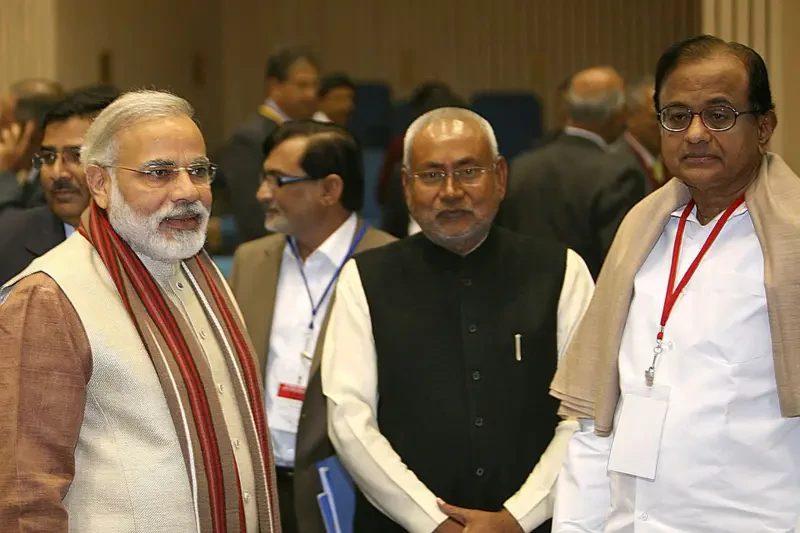
But feeling uncomfortable with the rise of Narendra Modi in national politics, Nitish left the BJP and fought the 2015 assembly elections in alliance with the RJD and Congress.
In 2015, Nitish had expressed his opposition by sending the DNA samples of Biharis to Delhi.
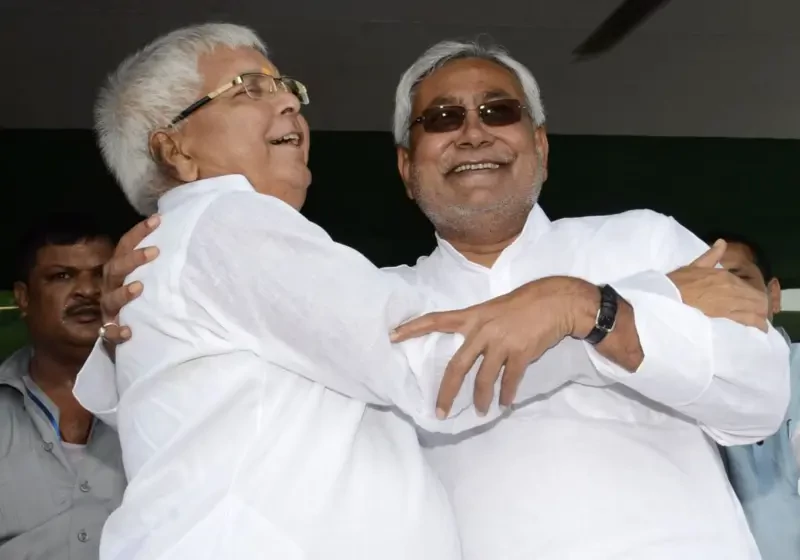
Later, he came back into an alliance with the BJP in 2017. In 2022, Nitish Kumar again formed an alliance with the RJD and Congress but broke this alliance in 2024.
Since then, his party JDU and BJP are together. In the last assembly elections, Nitish was repeatedly reiterating that he had made a mistake twice by going with the RJD and would not go anywhere now.
Nitish, who once fought a battle to get special state status for Bihar, has now agreed to a special package.
Nitish, who once connected 'Bihari-ness' and being a Bihari with 'pride' by organizing grand Bihar Day events, has now become weak. When Nitish took over the administration of Bihar, he was 54 years old, now he has crossed 75.
This specific news has been automatically translated by AI. As a result, there may be some inaccuracies or language errors.