Informal Sector Workers in Kanchanpur Face Exploitation and Forced Labor Risks

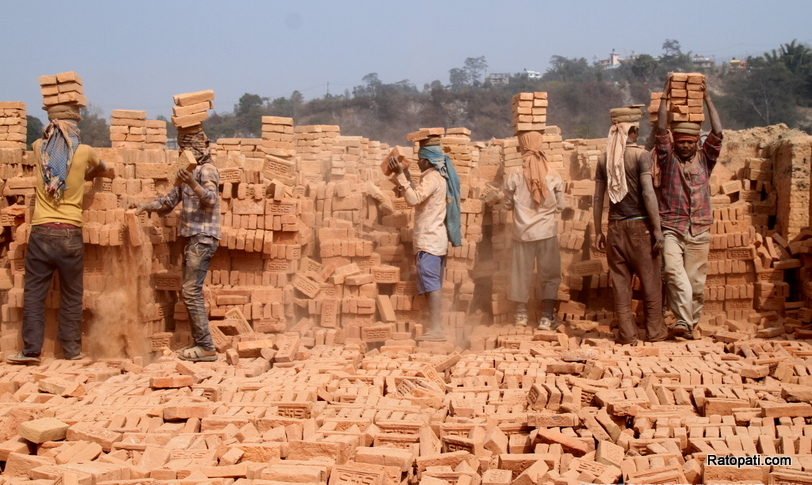
Kanchanpur. Workers in the informal sector in Kanchanpur remain forced to work in hazardous conditions.
Workers in brick kilns, construction, agriculture, and domestic sectors continue to perform dangerous tasks without safety equipment. Furthermore, deep-seated wage discrimination between men and women complicates the situation for laborers.
According to the Labor Act 2074 and International Labour Organization standards, work performed under fear, threats, or pressure falls under forced labor. In practice, this condition is widespread across agriculture, construction, domestic work, and even foreign employment.
Practices such as withholding wages, creating pressure through debt, and resorting to violence or threats prevent workers from choosing or leaving jobs at will.
A study conducted in Kanchanpur, Bardiya, and Saptari using four indicators has shown a high prevalence of forced labor among former Kamaiya, Haliya, and Harwa-Charwa communities.
According to the study, approximately 80 percent of freed Kamaiya, 85 percent of Harwa-Charwa, and 61 percent of Haliya communities lack labor freedom.
It was found that women receive nearly 33 percent less wages than men for the same work, face delays in payment, and are penalized for taking leave. Only 43 percent of freed bonded laborers receive the prescribed wages.
The 'Parishram' project has been launched under the coordination of the National Freed Haliya Society Federation Nepal to strengthen organizations of freed bonded laborers in the informal sector, advocate for their rights, and combat forced labor.
Supported by the Freedom Fund and in collaboration with ActionAid Nepal, this project, running from January 2026 to December 2027, aims to organize freed bonded and informal workers to empower them to raise their voices for their rights. The project is being implemented in all nine local levels of Kanchanpur.
Project Coordinator Hari Singh Bohara stated that the project was launched with the objective of effective implementation of labor laws, reduction of child labor, and expanding access to social security for workers.
According to him, because informal workers remain outside the state's oversight, they are deprived of insurance, social security, trade union rights, and regular monitoring.
“We enroll children forced into labor into schools with educational materials under the project's program,” he said, “We believe this will provide access to education and help reduce the risk of them returning to labor.”
He noted that the condition of workers is weak due to having to work for wages lower than the district rate, lack of safety equipment (masks, gloves, boots), and the absence of a daily attendance system.
“Workers' rights to freely choose employers, bargain for wages, and work in a fear-free environment must be ensured,” he said.
Ishwor Sunar, Central President of the National Freed Haliya Society Federation Nepal, emphasized the need to implement equal pay for equal work, noting that wage discrimination persists due to the social mindset that considers women weaker than men.
Sibi Luhar, President of the National Haliya Liberation Society, stated that it is necessary for workers to be organized and determined not to work for less than the prescribed wages. He added that safety equipment and insurance must be mandatory for hazardous work.
He identified poverty, illiteracy, debt, landlessness, discrimination, lack of employment, lack of public awareness, and weak implementation of government policies as the reasons for forced labor.
Freed Kamaiya leader Bhagiram Chaudhary pointed out the need for the state to introduce effective protection policies for impoverished families forced to work for low wages. Another freed Kamaiya leader, Ram Prasad Rana, emphasized the need to make workers aware of their rights and ensure those rights through organized struggle.
He mentioned that effective policy implementation, strict monitoring, expansion of social security, and worker empowerment are essential to solving the problems of workers in the informal sector.
This specific news has been automatically translated by AI. As a result, there may be some inaccuracies or language errors.