The Jalari Community's Struggle for Survival on the Shores of Phewa Lake


Pokhara. Ramchandra Jalari of Khapaudi was just 3 years old when he first accompanied his father on a boat with a fishing net on Phewa Lake. Now 63, he has spent 60 years sharing a deep bond with the lake.
The spot where Ramchandra used to cast his nets 30 years ago has now turned into paddy fields. 'Phewa Lake used to extend much further, sir! The paddy fields you see now were once 20 hands deep under water,' he told Ratopati while sitting on the lawn in front of his house. 'Watching it disappear, one-third of the lake has been filled in. My heart aches seeing this.'
In Ramchandra's experience, the northern shore of the lake has remained stable since he can remember. However, the upper reaches have been unnaturally filled due to silt carried by streams flowing from the highlands.
No one has precise records of how long the Jalari community has lived in Khapaudi. Those who recall stories from their ancestors say their forefathers have lived here for about 300 years. That is why they love the shores of Phewa so dearly.
Now, following discussions on implementing the 65-meter standard and the government's use of bulldozers, the community is gripped by the fear of displacement. Ramchandra is not satisfied with the government's proposal to remove them with compensation.
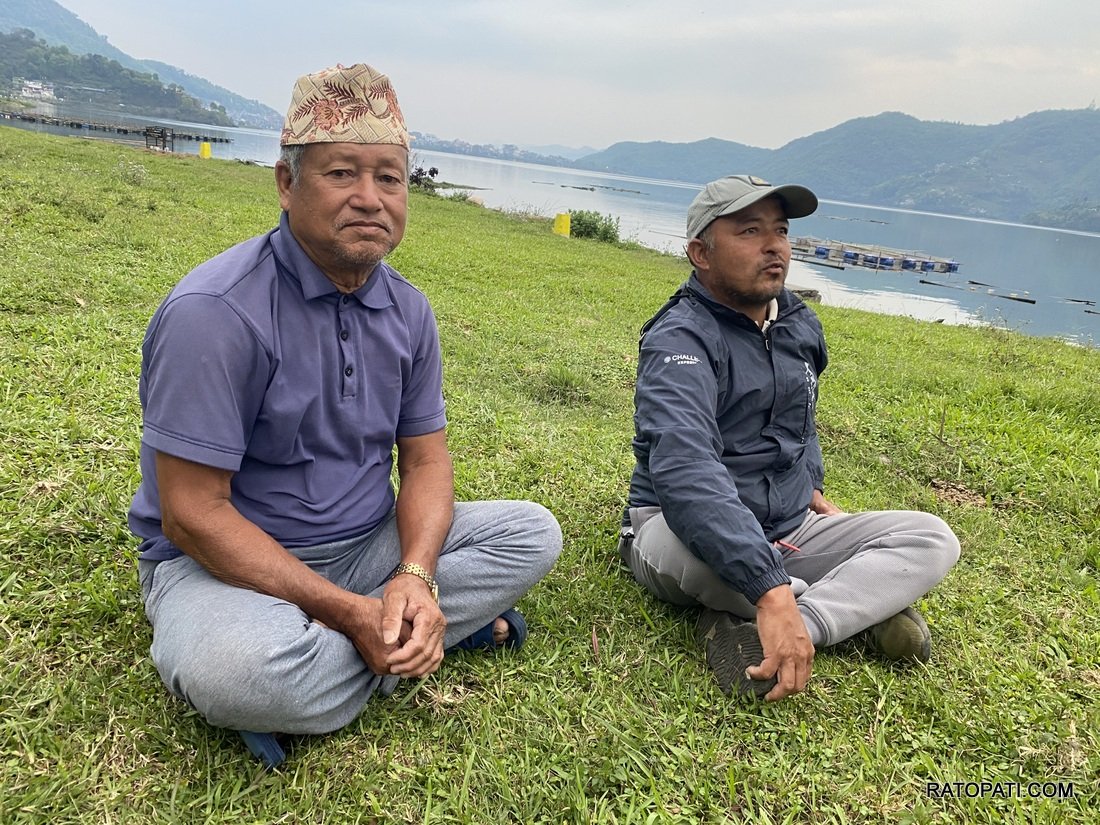
The lives of the Jalari people are tied to the water and fish of Phewa Lake. He said, 'Even if they build us houses of gold, it is of no use. We would rather live in huts; Phewa Lake is our home.'
The Jalari people have no desire to leave the lake shore. Echoing Ramchandra's sentiments, another local, Shailendra Jalari, said, 'We have been living on this Phewa Lake for 200-300 years. We are people who play with this water; moving us to the mountains won't work. We need this shore.'
Before the state uses bulldozers, they are seeking a guarantee that the Jalari people can continue to live on the lake shore. About 90 Jalari families reside in the Khapaudi area. They no longer catch as many fish as they used to for their livelihood.
Shailendra once caught 1,200 kilograms of fish in a single day. 'I once caught 1,200 kilograms of fish in my net in one day. My fingernails would tear and bleed while pulling in the nets,' he said. 'Now, catching even 2-4 kilograms of Tilapia is a matter of luck. There are no fish left in the lake.'
Native fish species have almost disappeared from Phewa Lake. There are many reasons for the decline. According to locals, invasive species like Sisa-bhitta and Tilapia have wiped out the native fish. 'This Sisa-bhitta eats the eggs of other fish. Because of this, species like Sahar, Bam, and Rewa have not been able to reproduce,' Ramchandra said.
Native fish species travel from the lake to the upper streams to lay eggs. He explained that they are reaching the verge of extinction because people catch them during that time. The number of fish is decreasing every year due to fish being washed away from the dam, pollution, and disease.
In the lake where quintals of fish were once caught, now it is difficult to catch even 50-60 kilograms. Therefore, they mentioned that the fish sold on the shore are not from Phewa Lake. 'How much fish is sold in a day? If there is a lot in this lake, it might be 50 kilograms,' Shailendra added. 'All the fish are coming from outside. You don't find that many fish in Phewa Lake.'
Previously, there were a large number of cages for fish farming in the lake. Now, as the cages have disappeared due to the 2072 flood and other reasons, the number of fish in the lake has decreased. They mentioned that before the flood, there were up to 564 cages in the lake. Currently, that number has dropped to 12.
- Are the Jalari people the ones filling the lake?
The government considers landowners and business people on the lake shore as the main cause of the lake being filled. Even if not explicitly written, that is the government's practical understanding. The reason for using bulldozers last Saturday under the pretext of implementing the 65-meter standard is the same.
In the experience of the Jalari people here, the main reason for the lake being filled is government policy. The lake has been filled the most since the road was expanded from the shores of Phewa Lake.
Another local, Raju Jalari, argues that since the government started building roads by using bulldozers everywhere in the name of development, stones and soil have accumulated in the lake due to landslides and floods. 'Wherever you look, bulldozers are running. Roads have been brought into the same village from four directions,' he said. 'There is road construction on the hills and soil in Phewa. It is not our settlement that is filling the lake, but the silt coming down from those hills.'
_dHSHG10QLp.jpg)
Raju explained that during the monsoon, when water with silt flows from above and the dam gates are opened all at once, all the silt is pulled and deposited in the middle of the lake. 'It is the same as it was when we were born; these shores are still the same,' he said. 'But the Harpan Khola has been filling the lake by 200-300 meters every year. If you really want to save it, you shouldn't remove the settlements, but stop the silt coming from Harpan Khola and increase the height of the dam.'
Some Jalari people registered their land generations ago based on usage, while others bought it from others.
Various studies have concluded that Phewa Lake will be filled and disappear in about 100 years. The Jalari people are not ready to believe that. They think, 'If it continues to be filled at this rate, the entire lake will turn into Phewa Phant in just 40 years.'
They have suggested to the government to remove the soil from inside the lake and make arrangements to prevent further debris from coming from the upper reaches. 'There is no need to touch the current settlements and houses. If the soil is removed from where the lake used to be at the headwaters, the lake will grow on its own,' they said. 'Bulldozer development must be stopped.'
Currently, hundreds of kilometers of roads have been dug in the watershed of Phewa Lake.
This specific news has been automatically translated by AI. As a result, there may be some inaccuracies or language errors.