Debate Intensifies Over Reviving the Defunct Hetauda Textile Industry


Makwanpur. A debate has begun regarding the revival of the closed Hetauda Textile Industry. The industry, which has been shut down since 2057 BS, was decided to be liquidated by the Council of Ministers in 2060 BS.
Following the 2062/063 People's Movement, preparations were made to restart the industry during the tenure of Pushpa Kamal Dahal 'Prachanda' as Prime Minister and Dr. Baburam Bhattarai as Finance Minister. After failing to bring it into operation, it was liquidated again in 2066 BS. With the formation of the government under the leadership of Rastriya Swatantra Party senior leader Balendra Shah (Balen), the debate on restarting the industry has resurfaced.
Home Minister Sudhan Gurung recently announced that police uniforms would be produced within Nepal after hearing complaints from Inspector General of Police Dan Bahadur Karki. Citing the poor quality of police uniforms, he stated that an industry would be established in the country to produce high-quality textiles.
'When we see the uniforms of police in other countries, they look intimidating to criminals. But our police uniforms look worn out and faded,' Home Minister Gurung said at a program held at the Police Headquarters. 'Now we will open our own garment factory, which will also provide employment to locals.'
_HQ2r7JtynU.jpg)
Following Home Minister Gurung's proposal, discussions have emerged on whether to open a new industry or revive the Hetauda Textile Industry, which already has sufficient infrastructure. Prime Minister Balendra Shah has also been stating that government industries should be operated and can compete with private ones. This has led many to believe that the textile industry, closed for years, might get a new lease on life under the current government.
- Issue of reviving the textile industry raised in Federal and Provincial Parliaments
With Home Minister Sudhan Gurung's announcement to produce police uniforms in Nepal, the issue of operating the long-closed Hetauda Textile Industry has been raised in the House of Representatives and the Bagmati Provincial Assembly. RSP MP Prashant Upreti, elected from Makwanpur-2, and MP Ramkrishna Chitrakar, elected from Lalitpur to the Provincial Assembly, raised the issue regarding the justification for operating the textile industry.
Federal MP Upreti has urged the federal government to take initiatives to operate the long-closed Hetauda Textile Industry. Expressing his views at the House of Representatives meeting last Wednesday, MP Upreti said that the textile industry located in Hetauda-8 is waiting to be operated and a concrete decision from the government is required for that.
_fLjhOakM00.jpg)
He recalled the recent announcement by Home Minister Gurung to produce Nepal Police uniforms domestically and suggested that this work could be started from the Hetauda Textile Industry. 'If we are to produce Nepal Police uniforms domestically, it is appropriate to operate the Hetauda Textile Industry,' he said. 'The government should take necessary steps to bring the industry back into operation.'
MP Upreti stated that if the currently closed textile industry can be brought back into operation with new management, it will not only create jobs but also promote domestic production.
Similarly, Provincial MP Chitrakar has urged the government in the Bagmati Provincial Assembly to restart industries that were closed for various reasons and excuses. He mentioned that industries like Hetauda Textile Industry and Hetauda Cement Industry, established with the support of friendly nations, could be restarted. He argued that it is essential to operate closed industries for the utilization of domestic capital, job creation, and the development of a new economy.
_9S3CVflcV6.jpg)
Provincial MP Chitrakar claimed that when he was the Minister of Industry, Commerce, and Supplies of the province, he had also made efforts to restart the industry, but the efforts were unsuccessful due to a lack of expected support from stakeholders. He stated that the federal and provincial governments should now collaborate to take concrete initiatives toward operating the industry.
Provincial MP Chitrakar emphasized that along with operating the industry, the provincial government should prioritize research and innovation in science and technology to strengthen the future economy. He said that if the textile industry and other closed industries can be operated, it could strengthen the country's weak economic condition and stop the exodus of youth who are leaving the country due to a lack of employment.
- What was the Army's proposal regarding running the textile industry?
In a report submitted to the government by the Army on 17 Magh 2080, it was mentioned that some structures and machines currently in the industry need maintenance, and many new machines need to be purchased. According to the study conducted by the Army, the industry could be operated by arranging an initial investment of 1.93 billion and an annual operating cost of 780 million.
_GPrw6MPBXv.jpg)
The Army mentioned in the report that there is sufficient budget in the Nepali Army's Welfare Fund, so the government would not need to provide the capital required to run the industry, and it could be spent from the Welfare Fund. The Army stated that there would be no problem with the market if the textiles produced by the industry were made mandatory for use by security agencies and civil servants.
The Army mentioned in the report that 166 ropanis of land are available under the ownership of the industry, the minimum infrastructure required for the industry exists, and most of the raw materials for the industry are available within the country. It was proposed that if the government made a policy decision in the fiscal year 2081/82 and transferred the ownership of the industry to the Army, the work of infrastructure construction, purchase of machines and equipment could be done immediately to start trial production, and capacity expansion and regular production could begin in the current fiscal year 2082/83. The Army claimed that the industry would become profitable after nine years of operation.
- Industry turned into ruins
The textile industry, which was registered as a company on 30 Bhadra 2032 BS with the goal of producing textiles within the country and had its foundation stone laid in Poush 2032 BS, conducted trial production in Kartik 2035 BS. Although the industry was formally inaugurated on 5 [Month] 2035 BS, it had already started regular production.
The Hetauda Textile Industry, which mainly produced cotton yarn, raw, colored, patterned, and white cloth, also used to produce cloth required for the Nepali Army, and 1,200 workers had direct employment. However, with the establishment of democracy in 2046 BS, the industry started suffering losses due to political appointments and strikes.
_5GVvYWcGfJ.jpg)
The industry went into loss for the first time in the fiscal year 2053/54. As the industry started incurring continuous losses, a decision was made to close it on 18 Magh 2057 BS, and it was taken into the liquidation process for the first time in 2059 BS.
Since then, efforts to operate the industry have not been lacking. The then Dr. Baburam Bhattarai government decided to restart the industry in the fiscal year 2065/66. After minor maintenance, the industry even conducted trial production in 2066 BS. However, concluding that the industry could not be operated in its old state, a second liquidation decision was made on 11 Kartik 2066 BS.
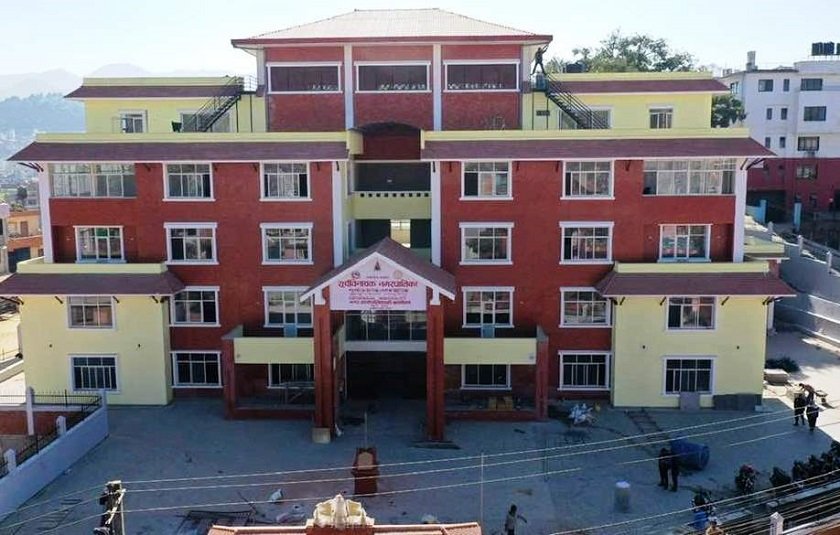
Since then, the Hetauda Textile Industry has been closed for a long time. Despite having machines worth millions, large physical structures, and the necessary infrastructure, the industry has been in a state of disuse and ruin for years. Although there have been discussions between the government, ministries, and stakeholders at various times regarding the operation of the industry, no concrete decision has been reached. Reports have already been submitted stating that the industry can be restarted with minor maintenance and management improvements. Previously, the Nepali Army had conducted a feasibility study for operating the industry and submitted a report to the government led by the then Prime Minister Pushpa Kamal Dahal 'Prachanda' on 17 Magh 2080.
This specific news has been automatically translated by AI. As a result, there may be some inaccuracies or language errors.
_Sw2x64Nala.jpg)