Analyzing the Roots of Political Instability and Social Unrest in Nepal

The recent election on Falgun 21 in Nepal, following the Gen-Z uprising, has established the Rastriya Swatantra Party as a major political force in Parliament. The extraordinary support for the party stems from the public's strong desire for good governance and development. However, reaching power, maintaining it, and governing effectively are distinct aspects of politics.
There are many examples where powerful governments or rulers were removed from power when they failed to govern effectively. For instance, in India, after the 1977 Emergency, the 'Janata Party' came to power with a nearly two-thirds majority. However, they could not provide a stable government during their designated five-year term and changed two Prime Ministers in less than three years.
KP Oli's last government also claimed to have a majority, but he could not rule for more than a year. The fact that 14 governments have changed in 18 years since 2008 shows that stable governance is not easy in Nepal. Therefore, any government coming to power must learn from past mistakes and history to provide stability and effective governance to the people.
Furthermore, various movements, such as the recent Gen-Z uprising, have caused damage to government and private property of historical and cultural significance. Therefore, it is necessary to analyze the root causes and related aspects of such movements so that they can be managed with minimal damage in the future.
In this article, we will attempt to identify the potential causes of such events.
The Gen-Z movement that took place in Nepal on September 8 and 9, 2025, was not inspired by a single cause but can be understood as the frustration of a society burdened by social, economic, and cultural discrimination that has persisted for centuries in Nepal.
1. Incomplete Nation-Building and State Structure
Although Nepal is a multi-ethnic, multi-lingual, and multi-cultural country, the process of nation-building is still incomplete. Cultural, economic, and political differences in Nepal are very deep. These differences are formed by historical, geographical, and civilizational reasons. Historically, state power remained centered in the Khas-Arya community.
The 30-year religious war between Catholics and Protestants in 17th-century Europe was ended by the Peace of Westphalia (1648). That treaty laid the foundation for the modern nation-state system. Several important provisions were included in that treaty. For example, each state would have the right to choose its own religion, government, and laws. Sovereignty between states would be equal, and other states would not interfere in the internal affairs of a state.
The treaty gave birth to the concept of tolerance, which created a situation where different religious or cultural communities could live together while maintaining their identity within the same state. However, in a multi-ethnic and multi-cultural society like Nepal, the Westphalian principle often led to a situation where minorities had to sacrifice their sovereignty instead of tolerance and acceptance. The majority community here used democracy as a tool to maintain their power. This accustomed minorities to living as 'tolerant' subjects rather than achieving true equality.
No revolution attempted to correct the path; instead of integrating minorities into a shared life, the state used resources to create separate provinces for them. Therefore, while the provincial structure is good in a limited sense, it is incomplete.
Thus, in Nepal, Westphalian tolerance began to play a role in legitimizing the imbalance of power rather than political inclusivity. Here, Madhesis, Janajatis, and other communities have felt excluded from the state structure. The Madhesh movement, the Janajati movement, and past Maoist movements are reactions to this inequality. Until 400 years ago, the official religion of a state in Europe was determined by the ruler of the state. At that time, the saying 'Cuius regio, eius religio'—meaning 'whose realm, his religion'—was prevalent. This limited the religious freedom of minority communities.
The 30-year religious war (Catholic vs. Protestant) that followed was ended by the Peace of Westphalia. Since then, the basis for the sovereignty of modern nations has been prepared.
In the context of Nepal, the revolutions of 2007, 2046, and 2062/063 sought to continue the status quo rather than address structural inequality. The latest revolution has provided only a limited solution by creating separate provinces rather than integrating minority communities into a shared life. Comparatively, Singapore's experience shows that even if a community is multi-majority and multi-ethnic, the state can succeed in building an inclusive national sentiment through inclusive citizenship, practical governance, and clean administration.
In a small country like Nepal, most parts of the country have not yet been fully integrated. Nepal is a diverse country with over a hundred ethnic groups. Even before democracy, the dominance of the majority was established in Nepal. However, until now, minorities have had to sacrifice their sovereignty in exchange for tolerance and acceptance.
No revolution attempted to correct the path; instead of integrating minorities into a shared life, the state used resources to create separate provinces for them. Therefore, while the provincial structure is good in a limited sense, it is incomplete.
In reality, being a minority is not a political subject but an experience that those communities are forced to face. Therefore, revolutions must be able to challenge the power structure, not the 'Khas-Arya' themselves. To be honest, no system so far has attempted to correct the discriminatory nature inherent in the state.
Singapore can be a potential example of nation-building. Singapore became independent from British colonial rule on August 9, 1965. In this nation, which has the largest Chinese community outside of China, there were other Asian communities as well. However, Lee Kuan Yew, who took the lead at that time, governed based on a clean legal structure.
He maintained the British system while encouraging English-medium schools instead of Chinese schools. He made military service mandatory for men to instill a sense of 'patriotism' in the people. Through clean civil service, a practical approach, and pragmatism, he made patriotism and economic success possible in the country.
2. The Concept of Law
In Western civilization, law is considered divine and immutable, but in Asian society, law is considered man-made, flexible, and changeable. For example, the Ten Commandments are mentioned in the Old Testament of the Bible, which are described as laws given by God to the prophet Moses on Mount Sinai. These laws became the fundamental principles of major Abrahamic religions. These rules were followed by Christian and Jewish communities as part of their religion. This established the notion that law must be followed with religious faith and that violating the law is akin to disobeying God.
Violence and arson against public property during movements are examples of such violations of the law. The practice of bending the constitution to make a non-parliamentary person the Prime Minister in Bangladesh and Nepal can also be taken as an example of the tendency to consider law as man-made and flexible.
However, in Asian civilizations, law is considered man-made. Being man-made, they thought that humans could change, modify, or violate it. Therefore, society appeared ready to break laws that were not in their interest. In Nepal, both rulers and citizens have been misusing this tendency. For example, everything from the distribution of political posts to traffic violations is considered normal. This weakened the legal culture and continuously pushed citizens towards street movements, which resulted in the first and second People's Movements in 2047 and 2062/063, and the Madhesh uprising in Nepal.
Violence and arson against public property during movements are examples of such violations of the law. The practice of bending the constitution to make a non-parliamentary person the Prime Minister in Bangladesh and Nepal can also be taken as an example of the tendency to consider law as man-made and flexible. Recent movements and the achievements gained by bending the law are creating a 'feed-forward loop,' which is strengthening the collective psychology of rebelling against the government and violating rules for that purpose. This may increase the possibility of more movements in Nepali politics in the future.
Future governments and society as a whole must learn from such strong psychological tendencies and develop the capacity for appropriate law enforcement. Measures to make citizens follow the law and be disciplined must be adopted, and effective communication networks between the government and the people must be built to minimize the risk of potential movements in time.
3. The Nature of the Ruler
Asian political philosophy considers a king or ruler who is dedicated to the welfare of the people, moral, compassionate, and pious as ideal. According to the concept of Ram Rajya, an ideal king is not just powerful, but a righteous, justice-loving, people-oriented, and responsible ruler who puts the interests of the nation and the people above his personal interests. In the West, too, Thomas Hobbes said that for stable governance, people want a 'trustworthy and exemplary sovereign.'
According to the Mahabharata or Manusmriti, a king must follow Dharma. If a king becomes unrighteous, it becomes the duty of the people to resist the king. The struggle of Krishna against Kansa, the struggle of the Pandavas in the Mahabharata, and the struggle of Rama against Ravana are taken in this sense.
However, contemporary Nepali leaders have emerged as arrogant, unreliable, and corrupt rulers. It would not be an exaggeration to say that parties and their leaders have a spirit of 'war once clan against all.' This is because every politician tries to centralize the people's money and power towards themselves by using their political power to place their cadres and family members in political positions.
Due to intense competition, mutual distrust, and power struggles within parties, party and personal interests appear to dominate over national interests. Nepal currently needs responsible political leadership capable of maintaining political stability, strong governance, and public trust, and capable of enforcing effective laws.
4. The Tradition of Rebellion
The greatest threat to any ruler is his own people. This is because people have a tendency to rebel. In Asian culture, rebelling against an unjust ruler is considered a moral duty.
According to the Mahabharata or Manusmriti, a king must follow Dharma. If a king becomes unrighteous, it becomes the duty of the people to resist the king. The struggle of Krishna against Kansa, the struggle of the Pandavas in the Mahabharata, and the struggle of Rama against Ravana are taken in this sense.
Similarly, according to Confucius's 'Mandate of Heaven,' if a ruler becomes corrupt or dictatorial, loses virtue, and harms the people, it is considered morally appropriate for the subjects to resist him or remove him from office.
Therefore, the Yellow Turban Rebellion (184 AD) during the Han dynasty, the Red Eyebrow Rebellion (18-27 AD) during the Xin dynasty, the Taiping Rebellion (1850-1864) during the Qing dynasty, and the Boxer Rebellion (1899-1901) during the Qing dynasty in Chinese history are examples of this. The ideas of these historical rebellions are deeply embedded in the subconscious of the masses. When people see injustice, their natural tendency is to rebel or challenge the existence of the ruler.
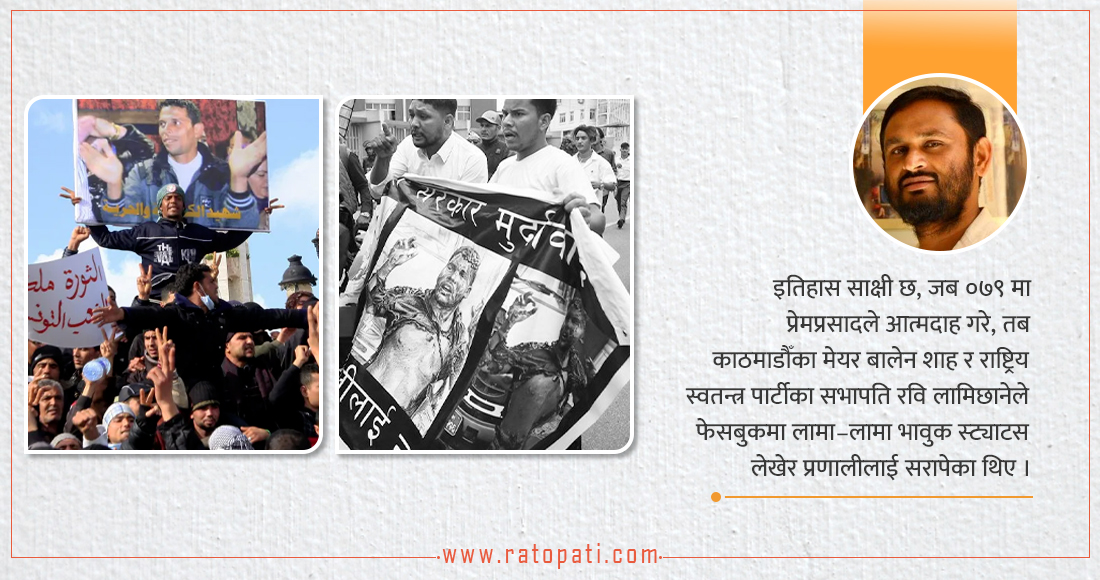
Since symbols of an inclusive society like the republic, constitution, and federalism are still new in Nepal, emotional loyalty to these concepts has not yet taken deep root among the people. For this reason, the tendency to take the misuse of the constitution as a legitimate alternative for movement is still strong. Furthermore, some modern parties in Nepal, especially leftist or revolutionary parties, use symbols like the hammer and sickle, red flags, and pictures of martyrs to remind people of past historical rebellions.
These symbols inspire people to resist by reminding them of the struggle against oppression. In the coming time, it might be appropriate to conduct programs that strengthen the relationship between the people and national symbols to reduce the possibilities of new rebellions.
5. Wealth Inequality and Envy
Despite significant progress in health, education, infrastructure, and living standards over the last five decades, social discontent persists. The reason for this is social inequality and envy. When the gap between the rich and the poor increases, ordinary people feel that their standard of living will not improve or that opportunities are limited. Inequality, combined with cultural and social divisions, prepares the ground for rebellion. This is because people feel they are not receiving fundamental justice.
Similarly, when only a limited number of individuals or groups in society are able to acquire excessive power, wealth, or honor, envy arises in others. Envy creates dissatisfaction and conflict, which inspires rebellion or disobedience. A famous businessman and investor, Charlie Munger, has said, 'The world is not driven by greed, but by envy.'
In Nepal, it is felt that when a certain class enjoys excessive wealth, discomfort and dissatisfaction increase in other classes. This trend also matches other Asian societies in the process of modernization. Educating the public about the economy and capitalism can be beneficial to remove such envious feelings driven by economic imbalances.
In a private economy, some individuals become rich first, and the enterprises and industries opened by those individuals help others become rich as well. Similarly, education based on social values, mutual cooperation, tolerance for different opinions, and healthy competition teach people to take inspiration from others' success rather than compete.
6. Shrinking Opportunities and Low Economic Literacy
Due to geographical conditions, the possibilities for rapid economic progress in Nepal are limited. However, there is a lack of sufficient understanding of this among the general public. When employment, education, business, and social opportunities are not equally available to all, the embryo of discontent begins to develop in the people. When the youth or weaker groups do not find a path for economic/social advancement, they adopt the path of rebellion or movement.
Due to the lack of practical economic knowledge, when they cannot properly evaluate resources and opportunities, they are inspired to criticize corruption and abuse of authority. When individuals cannot improve their income and resources but only see others progressing, their tendency towards envy, dissatisfaction, and rebellion increases. Currently, due to insufficient knowledge about international trade, law, and long-term development processes, public expectations have become unrealistic, leading to increased frustration.
Personal envy can be reduced by providing knowledge about social opportunities and rights. Third, vocational education. By increasing entrepreneurship, skills, and employment opportunities, the tendency of low envy and high effort in others' success can be promoted.
For this, basically five methods can be adopted. First, financial literacy. In this section, the public can be turned towards a campaign to make them economically capable by teaching them about savings, budgeting, investment, and debt management. Second, education on equality and social justice. Personal envy can be reduced by providing knowledge about social opportunities and rights. Third, vocational education. By increasing entrepreneurship, skills, and employment opportunities, the tendency of low envy and high effort in others' success can be promoted.
Fourth, value-based education. Education that imparts the values of cooperation, tolerance, compassion, and inspiring competition must also be given equal importance. Fifth, civic education. The public must be continuously informed about the constitution, law, and political rights. This helps in understanding the factors of inequality and reducing social discontent.
7. Migration and Social Impact
Millions of Nepali workers are abroad. While foreign experience has increased awareness of freedom, opportunities, and individual rights, the failure to meet such expectations at home is fueling discontent and rebellious feelings. The migration of workers in Nepal has indirectly contributed to rebellion or movement. The social inequality, excessive labor, low wages, and lack of local opportunities experienced by Nepalis working abroad have increased their sense of dissatisfaction.
When these workers return their experiences to society, the stories of inequality and oppression they point out awaken the demand for rights and the consciousness of rebellion among the local people. Also, although remittances sent from abroad bring new opportunities to the local economy, their unequal distribution can increase even more dissatisfaction and the tendency for movement. Thus, the migration of Nepali workers plays a role in inspiring rebellion or movement through social consciousness and the perception of inequality.
In the name of focusing, this model has adopted a department system, in which each student must focus on only one subject, such as science, mathematics, or philosophy. As a result, people educated in science have no knowledge of politics, and those studying politics have no knowledge of science. This creates a knowledge gap in the general public, which provides an opportunity to fuel rebellion or movement.
To minimize such effects of migration, local leadership and the government must be made transparent and responsible. Conducting dialogue, training, and participation programs between workers and society can reduce the harm caused by migration. Similarly, ensuring the safety, wages, and legal rights of workers working abroad also reduces worker dissatisfaction and minimizes the possibility of them returning and engaging in rebellion or movement in society.
8. Incomplete Knowledge of International History and Law
Since Nepal's university system is a copy of the Indian and Western models, it has failed to encompass local and Asian realities. Nepal's universities are based on the Humboldtian education model established by Wilhelm von Humboldt of Germany, which was based on the liberal ideas of Friedrich Schleiermacher, especially the importance of seminars and laboratories. These universities are often focused on science and were established with the aim of serving upper-class students.
In the name of focusing, this model has adopted a department system, in which each student must focus on only one subject, such as science, mathematics, or philosophy. As a result, people educated in science have no knowledge of politics, and those studying politics have no knowledge of science. This creates a knowledge gap in the general public, which provides an opportunity to fuel rebellion or movement.
Similarly, as subjects like citizenship, constitutionalism, and nation-building cannot be taught holistically, the gap between national consciousness and international reality has increased in the younger generation. Therefore, it is necessary to promote a holistic education model where students can learn basic knowledge of many other subjects along with their own major subject, so that capable citizens can be produced.
9. Competition of Experts and Public Intellectuals
Globally, 'global scholars' are evaluated based on their subject excellence, while the public intellectual class is known based on contextual relevance within the country. Nepal's 'intellectual class' seems to have gained popularity through criticism of the existing system via social media. But their failure to provide any concrete long-term solution has further weakened institutional trust.
If the intellectual class can present long-term strategies by incorporating expertise, research, and practical policy advice, their contribution will not be limited to criticism, and they can play a powerful role in restoring trust in social institutions.
In this context, it is further said that the influence of the public intellectual class in Nepal is often limited to rapidly spreading debates and social media reactions. Their criticism brings immediate popularity, but the capacity to transform into long-term policy-making, institutional reform, or practical action appears low. As a result, dissatisfaction and distrust increase among citizens, but the path to a permanent solution or reform is not clear.
If the intellectual class can present long-term strategies by incorporating expertise, research, and practical policy advice, their contribution will not be limited to criticism, and they can play a powerful role in restoring trust in social institutions.
10. Erosion of Rules and Weak Implementation
After the Rana regime, the state gave a legal form to the law-based social structure but could not implement it effectively. Slow judicial processes, widespread corruption, and the weak functional capacity of social mechanisms have reduced trust in the legal system. This has directly encouraged rebellion and non-cooperation.
As a result, the general public has begun to lose faith that they can secure their rights through legal channels. When the state fails to enforce rules and laws, people are forced to seek other legitimate alternatives and engage in rebellion or non-cooperation. This increases social instability and weakens efforts to seek justice at the individual and community levels. Also, weak implementation of the law provides opportunities to powerful groups and special interest holders, which increases inequality and dissatisfaction, further escalating the possibility of rebellion.
Therefore, it seems easy for the current state power of Nepal to work by focusing on the above reasons.
This specific news has been automatically translated by AI. As a result, there may be some inaccuracies or language errors.




_6FSvCrCShE.jpg)