A Mother's Despair: Fulmaya's Struggle Against Poverty and Betrayal

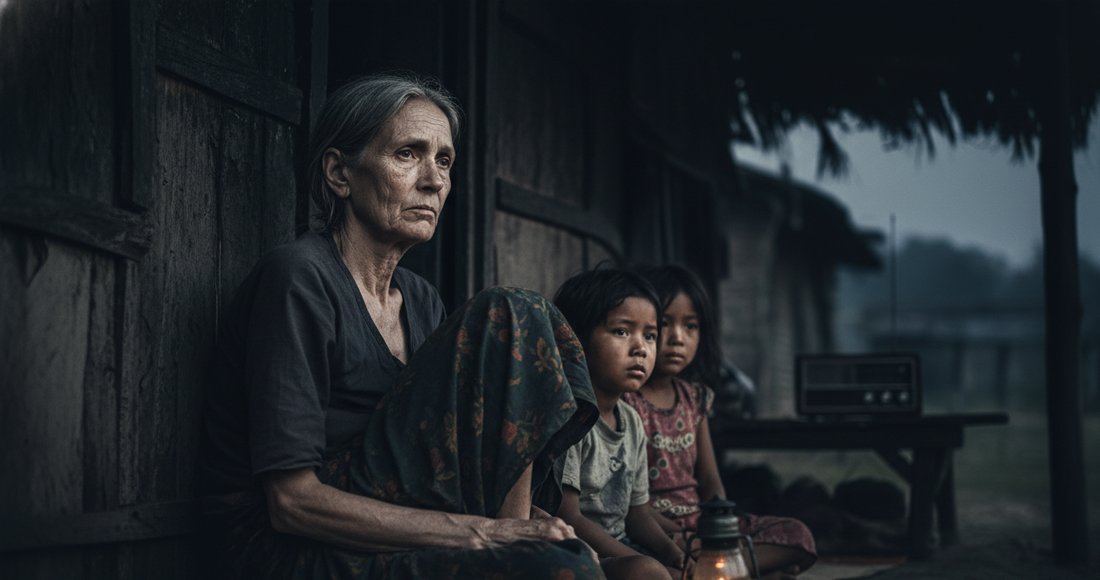
“Mother!” Nepti said breathlessly, panting and wheezing as she rushed in, “Three people are coming down the field path by the stream.”
“Foreigners or laborers?”
“People like the soldier (Laure). One playing music, two carrying loads.”

A faint ray of hope dawned in Fulmaya's heart. Waves of strength surged through her limbs. Using her two hands to steady herself on the ground and feel the wall, she straightened her trembling legs, stood up, and slowly counting her steps with Nepti's support, reached the base of the mango tree behind the thatched hut. Six thirsty, disappointed, and hungry eyes fixed on the riverbank below. The approaching man was not short and agile like Fulmaya's husband, Ganj Bahadur Gurung. He looked like the soldier (Laure).
“Everyone's sons come back. Husbands come back. Fathers come back. Only our cruel, worthless one has not returned,” Fulmaya expressed the fire in her chest with a sigh mixed with sorrow and anger.
First, the tall, lean, and fair-skinned soldier (Laure). Following him, two porters trudging along, carrying huge loads. Six unfortunate eyes were glued to the soldier's movements. Three hearts burning with fire longed to rest under his four-penny shade. Three restless souls stood waiting by the path to beg for his mercy. Inside the dark thatched hut, a little rice and two or three pegs of liquor were waiting for the soldier. As the soldier approached the crossroads, Fulmaya's legs trembled—“Oh God! Where is he going?” Moving like the wind, she rushed ahead of him, blocking his path, her soul yearning to lead him to her dark hut. The soldier did climb up, but one step remained.
“Parameshwori Kalika Mai! May his heart not wander elsewhere.”
Time spent waiting becomes slow like an old buffalo. Extremely tedious.
The distance of twenty-five to thirty yards from the riverside path to the base of the mango tree felt longer to Fulmaya than her entire life as the soldier crossed it. As he came closer, the soldier seemed to look at her as if he had seen her somewhere before, as if he recognized her. After reaching four terraces below where she stood, the soldier glanced at her. He stopped abruptly, looking conflicted, and then smirked a scornful smile on his thin, smooth lips, moving sideways along the terrace. Despair was painted in the six unfortunate eyes. The flame of sorrow burned brighter in the three scorched hearts. The faint light of hope in the three restless souls was instantly extinguished, and a plume of darkness enveloped the entire world. With a faint sigh, Fulmaya slumped onto the dust. Disappointed, Chature and Nepti looked at each other blankly.
Cutting through the quietness of the spreading twilight, the soldier's 'Redui' instrument sang a song in a mournful tone.
When there is wealth, everyone says 'Hi-Hi' (admiration).
When there is adversity, there are no brothers!
That song of separation and lamentation pierced Fulmaya's heart like a knife. The sinner seemed to have entered her fractured chest, woven her feelings of agony into the song, and sung it to make her cry.
“The adulterer turned towards the fake woman's den,” Fulmaya said, as if she had lost the gamble of her life, “The destitute are neither looked upon by man nor by God.”
In a moment, a crowd of people from Syaule Bazaar gathered at the den of the 'fake woman'. Seeing the fervor of the song, the sensation of the gathering, and the merriment of the atmosphere, Fulmaya's eyes burned with jealousy and envy. Since the 'fake woman' set foot in that Syaule Bazaar, Fulmaya's fate seemed to have been erased. Fulmaya was middle-aged. Thin, pale, and stooping. The 'fake woman' was a vibrant young woman. With a slender waist, affected airs, sharp eyes, and cutting words. In the evenings, when the soldier or the traveler (Butwa) arrived, there was a fierce scramble between these two. Fulmaya was often the loser in that scramble. She lost in insults and arguments, and even in brute strength. Finally, experiencing the bitter feeling of losing the gamble of life, she roared, “Fake woman! You boast so much to me! You are envious seeing what others have earned through hardship. You... you... you... prostitute!”
“Prostitute?” The 'fake woman' roared like a tigress and lunged to take her spot. “Who put thorns in your husband's path, old hag? Who looks at you, you stinking carcass? Instead of cursing your own repulsive appearance, you blame me? Are you jealous because I have ensnared your husband?” Saying this, the 'fake woman' moved to attack. Fulmaya retreated three or four steps. She muttered indistinctly. Her brow furrowed with anger. Her eyebrows knotted, and placing her hands on her waist, she shook her shoulders and said, “You wicked woman, you have stolen my livelihood. You have set fire to my happiness. For this sin, you will suffer in hell for eighty-four million lifetimes. You will suffer more!”
“Suffer more?” Attacking, the 'fake woman' grabbed Fulmaya's hair. “If I suffer once, you suffer twenty-five times! If I am one whore, you are ten!”
“You, the shameless one, who came down to sell your youth at the crossroads while your husband is at home! You, the despicable one, who boasts of stealing someone else's sustenance! I was disgraced through hardship. You, by choice. Even if the world doesn't see it, God will see my ruin.”
A sensation would spread in the desolate atmosphere of Syaule Bazaar. People, victims of the monotony, misfortune, and dissatisfaction of life, would flock to watch the spectacle. And when the fistfight began, the women would separate Fulmaya and the 'fake woman', cursing them. “Wicked ones who deserve the life of a dog!” Kanchhi the landlady would comment. “This market won't prosper until you two leave.” Then people would retreat to their respective thatched huts, spitting out the stench of the environment. The Syaule Bazaar was like the disgusting world of the hell described in the Puranas, yet people would say, “Go to hell! May you reside in hell!”
Defeated in that vile squabble of life, Fulmaya, exhausted by anger, shame, and despair, entered her dark thatched hut. Leaning against the wooden post used to prop up the hoe, she sat slumped on the dirt floor covered in filth. She sighed deeply, recalling the trivial drama of the life she had endured.
Once, she too was a young woman like the 'fake woman'. Her appearance held charm and fragrance. Her chest held youth and pride. Her arms held courage and arrogance. But now the reign of her youth had fallen. The value of her dominance had decreased. The enchanting gleam in her eyes had faded, and the ship of her life had sunk. Now she was like the tasteless, meaningless core of a mango, sucked dry of all its juice and thrown into the garbage.
Remembering the old history of her youth, Fulmaya felt an inexplicable jealousy. Seeing that history collapse from its foundation brought unbearable regret. And the jealous, disgusting, and mean life she had lived stirred up a great storm of anger, self-reproach, and rebellion in her heart. Then, distressed, worried, and worn out, she sat motionless, as if in a trance.
“Did you eat, elder sister?” The 'fake woman' asked, arriving suddenly, swaying her waist rhythmically and blinking her eyes flirtatiously. Fulmaya sensed mockery, ridicule, and insult in that question. She became instantly angry.
“No,” Fulmaya replied, forcing down her anger, “Whose lover should eat?”
“Didn't you go to sing with the soldier?”
“In the next life...,” Fulmaya's fierce eyes glared at the 'fake woman's' face.
The small amount of rice and two or three pegs of liquor that Fulmaya had hidden with the vain hope of sustaining life for a few days were also finished today. Piercing Fulmaya's heart, a desolate song echoed in her ears once more—
When there is wealth, everyone says 'Hi-Hi'...
Oh God! How will I survive now?
That night, Fulmaya did not sleep for a moment.
000
“Eldest daughter! Hey, eldest daughter! Is anyone home or what?” Early in the morning, Landlord Kanchha called out, peering through the opening of the hoe shed. Fulmaya felt like ignoring him completely.
“Is anyone inside?”
Seeing Landlord Kanchha arrive so early surprised Fulmaya and made her heart flutter.
“Are you very ill, perhaps?”
“It's just the body, dependent on food and water...,”
“I hear you are in great trouble.”
Sniffing, Landlord Kanchha said in a slick voice, “Haven't you received any letters from your husband? Oh! Those people are so carefree. Never mind... never mind... You don't need to hide things from me. I hear the fire of famine is burning. I don't see you looking cheerful these days either. I see the market is empty. Why do you treat us like strangers? Isn't this the time when neighbors and relatives are needed, in times of trouble? How long can you rely on old favors? If nothing else, we can share a few meals. I just came to understand the situation.”
Fulmaya wanted to give him a harsh reply that would strike him in the gut. But she suppressed her temper. She glanced at Landlord Kanchha. Mucus crust was stuck to his coarse, stubbly mustache. There was no hint of kindness or charity on his face. She saw a strange, mysterious expression on that face. She felt as if she were dreaming or in a trance. “Even if you women don't get along, don't treat me like a stepson's child,” saying this, the landlord left.
Fulmaya sat stunned for a long time, gazing at the blue sky in the west. Landlord Kanchha, with the disgusting mucus crust on his stubbly mustache, stood imprinted in her mind. Unable to think of any trick to save her life from that terrifying trap of death, she became terrified. Nepti, who had gone out to play, returned with sweat beading on her forehead. Chature, disheartened by the poisonous atmosphere of Syaule Bazaar and the hellish state of their home, had not yet returned.
The laborers went about their chores. Mealtime passed. The sun moved, a slight breeze blew, and the mango leaves rustled slowly. It was midday, and sitting still for so long, Fulmaya's back ached. Her eyes stung. And her heart grew heavy.
“Write a small agreement, son!” Fulmaya pleaded as the village schoolmaster was leaving for his class. Her belief that her husband was there, would return, and would remove the thorn from her chest, now held no weight. Her husband was now like a straw for someone about to drown.
When the content written by the master did not satisfy her, she dictated the content herself, and the master wrote it down with a sly smile and a crooked pen—
My Husband,
The mirror of your heart is laid low by hunger, disease, and sorrow. The threads of your love have been ruined by famine. Your home has become as desolate as a cremation ground. You went to fight in the foreign land (Muglan). I am struggling to survive, crushed by the struggles in the village. Destiny did not write for me to rest in the lap of your love. Nor to see the smile of your eyes. Nor to hear the sweet talk of love. My husband! Do not curse me later if the wife has ruined the children. Do not regret later that the wife has smeared soot on the face of honor. Here, the entire world has become my enemy. If I were to pour out all the heat of my heart, your heart would shatter like a sieve. A hint is enough for those who understand. With folded hands, I send my greetings, my husband! Come home soon.
Your loving younger one,
Fulmaya Gursini
From Syaule Bazaar
Jestha 10th
Fulmaya stared at the letter for a long time after receiving it. Remembering the weak content of the letter, she was utterly dissatisfied. She should have scolded her husband, who was like a blockhead who completely forgets relatives once he secures his own food, to the point of fainting. She should have made him dizzy. She should have burned his heart so badly that he would rush home immediately.
Chature came back carrying seven or eight small fish threaded onto a string, dangling them. Fulmaya entrusted him with dropping the letter in the post office. Chature stood there for a moment, looking conflicted. Biting his lip, he frowned, thinking about something. “No need,” he snapped, “What's the use of a letter to a father with a heart of stone?”
“Don't say that,” Fulmaya advised, “Even if the father is a thief, he is still a father. Even if he is ungrateful, he is still a father. If we nurture him, we are blessed. If we kill him, it is a sin!”
“I won't go,” Chature retorted.
“Go, I command you,” Fulmaya insisted.
“I'd rather wipe my backside with it,” Chature snapped. “What kind of father is someone who never returns no matter how many letters are written? He is a landlord (moneylender).” He tore the letter to shreds.
Fulmaya glared at her son. Part of her agreed with her son's defiance, but her heart was not appeased. As she watched, her face twisted towards malice. Her expression became distorted. Red veins appeared on the surface of her eyes. It seemed as if sorrow had sucked out and dried all the blood from her heart.
She looked at her son with loving eyes. She recalled some sweet feelings of happiness from the time when her body was full of robust youth. Two years after marriage, she had conceived. When she told her husband, hiding her excitement and shame, he had looked at her with great affection and silently praised her. Just as one cherishes a diamond hidden safely in a miserly landlord's box, she cherished the form of the new human inside her womb every moment. She imagined the share of her heart's desire. She recounted the poignant story of his intellect and manliness. And without giving a thought to all the suffering and pain involved in nurturing that being inside her with her own blood and flesh, she would plunge into an ocean of unprecedented joy and pride. “My husband, the light of my heart, my darling!”
On the night she gave birth, after everyone else slept and the environment became quiet, her husband entered the room where she lay, smiling faintly and holding a dim light. Lifting her heavy head, she looked up at her husband, beaming with joy and pride. The husband shone the dim light on the baby's face. The baby was sleeping soundly in a peaceful manner. In the faint glow of the lamp, Fulmaya saw the proud expression on her husband's face. Seeing the bright rays of love and affection pouring onto her face from his golden eyes, her chest swelled like a winnowing basket. A pure, affectionate, and companionable word echoed in her heart—Mother! Imagining she had won the biggest and most difficult gamble of life, she praised herself. She earned the name Mother. She received love. She gained honor. And she gave birth to a human being, a living example of humanity. In a world with such miraculous seeds of creation, how joyful it is to be born as a human!
But seeing those sweet feelings, beautiful dreams, and that romantic joy burn to ashes in the harsh and cruel fire of life, her entire body felt pricked by thorns. That same mother, who was ecstatic with joy and enthusiasm at the moment of new creation, is today reviled as a prostitute. That same mother, who has a fertile chest capable of giving birth to intelligent beings who can adorn the earth, which knows how to love and create, with the garland of progress and love, is ground in the millstone of gossip, accused of theft, and burned in the fire of insult, with a nail of ruthlessness hammered into her heart, turning her into a living corpse. That living idol of love, capable of making the foul and dark face of the world look neat with fragrance and shine, is now about to be swallowed whole by the cruel demon of poverty.
Staring intently at Chature, Fulmaya's eyes seemed to plead, as if saying—“Son! I never wanted to give birth to an unfortunate one like you. I did not give birth to you to drown in this hell pit.”
This specific news has been automatically translated by AI. As a result, there may be some inaccuracies or language errors.