Court Marriages Gain Traction in Nepal Amidst Changing Social Dynamics

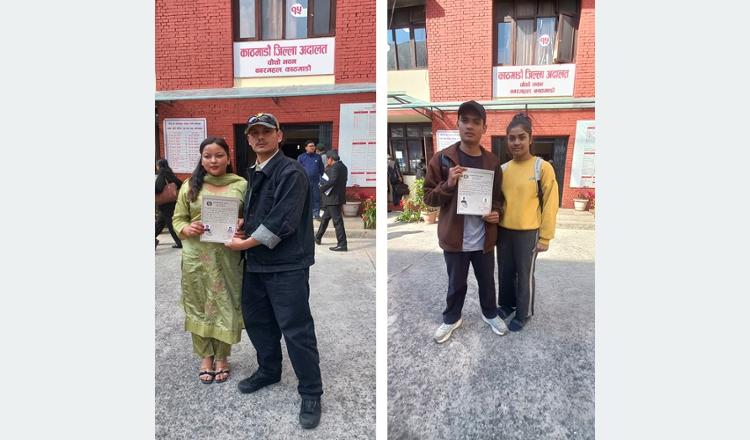
Kathmandu. On Chaitra 11, Lokesh Kumar Ayadi from Triveni Municipality-7, Bajura, was seen at the Kathmandu District Court premises wearing a black denim jacket and pants, appearing quite rushed. Accompanying him was Punam Kunwar from Gaumul-4 of the same district, adjusting her green kurta-suruwal. They were not at the court for any administrative hassle or legal dispute. They were there for a court marriage, or registered marriage. After completing the necessary procedures, the groom Ayadi and the bride Kunwar received their marriage registration certificate the same day.
Ayadi, who works abroad in Japan, came to Nepal on a short leave and got married in court with the consent of his family. Groom Ayadi says, "It is the month of Chaitra, and there were no auspicious dates or times for a traditional wedding. Since that wasn't possible, I decided to have a court marriage with the permission of my family. It wasn't possible to go home, and since this route is less expensive and quick, I chose it."
While it is natural for many to associate marriage with elaborately dressed brides and grooms adorned with jewelry, and traditional decorations, the increasing trend of registered marriages is starting to challenge these conventional narratives. Not just Ayadi and Kunwar's couple, but on Chaitra 10, Kasam Pant from Bhanu Municipality-12, Tanahun, and Bhawana Giri from Tripura Sundari Rural Municipality-1, Dhading, also registered their marriage at the same court.
Pant and Giri's couple, dressed in simple attire like students with backpacks slung behind them, were taking a picture with their newly obtained marriage registration certificate, ensuring the court's sign board was visible in the frame. Groom Pant stated, "I learned through self-study that court marriage is reliable and trustworthy, so I came here; this is a legal marriage in itself. If the couple and the family agree, it is a marriage that can be completed quickly, is less expensive, easy, and does not burden the family financially."
In recent times, increasing urbanization, foreign employment, busy lifestyles, and the extravagance of social traditions have led to a growing interest and attraction towards registered marriages (court marriages) among the general public. Society is becoming more positive towards court marriages as they discourage child marriage, polygamy, and false marriages, save time, and help reduce social evils like the dowry system.
The Kathmandu District Court has a record of 27 couples registering their marriage on a single day last Falgun, the highest number. According to the court's Information Officer Deepak Kumar Shrestha, on days with auspicious wedding dates, a maximum of 27 registrations occur, while on other days, an average of 10 registrations take place daily. In the first nine months of the current fiscal year (up to Chaitra 11), 1,755 registered marriages were performed at that court, he informed. In the previous fiscal year, 2,843 applications were received for registered marriages. However, the District Court stated that the records of total registered marriages were destroyed in the Janata Andolan (People's Movement).
According to Nepali tradition, auspicious months for marriage are determined based on astrological charts. However, the Kathmandu District Court records show that 194 registered marriages took place in Shrawan, 159 in Kartik, 226 in Poush, and 67 until the 9th of Chaitra, months not traditionally considered ideal for such ceremonies.
Legal Encouragement for Registered Marriage
Sociologist Tikaram Gautam views registered marriage as a characteristic of modern society and a sign of social change. He says, "All cultures in society are interpreted by linking them to the social structure and people's needs. Today, the religious, political, cultural, and social structures in Nepali society have changed significantly compared to the past. As that practice changes, the number of registered marriages has also increased."
The state has always encouraged court marriages, which are performed after fulfilling the prescribed qualifications with witnesses from the law and relatives. In Falgun, when there were auspicious dates for marriage, 259 young men and women registered their marriages through the Kathmandu court. During that month, 78 couples, including Nepali and foreign citizens, registered their marriages.
The couples opting for registered marriages are mostly those residing in Kathmandu for studies, business, or employment, and who find it inconvenient to travel to their permanent addresses for marriage registration. Senior Advocate Sunita Regmi Pokharel mentions that registered marriages used to be done at the Chief District Officer's office but are now conducted at the District Court.
"This number is seen to increase as the trend of young people going abroad for foreign employment rises. Whether it's the man or the woman coming to Nepal from abroad to register their marriage, official and certified documents are created for both, which increases its importance," she says. "The law also mandates the public declaration of marriage. The encouragement for such marriages stems from the youth's understanding that there are flaws in traditional marriage processes like Kanyadaan (giving away the daughter), washing the groom's feet, and handing over the daughter."
Senior Advocate Regmi clarifies that marriage registration and registered marriage are different matters. The process done at the Registrar's office is marriage registration, whereas registered marriage is the subject handled in the court.
Marriage for Five Hundred Rupees
For a registered marriage, both parties must submit an application with certified copies of the citizenship certificates of their witnesses, along with a photograph, affirming that they are legally eligible to marry. The court charges a fee of five hundred rupees for performing the registered marriage.
Binod Bista from Lamki, Kailali, who arrived at the Kathmandu District Court for marriage, stated that he opted for a registered marriage to utilize his short time before leaving for employment in Serbia. He said, "I got the opportunity to have a legal marriage at an official body; it is not only less expensive but also easier to obtain the necessary documents for going abroad." He was united in matrimony with Rashmi Baduwal, also from Kailali, on Chaitra 10 after completing the court procedures.
Although the law stipulates a seven-day period for court-registered marriages, the court provides the marriage registration certificate on the same day if all documents are complete, informed Court Information Officer Shrestha.
Considering that citizens from all 77 districts of the country reside in Kathmandu, and in some cases, the need to marry quickly before leaving abroad, arrangements have been made to issue the certificate within two hours, he clarified. "This is the 'fast track service' provided by the court to service recipients," he said.
Dalit rights activists believe that court marriages have also helped reduce caste discrimination historically seen in Nepali society. There are instances where couples arrive at the court marriage dressed up with their families and receive the certificate after observing auspicious timings.
For marriages between Nepali citizens, a recommendation letter from the respective ward office confirming the permanent residence of both unmarried individuals is required. In the case of foreigners, documents proving residence in Nepal for at least 15 days are necessary. Additionally, a 'No Objection Letter' and a certificate confirming their eligibility to marry from the respective country's embassy in Nepal are required.
For foreigners, the minimum age for marriage stipulated by their country of citizenship must be presented, translated into Nepali, even if the original document is in another language. If there is no embassy of the concerned country in Nepal, the practice is to accept a recommendation from the embassy located in India.
Pre-Arrangements at Court Based on Auspicious Timings
Recently, it has been observed that some couples consult astrologers for auspicious timings even for registered marriages. The court also makes prior arrangements and manages manpower accordingly if there is an auspicious time for marriage the following day.
Scenes of couples exchanging garlands and rings, and applying vermilion powder, celebrating festively, are visible almost daily on the court premises. In recent times, interest in court marriages has also increased due to work commitments and busy schedules. Some couples are even found to observe their traditional rituals and customs after registering their marriage in court.
Marriage Becomes 'Lacking' When Joy and Sorrow Share the Same Space
There is a complaint that couples arriving for a celebratory court marriage do not get a suitable environment because the court lacks a separate building or premises for registered marriages. The necessity for a separate venue for marriages has been voiced due to the awkwardness arising from individuals involved in various criminal cases having to share the same space with families arriving for weddings. Marriage legally validates the orderliness of social and family life.
Although marriage registration occurs in all district courts across the country, court marriages are comparatively more frequent in districts such as Lalitpur, Bhaktapur, Kaski, Rupandehi, Sunsari, Parsa, Chitwan, and Makwanpur. The court consistently encourages marriages performed with relatives and legal authorities as witnesses.
This specific news has been automatically translated by AI. As a result, there may be some inaccuracies or language errors.