Rastriya Swatantra Party Faces Uphill Battle to Fulfill Constitutional Amendment Pledges

Kathmandu. The Rastriya Swatantra Party (RSP), poised to lead the new government with nearly a two-thirds majority, had committed before the elections to prepare a 'discussion paper' on constitutional amendment proposals within three months of forming the government.
During the House of Representatives elections, the RSP promised the general electorate reforms in the form of governance structure and provincial structure as a minimum concept.
'Within three months of taking charge of the government, we will prepare a discussion paper on constitutional amendment proposals with the aim of achieving national consensus. The following concepts will be the minimum to be presented for initial discussion from the Rastriya Swatantra Party: Directly Elected Executive, Fully Proportional Parliament, provision that MPs shall not be ministers, non-partisan local government, and an improved provincial structure,' states point number 10 of the RSP's manifesto.

The RSP, which set a historic record by winning 182 seats in the elections held on Falgun 21, will have the responsibility of amending the constitution by taking opposition parties into confidence, as per its manifesto. A two-thirds majority in the Federal Parliament is required for constitutional amendment. While there may not be a problem in securing a two-thirds majority in the House of Representatives, the RSP does not have a single seat in the upper house, the National Assembly. For that, the votes of the older parties—Nepali Congress, CPN-UML, and CPN (Maoist Centre)—will be decisive.
In terms of agenda, it appears easier for the RSP to collaborate with the CPN (Maoist Centre). The agenda for governance reform, such as federalism, directly elected executive, and fully proportional electoral system, was established by the former CPN (Maoist Centre). However, constitutional amendment cannot be achieved by collaborating only with the CPN (Maoist Centre). The CPN (Maoist Centre) has 18 members in the National Assembly, including the Chairman. In the total 59-member National Assembly, at least 40 members are required for a two-thirds majority.
If the RSP adopts a policy of not collaborating with the older parties, it appears they will have to wait until 2087 BS for the constitutional amendment as proposed. Beyond that, the constitutional amendment cannot happen solely through the RSP's efforts.
One-third of the National Assembly members' tenure expires in Falgun 2084 BS. If the government holds local level and provincial assembly elections before the National Assembly member elections, a new mandate may emerge. Even if the RSP secures an overwhelming majority then, similar to the current mandate, it will not be in a position to gather the necessary numbers for constitutional amendment.
Technically, there seems to be a possibility for the RSP to secure a two-thirds majority in the National Assembly by the National Assembly elections in 2086 BS, but this appears very challenging in practice. The tenure of two-thirds of the National Assembly members expires in 2084 and 2086. The RSP can only achieve a two-thirds majority if it wins all those seats. Otherwise, there is a compelling situation to collaborate and reach an agreement with the older parties.
The then Maoist party, which joined peaceful politics in 2062 BS after abandoning the armed struggle, participated in the 2064 Constituent Assembly elections with these very issues. Although the Maoist party was the largest party at that time, it could not implement its agendas because it lacked a two-thirds majority in the Constituent Assembly.
Ultimately, the Constituent Assembly was dissolved on Jestha 14, 2069 BS, without a constitution being drafted. The Maoist party suffered a humiliating defeat in the second Constituent Assembly elections in 2070 BS. As the Nepali Congress, CPN-UML, and other parties stood in favor of an improved parliamentary system, the Maoist party placed a three-point 'Note of Dissent' on the governance structure, electoral system, and provincial structure.
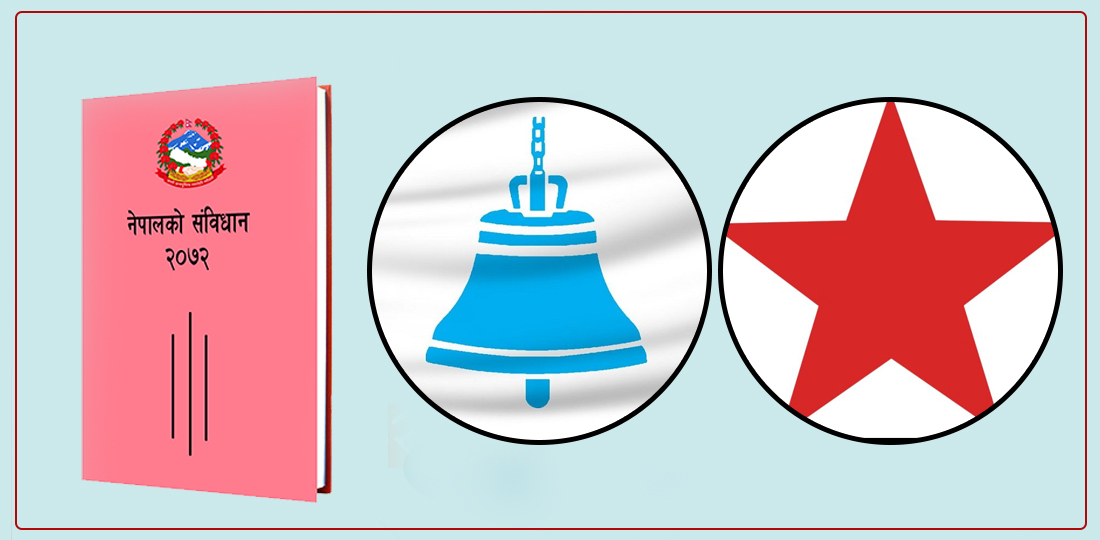
Ignoring the Maoist dissent, the Constitution of the Federal Democratic Republic was promulgated on Ashoj 3, 2072 BS.
The RSP, formed three years ago, won nearly two-thirds, or 182 seats, in the recently concluded elections with the same issues. In the elections held on Falgun 21, while leaders from older parties like the Nepali Congress and CPN-UML were defeated, former Prime Minister and CPN (Maoist Centre) Chairman Pushpa Kamal Dahal 'Prachanda' was successfully elected. Although he is not established as a decisive force in parliament, he can pressure the government to implement the issues he raised in the past. However, the governance structure is not clearly written in the commitment paper published by Prachanda's party, CPN (Maoist Centre).
It cautiously mentions a fundamental change in the governance structure to ensure checks and balances. The commitment paper states on page 8: 'To bring about a fundamental change in the governance structure, to change the governance structure in a way that ensures checks and balances.'

There is significant interest in whether the CPN (Maoist Centre) will support the RSP in amending the constitution to implement the agenda it had previously shelved. The CPN (Maoist Centre) entered the elections after uniting with the CPN (Unified Socialist) and 25 other leftist components, which were part of the 2062/063 People's Movement.
When they were part of the CPN-UML, leaders of the Unified Socialist had supported the improved parliamentary system. In a situation where they have become historically weak by winning only 17 seats (direct and proportional) in the election, the RSP, which is in power, has not given any public reaction to the proposal put forward by the RSP.
Regarding this, CPN (Maoist Centre) leader Dev Gurung stated that consensus from both the Federal Parliament and the provinces is necessary on the issue of constitutional amendment. He believes that amending the constitution based on the strength of numbers will only create further conflict.
'The issues may be their own, but consensus from all parties is necessary in the process. At least, amendments must be made after achieving national consensus among the constitution-supporting parties,' Gurung told Ratopati. 'A two-thirds majority in the Federal Parliament and, in some matters, consensus from the provinces are required for constitutional amendment. Amending the constitution based on the strength of numbers will only create more conflict.'
Gurung clarified that although the Maoist party clearly raised issues regarding governance structure, electoral system, and state restructuring for political stability in the past, consensus with the constitution-drafting parties was necessary to ratify them. He stated that all nationalist forces must unite when the country's geographical integrity, nationality, and system are under threat.
From 2072 BS to 2082 BS, the debate on reforming the governance structure, electoral system, and provincial structure for political stability was strongly raised. Concluding that no single party could secure a majority under the current system mentioned in the constitution, the two largest parties of the previous parliament, Nepali Congress and CPN-UML, reached a 7-point agreement on Asar 17, 2081 BS. However, before that agreement could enter the implementation phase, the Janta Andolan (People's Movement) in Bhadra led to the fall of the K.P. Oli-led coalition government.
After the government was formed under the leadership of RSP Senior Leader Balen Shah on Chaitra 13, the debate on constitutional amendment is expected to begin. RSP Co-General Secretary Bipin Kumar Acharya stated that the process for constitutional amendment would move forward as per the commitment made in the manifesto at the specified time.
'Whatever commitments we have made in the manifesto must be followed verbatim. Promises made to the general electorate must be fulfilled. The process for constitutional amendment will proceed accordingly,' he said.
A working group was formed before the elections under the convenorship of Santosh Pariyar to provide suggestions on constitutional amendment. After Pariyar left the party, Secretariat Member Sobita Gautam was given the responsibility.
This specific news has been automatically translated by AI. As a result, there may be some inaccuracies or language errors.