Report on 'Jenji' Protests Recommends Jail Time for Former PM Oli, Others; Government Keeps Findings Secret


Kathmandu. ‘Janastha’ has reported that it has obtained the report submitted nearly three weeks ago by the high-level investigation commission led by former Justice Gauribahadur Karki, which was formed to investigate the Jenji protests held on Bhadra 23 and 24, even though the government has kept the report confidential.
Janastha.com has also published some excerpts from the report today.
The commission submitted two reports, totaling 907 pages, to then-Chief Justice Sushila Karki on Falgun 24 after completing its study. The cabinet meeting chaired by Karki, who became Chief Justice on the strength of the Jenji movement, formed a three-member commission under former Justice Gauribahadur Karki on Ashoj 5.
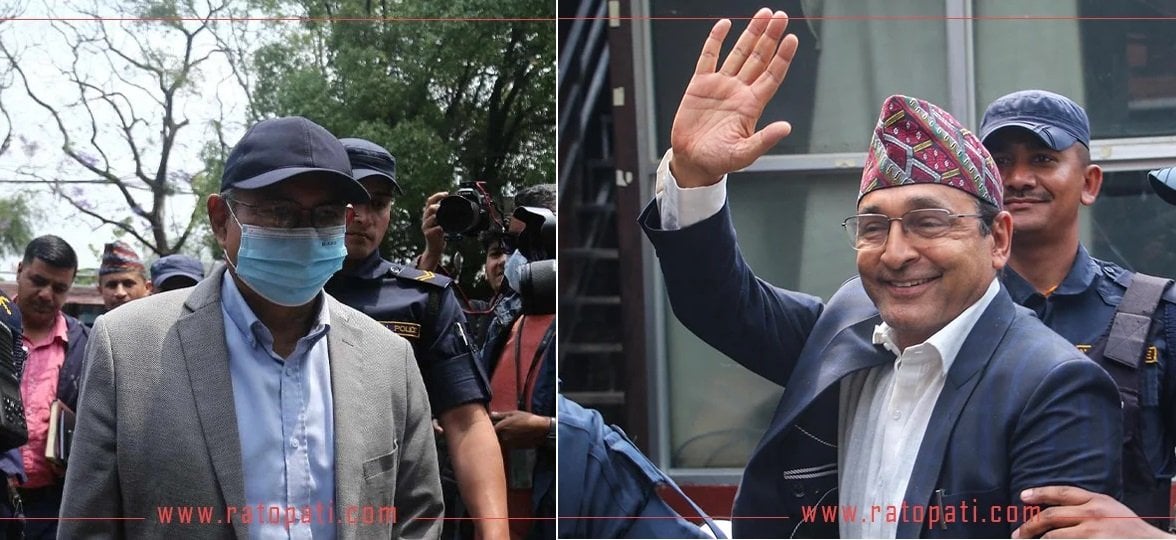
According to Janastha.com, the commission recommended that the government sentence then-Prime Minister KP Sharma Oli, Home Minister Ramesh Lekhak, and Inspector General of Police Chandrakuber Khapung to three to ten years in prison. Furthermore, it recommended action under Section 182 of the Muluki Criminal Procedure Code, 2074, against then-Home Secretary Gokarmani Dwadi, IGP of the Armed Police Force, Nepal Raju Aryal, then-Director of the National Investigation Department Hutraj Thapa, and Kathmandu CDO Chabilal Rijal.
According to Janastha.com, the report by the commission led by Gauribahadur Karki mentions that Prime Minister Oli was informed about the security situation on Bhadra 23 but disregarded it.
‘In the system of governance adopted by Nepal, the Prime Minister is the pivot of this system and the executive head,’ the Janastha.com online portal published excerpts from the commission's report, ‘The cabinet and bureaucracy are organs that support him. The responsibility for taking credit for good work done in the country and taking blame for bad work also falls to the Prime Minister.’
Stating that as the Prime Minister of the Government of Nepal, the Prime Minister is responsible for the work of the bodies under him, the report indicated negligence in security at a time when the National Investigation Department, for the first time during then-Prime Minister KP Sharma Oli's tenure, was placed under the direct supervision of the Prime Minister and the Office of the Council of Ministers, rather than the Home Ministry.
The report also stated that the information collected by the National Investigation Department and the Cyber Bureau was incorrect. ‘The security arrangements for Bhadra 23 were prepared based on information gathered by the National Investigation Department from various sources, according to which the estimated participation was around 3 to 5 thousand people, which proved wrong,’ the report stated, ‘It is seen that the Prime Minister and the Council of Ministers' Office did not take concrete steps to make an important body like the National Investigation Department strong and capable.’
Furthermore, the report stated that at the National Security Council meeting on the evening of Bhadra 23, instead of making a concrete plan for investigation into the reality of the incident and planning effective mobilization of security agencies with a real assessment of potential security risks from the following day, Bhadra 24, following the gruesome incident in the afternoon, only a casual and verbal decision was made without any written decision, suggesting the incident was taken lightly.
‘The government did not study the potential impact of imposing a ban on 26 social media platforms,’ the report mentioned that the ban on those social media platforms was lifted by the Communications Minister with a verbal order without any formal decision.
The report indicated that although the government could have imposed a state of emergency and mobilized the army after the Bhadra 23 incident, it did not do so. ‘Not only that, even in the National Security Council meeting held on the evening of Bhadra 23, there was an option to impose a state of emergency on Bhadra 24 and mobilize the Nepali Army to maintain peace and security. No concrete decision was taken on that matter. Nor did the Council take any other concrete decision regarding the potential consequences on Bhadra 24,’ the report stated. Consequently, it concluded that not only on Bhadra 23 but also on Bhadra 24, an unprecedented incident occurred in the country, leading to loss of life and property.
The report mentioned that clashes between protesters and security forces began shortly before the curfew was imposed by the Chief District Officer of Kathmandu at 12:30 PM in front of the Federal Parliament Building on Bhadra 23, and the confrontation lasted for about four hours.
‘Reporting of this matter was done through government mechanisms to high-level government bodies and even the Prime Minister. The then Home Minister mentioned in his statement that the Prime Minister was informed about the incident of that day,’ the report stated, ‘That news was also widely circulated on social media.’
The commission's report stated that in view of the deteriorating situation, the person in the responsible position of Prime Minister failed to resolve it or coordinate among security agencies to minimize risk and effectively deploy security personnel, and it was seen that the Prime Minister did not take necessary initiatives in time despite being aware of the security situation.
According to Janastha.com, the report also raised serious questions about the role of the Nepali Army. The commission concluded that the army's role in the Jenji protests was suspicious. The commission pointed out that the army failed to protect the central administrative center Singha Durbar, the Supreme Court, and other government and historical structures. The report also mentioned the discussions among protesters on Discord about jail vandalism and setting fires, claiming that instructions on where, how, and with what substance to set fires were learned from Discord.
‘The Nepali Army was stationed at Singha Durbar and Shital Niwas. Protecting them is the duty of the army, but it was not seen to be implemented,’ the report stated, ‘The military commanders stationed at Narsingh Dal in Singha Durbar, the Presidential Palace Shital Niwas, the Federal Parliament Building complex in Baneshwor, and the Prime Minister's residence in Baluwatar were not seen to have fulfilled their duties.’
Furthermore, the report mentioned that the police administration in Kathmandu and other districts complained to the commission that when the law and order situation went beyond police control on Bhadra 23 and 24, the Chief District Officers sought assistance from the Nepali Army as per the decision of the District Security Committee under the Local Administration Act, 2028, but did not receive cooperation.
‘If the Nepali Army had mobilized in front of the protesters with weapons when requested, the presence of the army would have created fear among many protesters and could have prevented further damage,’ Janastha.com quoted pages 667 and 668 of the report, which the government kept secret.
When the government spokesperson and Home Minister Om Prakash Aryal was repeatedly contacted to inquire about the authenticity of the report allegedly obtained by Janastha.com, he did not answer his phone.
This specific news has been automatically translated by AI. As a result, there may be some inaccuracies or language errors.