Nepal's EV Surge: Rapid Adoption Puts Nation Second Globally in New Car Sales, But Fuel Crisis Looms for Public Transport

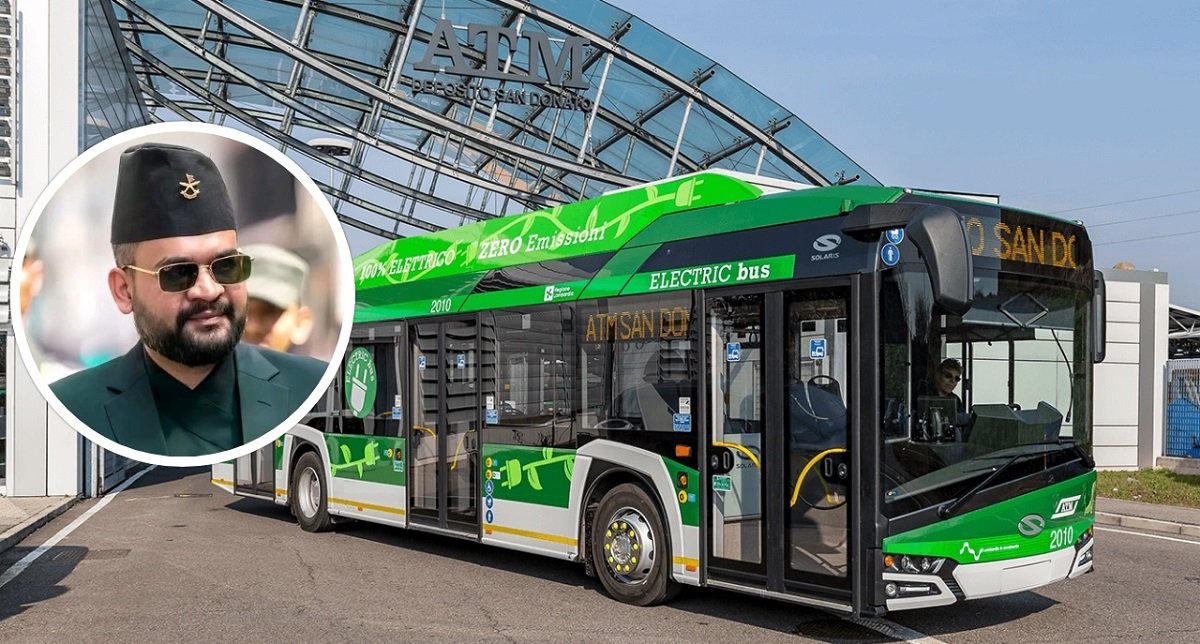
Kathmandu. Preparations are underway to form a new government in the country according to the mandate of the elections. The Rastriya Swatantra Party, which won nearly two-thirds of the seats, is engaged in groundwork for government formation. Amidst this, rising tensions in West Asia are signaling a petroleum product crisis in Nepal, which is expected to impact multifaceted sectors of the national economy.
If problems arise in the supply of petroleum products, the direct impact will be felt in the transportation sector. While the demand for private electric vehicles (EVs) has been increasing in Nepal recently, long-haul public transport and freight vehicles still rely on petroleum products.
Over 40,000 electric vehicles have been imported into Nepal so far. According to the Department of Customs, 31,386 electric vehicles were imported by the end of the last fiscal year 2081/82. Both the import and use of electric vehicles have been increasing over the last six years. The initial phase of electric vehicles in Nepal saw negligible imports in the fiscal year 2076/77, when only vehicles with capacities between 100 to 150 kW were imported.
However, recently, there has been a significant leap in the use of electric vehicles in private transport, excluding public and freight vehicles. Electric cars, once seen only sporadically, are now visible in significant numbers plying city roads and highways.
Currently, over 35,000 units of four-wheeled and two-wheeled electric vehicles are operating across the country. It is estimated that these vehicles save more than 35,000 liters of petroleum products daily.
Surendra Upreti, President of the Nepal Automobile Dealers Association (NADA), states that the West Asian conflict will affect the entire transportation sector, as well as the automobile sector.
'There is no shortage of diesel and petrol in the market yet, so there is no need to panic,' said President Upreti, 'but if the conflict prolongs, it could take a serious turn. Therefore, it is necessary to further encourage the government's policy of promoting electric vehicles and the growing attraction towards EVs.'
Share of Electric Vehicles on Roads
With the rapid increase in the use of electric vehicles, EVs now constitute more than 70 percent of new four-wheeled vehicle sales. In 2019, they accounted for only about 8 percent of new vehicle sales. By 2025, this share is projected to exceed 70 percent.
Due to the large number of old petroleum-fueled vehicles, their share in the total vehicle count is estimated to be only around one percent. The main reasons for the increased use of electric vehicles are the tax concessions provided by the government, rising petroleum prices, expansion of electric charging stations, and environmental awareness.
Compared to the total number of vehicles operating on Nepal's roads, the share of electric vehicles is still low. According to the Department of Transport Management data, approximately 5.85 million vehicles were registered in Nepal up to the fiscal year 2081/82. Of these, about 4.7 million are motorcycles and about 366,000 are four-wheelers (cars, jeeps, taxis). Approximately 376,000 new vehicles are added every year.
According to NADA President Upreti, the use of electric cars is increasing among private vehicles. Currently, electric vehicles hold about 76 percent of the share in private transport. However, the presence of electric vehicles in mass transportation (public buses) and freight vehicles (trucks, etc.) is negligible.
'When we talk about transportation, we must look at public transport and freight vehicles, where EV usage is negligible. Even among two-wheelers, 90 to 95 percent still run on petrol,' Upreti says, 'This makes the complete transformation of the entire transport sector to EVs very challenging.'
Due to the large number of old petroleum-fueled vehicles, their share in the total vehicle count is estimated to be only around one percent. The main reasons for the increased use of electric vehicles are the tax concessions provided by the government, rising petroleum prices, expansion of electric charging stations, and environmental awareness.
Nepal Ranks Second Globally
In 2019, the share of EVs in new car sales in Nepal was only 8 percent. But now, according to data from the International Energy Agency and Ember, the share of EVs in new cars sold in Nepal is projected to reach 73 percent by 2025.
Nepal has jumped to the second position globally in terms of the high share of EVs, following Norway (97 percent). This leap, surpassing European countries like Finland and Denmark, has become an example for the world.
Fuel Savings and Electricity Authority Revenue
Nepal's economy is constantly burdened by its dependence on petroleum products. According to Nepal Oil Corporation data, Nepalis currently spend NPR 533.5 million daily on petrol and cooking gas alone. NPR 70 million is spent daily on diesel, NPR 322 million on petrol, and NPR 213.5 million on gas, all going abroad.
Even calculating at NPR 172 per liter, it is estimated that a car or jeep owner can save approximately NPR 175,000 annually by switching to an electric vehicle. Similarly, a two-wheeler (scooter/bike) user can save more than NPR 56,000 per year.
However, the entry of electric vehicles is expected to curb this dire expenditure. So far, 46,382 units of various types of electric vehicles (two-wheelers, three-wheelers, and four-wheelers) have entered Nepal. These vehicles have reduced fuel consumption by 35.7 million liters annually. This has prevented approximately NPR 6.24 billion from going abroad annually.
The revenue of the Nepal Electricity Authority (NEA) has increased as electricity produced domestically is consumed. As electric vehicles consume more than 26.3 million units of electricity annually, the NEA has collected revenue of about NPR 314.9 million in tariffs. On a daily basis, EVs consume 73,131 units of electricity, generating approximately NPR 1.1 million in revenue for the government daily.
There is a vast difference between the operating costs of fuel-run vehicles and electric vehicles. On average, a petrol car driven 8,000 kilometers annually consumes 728 liters of petrol.
Even calculating at NPR 172 per liter, it is estimated that a car or jeep owner can save approximately NPR 175,000 annually by switching to an electric vehicle. Similarly, a two-wheeler (scooter/bike) user can save more than NPR 56,000 per year.
Comparison of Annual Vehicle Operating Costs

Import Trend: Need for Policy Stability
The increase in electric vehicle imports was not sudden. While only 1 EV was imported in the fiscal year 2076/77, this graph has been rising sharply in subsequent years.
Trend of Four-Wheeler Electric Vehicle Imports in Nepal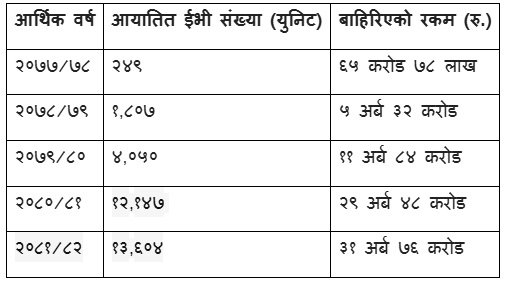
However, in the first 8 months of the current fiscal year (Shrawan–Falgun), the import of electric vehicles has decreased. According to customs data, while overall car imports have increased, EV imports have dropped by 9.74 percent. Petrol car imports have increased by 53.45 percent. Businesspeople attribute the decline to rumors of increased taxes before the budget and fear of policy instability.
Challenges Remain in Cargo Vehicles
Although the use of EV cars and scooters has increased in Nepal, cargo trucks, which account for the largest consumption of diesel, are still dependent on fuel. According to the Nepal Truck Transport Entrepreneurs Association, 70,000 large Nepali trucks and an additional 35,000 Indian trucks transport goods in Nepal.
The challenge for the new government being formed under the leadership of Balen Shah (Balen) is to maintain the positive momentum of electric vehicles while also having an opportunity to expand it further. For this, President Upreti states that the government needs to bring stability in policy and taxation.
According to him, frequent changes in customs duty and excise duty on EV imports have created mistrust among both consumers and businesses. He emphasizes the need for a stable and concessional tax policy on EVs for at least the next five years.
The government needs to expand charging infrastructure across the country. The campaign to build charging stations initiated by the Nepal Electricity Authority must be made nationwide in collaboration with the private sector.
The priority now should be on electrifying public buses and freight trucks rather than private cars. For this, special subsidies and concessional loan arrangements should be made for public EVs.
Businesspeople state that electric vehicles are not a fashion or luxury in Nepal. They believe it is the most reliable basis for reducing the trade deficit, increasing energy self-sufficiency, and creating a clean environment.
This specific news has been automatically translated by AI. As a result, there may be some inaccuracies or language errors.