Nepali Congress Faces Internal Contest for Parliamentary Party Leader Post After Election Results

Kathmandu. Following the Election Commission's complete announcement of the results for the House of Representatives elections held on Falgun 21, discussions have begun within the Nepali Congress regarding who will become the leader of the parliamentary party.
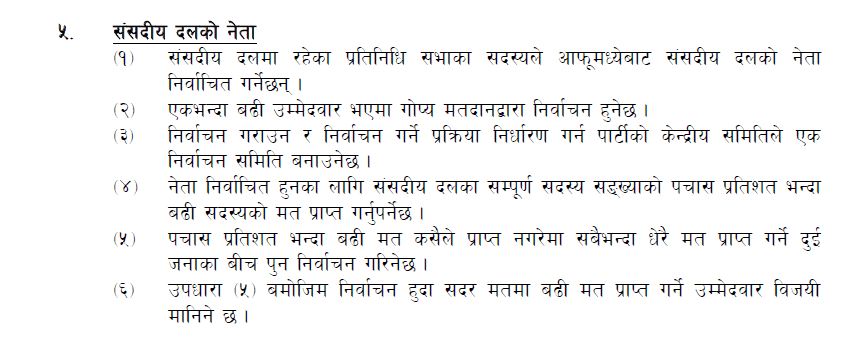
The 'Nepali Congress Parliamentary Party Statute (Amended and Revised, 2074)' contains provisions concerning the selection of the 'Parliamentary Party Leader' in Article 5. Sub-sections (1) and (2) of this article appear crucial for the selection of the party leader.
Sub-section (1) states, 'Members of the House of Representatives in the parliamentary party shall elect the parliamentary party leader from among themselves.' Sub-section (2) states, 'If there is more than one candidate, the election shall be held through a secret ballot.'
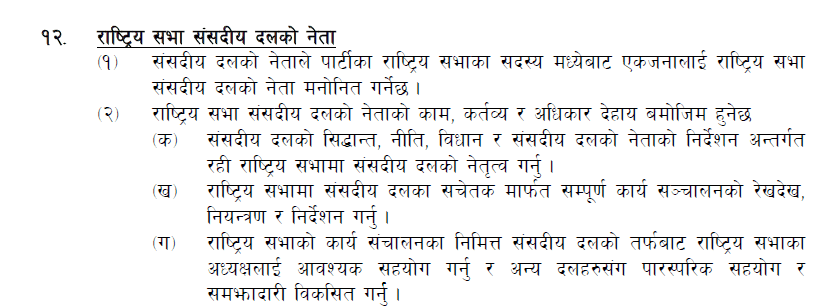
The Congress party statute stipulates that the leader of the National Assembly party shall be nominated by the leader of the House of Representatives party. Article 12, Sub-section (1) of the party statute states, 'The parliamentary party leader shall nominate one person from among the party's National Assembly members as the leader of the National Assembly parliamentary party.'
Since the 2064 elections, the Congress party leader has not been unanimous. Currently, factionalism within the Congress has reached a climax between supporters of the regular general convention and supporters of the special general convention. The 14th General Convention held in 2078 resulted in Sher Bahadur Deuba being elected as President. Amidst disagreements from Dr. Shekhar Koirala's faction, who was the closest rival for the presidency at that time, a special general convention was held in Kathmandu from Poush 27 to 30 under the leadership of the two General Secretaries from that convention, Gagan Thapa and Bishwaprakash Sharma. That special general convention formed a new working committee with Thapa as President and Sharma as Vice-President. No leaders from the Deuba or Koirala factions were included in that working committee.
The signatures of two leaders appear on the ticket distribution as presidents. Deuba signed as president on the closed list for the proportional representation system, while Thapa, who became president from the special general convention, signed the tickets for the first-past-the-post system. Consequently, there are members of parliament who were elected with candidates bearing the signatures of two leaders in the party (House of Representatives). Therefore, an election for the party leader is almost certain.
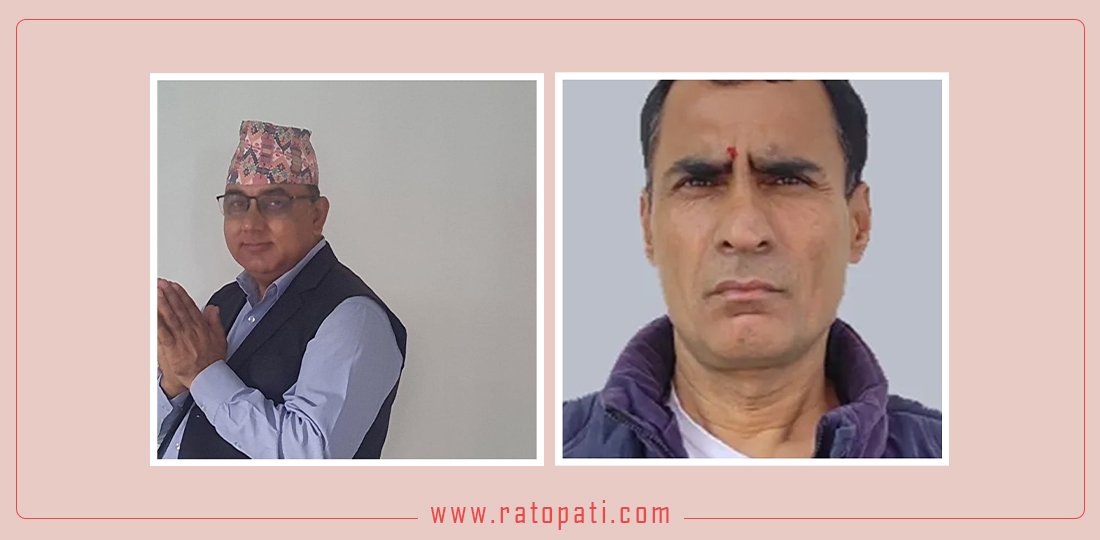
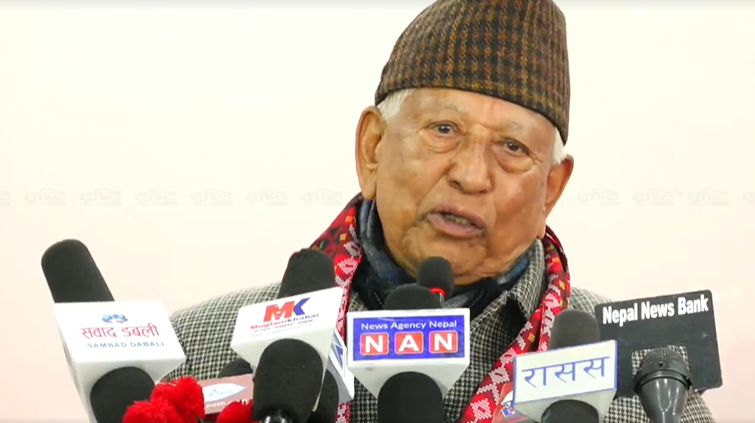
Looking at the aspirants for the party leader position now, leaders who participated in the special general convention and those who did not are staking their claims. According to Congress leaders, Bharat Bahadur Khadka, Janakraj Giri, Mohan Acharya, and Narendra Kerung, who won in the first-past-the-post system, are aspiring to be the party leader. Arjun Narsingh KC and Bhimraj Angdembe from the proportional representation category have presented their candidacies. KC, while going to attend the Central Working Committee meeting on Friday, told journalists that he would claim the party leadership.
In a situation where more than one person claims the leadership, the selection must be made through an electoral process, and securing more than 50 percent of the votes is necessary to be elected, making factional competition certain. In such a scenario, KC and Bhimraj Angdembe appear as potential candidates. Both leaders are former General Secretaries.
Leaders suggest that KC will be seen as the candidate of the current establishment faction, and Angdembe as the candidate of the Deuba-Koirala faction.
KC, elected through proportional representation, is the most experienced parliamentarian in the Congress. He has been a parliamentarian and minister since the Panchayat system. KC is also the leader who has contested the most elections in contemporary politics.
Angdembe was elected in the second Constituent Assembly election of 2070. He was elected as a General Secretary from the Deuba panel in the 14th General Convention.
The writ filed by Deuba and Koirala regarding the legitimacy of the special general convention is still under consideration by the Supreme Court. Therefore, leaders indicate that an informal agreement has been reached between the former Acting President Purna Bahadur Khadka and leader Dr. Koirala regarding moving forward together in the selection of the party leader as well. Both sides reportedly agree to nominate Angdembe as their candidate for the parliamentary party leader.
Deuba faction leader Min Bishwakarma stated that the party leader would not be unanimous and informed that they would present their claim. 'The party leader has not been unanimous in Congress after the recent elections. The dispute over legitimacy is ongoing within the party, so it won't be unanimous,' Bishwakarma told Ratopati. 'Our (Deuba-Dr. Koirala faction) meeting was held today (Sunday). The consensus is to move forward together. Acting President and leader Dr. Shekhar Koirala have been continuously discussing the matter of moving forward unitedly.'
Spokesperson Devraj Chalise informed that discussions on the party leader and other issues would take place only after the Central Committee meeting concludes. 'The party leader will be selected through a procedural process according to the party statute. We are preparing to start the process after the Central Committee meeting concludes,' he told Ratopati. 'So far, there has been no discussion on who to put forward or what to do.'
A leader from Dr. Koirala's faction stated that since they are numerically smaller and have moved forward unitedly in the Supreme Court regarding the legitimacy issue, they will also move forward unitedly with the Deuba faction in the parliamentary party. 'We will move forward unitedly with the Deuba faction now. There is a dispute over legitimacy in the party. We have gone to court united with the Deuba faction. We will move forward unitedly on the party leader as well,' the leader told Ratopati.
Congress has 38 parliamentarians in the House of Representatives, with 18 from the first-past-the-post system and 20 from the proportional representation system. Although the establishment faction has more MPs from the first-past-the-post system, the Deuba-Koirala faction has more MPs from the proportional representation system.
Counting all MPs from both direct and proportional representation, the establishment faction has 16 MPs, while the Koirala-Deuba faction (Deuba 15 and Koirala 7) has 22 MPs.
The establishment faction has 12 MPs elected directly and 4 MPs who came through the proportional representation system. The establishment faction members are Nishkal Rai, who won from Ilam-1; Md. Firdos Alam, who won from Rautahat-2; Abhishek Pratap Shah, who won from Kapilvastu-3; Prakash Singh Karki, who won from Solukhumbu; Basana Thapa, who won from Dailekh-1; Santosh Subba, who won from Tehrathum; Bharat Kumar Swar, who won from Achham-1; Mohan Acharya, who won from Rasuwa; Bharat Bahadur Khadka, who won from Doti; Narendra Kumar Kerung, who won from Panchthar; Janakraj Giri, who won from Bajura; and Khadga Shahi, who won from Mugu.
Furthermore, those elected from the establishment faction through the proportional representation system are Arjun Narsingh KC, Renuka Kaucha, Kalibahadur Sahakari, and Manmaya BK. Deuba signed as president when the closed list was sent to the Election Commission for proportional representation. However, tickets for direct candidacy were distributed with Gagan Thapa's signature.
Five members from the Deuba faction have won in the first-past-the-post category. After not participating in the special general convention, Thapa had given some seats to the Deuba and Koirala factions for direct candidacy. Among those tickets given to the Deuba faction, five candidates have won the election. Those winning directly from the Deuba faction are Bishnu Bahadur Khadka from Surkhet-1, Sandeep Rana from Palpa-1, Jayapati Rokaya from Humla, Tek Bahadur Gurung from Manang, and Khadga Bahadur Buda from Jajarkot.
The Deuba faction has ten parliamentarians elected through the proportional representation system. They include Madan Krishna Shrestha, Dr. Gangalakshmi Awal, Gita Gurung, Sushila Dhakal Acharya, Sita Thapaliya, Harina Devi Kami, Pabitra BK, Ninuk Kumari Karna, and Shahjahan Khatun.
The Koirala faction has succeeded in electing one member directly and six through proportional representation, totaling seven MPs. Yogesh Gauchan Thakali won the election directly from Mustang. Those elected through proportional representation are Gitakumari Sendang, Rukminidevi Koirala, Rina KC (Uprety), Dr. Pramila Kumari Gachhadar, Dr. Chandramohan Yadav, and Rekha Kumari Yadav.
- Deuba Faction Holds Absolute Majority Alone in the National Assembly, Establishment Has Only 2 Members
Congress has become the largest party in the National Assembly with 24 members. The Deuba faction alone holds a majority there. The Deuba faction has 16 members in the National Assembly. The Dr. Koirala faction has 6 members, and the establishment faction has two members.
The establishment faction members in the National Assembly are only Kamala Pant and Padam Pariyar. Pant's husband, Madhu Acharya, is one of the organizers of the special general convention.
Members from the Koirala faction include Bishnu Devi Pudasaini, Bishnu Kumari Sapkotta, Narayan Dutt Mishra, Ranjit Karna, Basudev Jangali, and Gita Devkota.
Members from the Deuba faction include Anand Prasad Dhungana, Kiran Babu Shrestha, Krishna Prasad Poudel, Krishna Prasad Sitaula, Krishna Bahadur Rokaya, Gopal Kumar Basnet, Jittjang Basnet, Durga Kumari Gurung, Narayan Dutt Bhatt, Yuvaraj Sharma, Sunil Bahadur Thapa, Lalitjang Shahi, Dharmendra Paswan, Jagat Timilsina, Chandra Bahadur KC, Basudev Jangali, and Khammabhadur Khati.
This specific news has been automatically translated by AI. As a result, there may be some inaccuracies or language errors.