Private Schools in Nepal Begin Admissions for New Academic Year Against Regulations

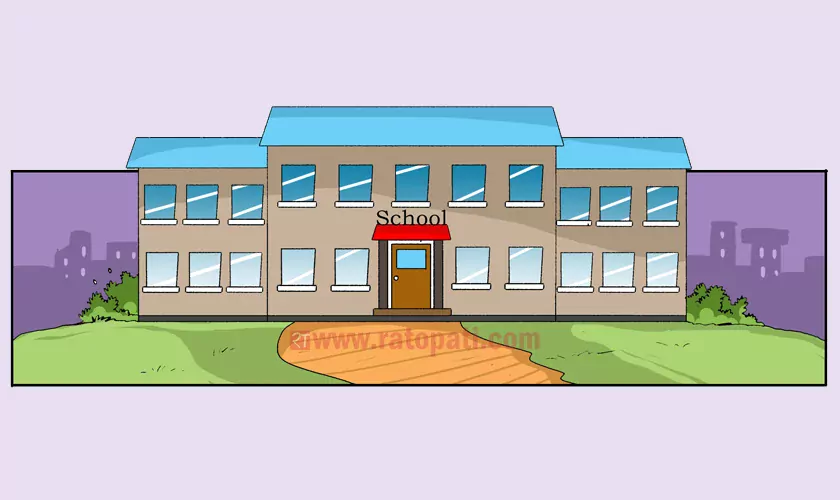
"Admissions are open for limited seats; you can collect the forms from the school." Such notices and advertisements are visible on the websites and notice boards of private schools these days. Most private schools in the Kathmandu Valley and various other regions have started the admission process for the new academic session, 2083, even before the annual examinations are complete, violating the Education Regulations.
The practice of starting admissions against the rules has been happening in previous years as well. Although the federal and local governments have urged adherence to the regulations by opening admissions only in Baisakh (mid-April to mid-May), private (institutional) schools have been continuously violating this.
For instance, Galaxy Public School in Gyaneshwor, Kathmandu, and Little Angels School in Hattiban, Lalitpur, have issued notices stating that the admission process for classes one through eight will commence throughout the month of Chaitra (mid-March to mid-April). Rosebud School in Buddhanagar, Kathmandu, has distributed admission forms for classes 1 to 6. Mount Everest School in Bhaktapur has also displayed a notice that admissions are open.
Such examples are numerous. Most private schools have internally set a schedule to complete the process of filling out forms and conducting entrance exams for new students by the third week of Chaitra.
Clause 78 (Ga) of the Education Regulations (Tenth Amendment), 2077, stipulates that the admission process must only begin after receiving the annual examination mark sheet and transfer certificate. The Kathmandu Metropolitan City School Education Management Regulations, 2074, also clarifies matters such as student admission, fees, and annual examinations in accordance with federal laws and regulations.
Shivakumar Sapkota, spokesperson for the Ministry of Education, Science and Technology, stated that since the operation and management of the school level fall under the jurisdiction of the local level, the central government will take interest if any complications arise in adhering to the laws and regulations.
Namraj Dhakal, Chief of the Education Department at the Kathmandu Metropolitan City (KMC), stated that legally, the time set for admissions for the new academic session is Baisakh, and formal admission of students before that is not permissible. "The rule does not allow taking admissions before the annual examination and publication of results. Examinations and result publication happen throughout Chaitra. Admissions start after that," he said.
Chief Dhakal mentioned that there seems to be an understanding between both private schools and parents to conduct the admission process informally, even if it is not formally permissible. He informed that action would be taken after monitoring if any formal complaint regarding admissions against the rules is received.
Currently, 674 institutional (private) and 87 community (government) schools are operating in KMC. The metropolis stated that since the city-level examination for basic education (Grade 8) has started, they cannot monitor all schools regarding admissions.
The Grade 8 basic education examination for the academic session 2082 for students studying in community and institutional schools under the metropolis began today in 57 designated schools and will continue until Chaitra 12.
R.B. Katuwal, General Secretary of the National Private and Boarding Schools' Organization (PABSON), stated that while the possibility of some schools conducting such activities internally cannot be ruled out, they have not yet received any formal or verified information about it.
"PABSON's clear stance, as always, is that the new admission process should only begin after the academic session formally concludes and the final results are published. The necessary programs and schedules are also set accordingly," General Secretary Katuwal said. "This reflects our commitment to fully incorporate and respect the Education Regulations and the directives issued by the local levels."
Gita Rana Chhetri, Chairperson of the National Private and Boarding Schools' Association (National PABSON), informed that although the admission process has started, full enrollment will only happen after the annual exams are over and mark sheets are issued. She mentioned that the admission process in community schools continues throughout Baisakh, and classes have been starting from the first week of Baisakh according to the wishes of private school students and parents.
The association had drawn the attention of the metropolis to the difficulty in managing the academic session if the new academic session begins every Baisakh and concludes in Chaitra, as per the existing arrangement, making it difficult to complete regular teaching and curriculum.
National PABSON's demand is for facilitation to start the admission process before Baisakh, as the municipality's notice to only admit students after the new academic session begins causes inconvenience in academic session management.
Subhaprabhat Bhandari, Chairman of the Nepal Parents' Federation, stated that the situation where admissions happen on different dates for community and private schools has not ended, emphasizing the need for effective policies and monitoring by the central and local governments for uniformity.
"Admissions in private schools have already started in Chaitra. The admission campaign in government schools starts from Baisakh 2. Since the academic session is set to start from Baisakh, it should be followed. We hope that the upcoming government will bring a clear policy on whether to leave it open according to the municipality or the type of school, or what to do," he said.
Damodar Dhungana, Principal of Rosebud School, stated that while the admission process used to open from Falgun in the past, it has now started from Chaitra in coordination with the local level, clarifying that they adhere to the laws, regulations, and government directives. According to the Ministry of Education, Science and Technology, there are currently 26,606 community, 7,886 institutional, and 1,384 religious schools operating across the country.
This specific news has been automatically translated by AI. As a result, there may be some inaccuracies or language errors.
-(2)_QJLjKxR87n.jpg)
_xzOO6ppgRG.jpg)