Nepal's Paddy Plantation Pace Slower Than Last Year

_xzOO6ppgRG.jpg)
Kathmandu. This year, the pace of paddy plantation in Nepal appears to be slower compared to last year. According to statistics released today by the Department of Agriculture under the Ministry of Agriculture, Forests and Environment, the delayed monsoon activity has affected plantation across the country.
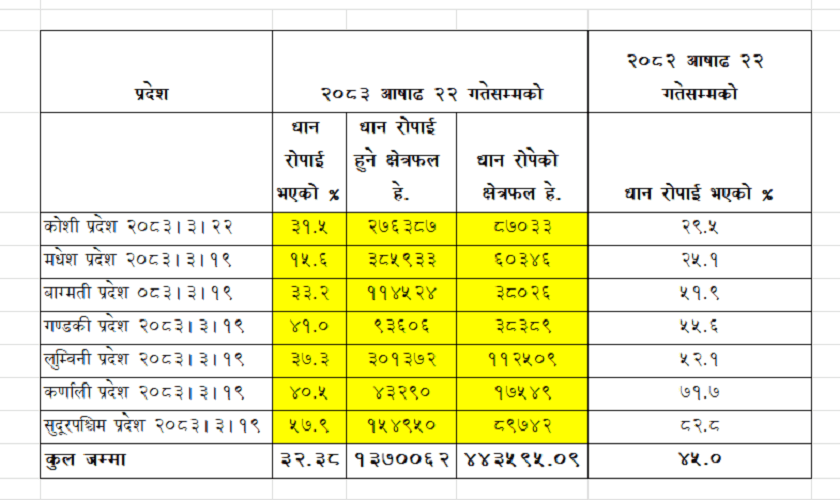
According to the department, only about 32.38 percent of the total cultivable land for paddy nationwide has been planted so far. Compared to 45.0 percent of land planted by Asar 22 in 2082 BS last year, the progress by the same period this year is about 12.5 percent lower.
Currently, out of Nepal's total 1,370,062 hectares of paddy cultivable land, only 443,595.09 hectares have been planted.
Paddy Plantation Decreased in All Provinces Except Koshi
According to provincial data, the percentage of plantation has decreased in all provinces compared to last year, except for Koshi Province. As of Monday's data in Koshi Province, out of a total of 276,387 hectares, 87,033 hectares, or 31.5 percent, have been planted. This is a slight increase from 29.5 percent during the same period last year.
The Madhesh Province, which has the largest area for paddy cultivation, has seen a very slow rate of plantation. In Madhesh Province, with 385,933 hectares of land, only 60,346 hectares, or 15.6 percent, have been planted as of the data from Asar 19, whereas 25.1 percent of plantation had been completed by this time last year.
Similarly, the rate of plantation in Bagmati and Gandaki provinces also appears weaker compared to last year. In Bagmati Province, out of a total of 114,524 hectares, only 38,026 hectares, or 33.2 percent, have been planted.
This was 51.9 percent last year. In Gandaki Province, out of a total of 93,606 hectares, 38,389 hectares, or 41 percent, have been planted. Last year, 55.6 percent of plantation had been completed by this time in Gandaki. In Lumbini Province, 37.3 percent (112,509 hectares) of the total 301,372 hectares have been planted. Last year, 52.1 percent of plantation was completed here.
A decline in the pace of plantation is also observed in Karnali and Sudurpashchim provinces. In Karnali Province, out of a total of 43,290 hectares, only 17,549 hectares, or 40.5 percent, have been planted as of Asar 19, which is significantly less compared to last year's 71.7 percent. Despite having the highest percentage of plantation, Sudurpashchim Province has also seen a slowdown this year compared to last year. Out of Sudurpashchim's total 154,950 hectares, 89,742 hectares, or 57.9 percent, have been planted so far. Last year, 82.8 percent of plantation had been completed by the same period.
According to the department, the delayed monsoon activity in the central and western regions has prevented timely plantation. The department estimates that the overall national average rate of paddy plantation has decreased this year due to changes in monsoon activity and irrigation availability.
This specific news has been automatically translated by AI. As a result, there may be some inaccuracies or language errors.


_E5Ej4ZyTdN.jpg)