Interim PM Sushila Karki Appears Relieved and Engaged in Farewell Diplomacy After Elections


Kathmandu. Interim Prime Minister Sushila Karki's shoulders feel lighter after nearly two weeks. Her main responsibility of conducting the House of Representatives elections has been fulfilled.
Those who meet her say that her face, which appeared somewhat anxious and stressed until before February 21, now shows a kind of glow, and changes are also visible in her expressions.
Prime Minister Karki's tenure is reaching its final stage. She will lead the government as the caretaker Prime Minister until a new government is formed. Once she hands over power to the popularly elected government, she will step down from her executive role.
Prime Minister Karki is currently in a different situation and role, staying away from the power struggle, political maneuvering, and tug-of-war for the chair. She is nearing the moment of 'farewell' after completing her responsibilities and tenure.
Perhaps she naturally feels relieved after skillfully completing the responsibility entrusted to her by the turn of events. That is why she is seen in roles such as visiting the homes of grieving leaders to offer condolences, or calling leaders to Baluwatar to say 'thank you'.
Besides that, Prime Minister Karki did not miss out on a religious journey. Just on Wednesday, she visited Pashupatinath Temple and participated in the Rudrabhishek Puja.
'May our country move forward on the path of progress. May the spirit of unity, harmony, and affection among all Nepalis become even stronger,' Prime Minister Karki shared a message with prayers via the social media platform 'X' after the Rudrabhishek.
In Nepali politics, there is often a tendency to show power while in office and become 'invisible' or display arrogance and conceit upon leaving office. Prime Minister Karki, however, adopted and demonstrated a different style.
In the past few days, she has tried to show goodwill and tolerance by meeting the top leaders of all political parties one by one. Baluwatar has termed this as 'maintaining relations and 'courtesy calls'.' However, in political circles, this is viewed as the Prime Minister's meaningful style and campaign of 'meeting everyone before departing'.
After the elections were held peacefully and results were out, Prime Minister Karki first visited CPN-UML Chairman and then-Prime Minister KP Sharma Oli at his residence in Gundhu, who was mourning the loss of his father. Subsequently, she called Nepali Congress President Gagan Thapa, Vice-President Bishwa Prakash Sharma, and other leaders to Baluwatar, expressing gratitude for the support and cooperation received in conducting the elections peacefully.
After meeting the UML Chairman and Congress President, she called UML leaders Ishwar Pokharel, Pradeep Gyawali, and others to Baluwatar for discussions. She then maintained courtesy by calling leaders including CPN (Maoist Centre) Chairman Pushpa Kamal Dahal 'Prachanda', Co-Chairman Madhav Kumar Nepal, and National Assembly Chairman Narayan Dahal to Baluwatar.

During the meetings with them, Prime Minister Karki thanked them for their cooperation in the elections and other tasks during her tenure.
Some interpret Prime Minister Karki's recent meetings not as any political bargaining, but as an attempt to mend the bitterness that arose while working through past difficult situations.
According to a source in Baluwatar, she often tells leaders during meetings, 'I had to take a firm stand in some places while working; someone might have been displeased, but it was for the country and the system. Now it is your turn; handle this.'
During the meetings, some leaders also inquired about Prime Minister Karki's future plans.
'I am going home, but you all must stay here. The responsibility of running the country is on your shoulders,' the source quoted the Prime Minister's smiling response to those who inquired.
The source also mentioned that she advised political party leaders not to panic, assuring them that everything will fall into place once the system is established.
This dialogue is interpreted by some as the Prime Minister's 'consolation' to the parties. Prime Minister Karki has not only provided reassurance in a parental role to many party leaders exhausted by the game of forming a government and under election pressure, but she has also managed to convey the message that institutional development is more important than needless 'political conflict'.
Generally, any Prime Minister becomes defensive when leaving power. However, Sushila Karki was an exception and appeared different. While she seemed somewhat aggressive towards the old and established political parties in the initial days, in the final moments, she became humble and clear.
She met not only her allies but also opposition leaders with equal respect, urging them to unite on national issues, thereby answering questions raised against nationalism, the constitution, and the system through her actions.
Party leaders are also surprised by the Prime Minister's style. One top leader commented, 'We have always seen only power bargaining, but few Prime Ministers are seen offering consolation and expressing thanks in this manner upon departure.'
Devendra Paudel, a leader of the CPN (Unified Socialist) and former advisor to former Prime Minister Dr. Baburam Bhattarai, states that while this series of courtesy calls by Prime Minister Sushila Karki may not be a new culture in Nepali politics, her working style should be viewed positively.
'We have experience of other Prime Ministers meeting various leaders while leaving Baluwatar, but Prime Minister Sushila Karki, despite leading an election government, has set a good culture,' Paudel said. 'We should all view this positively.'
He mentioned that while many former Prime Ministers left in a mood of stress, different situations arise. 'There is a natural mood when leaving after completing elections. It is different when one has to leave due to other political developments,' Paudel said. 'The situation after the peaceful announcement of election results is different. The current situation is the same.'
By offering 'consolation' to both her companions and competitors while leaving office, Prime Minister Karki has not only enhanced the stature of her personality but has also awakened the hope that human sensibility and courtesy still exist in politics.
About six months ago, when Sushila Karki assumed the office of Prime Minister, there was uncertainty about whether elections would be held, or if the country would return to the constitutional path. There was also uncertainty whether the parties that lost power would trust the election government and participate in the elections or adopt a policy of boycott.
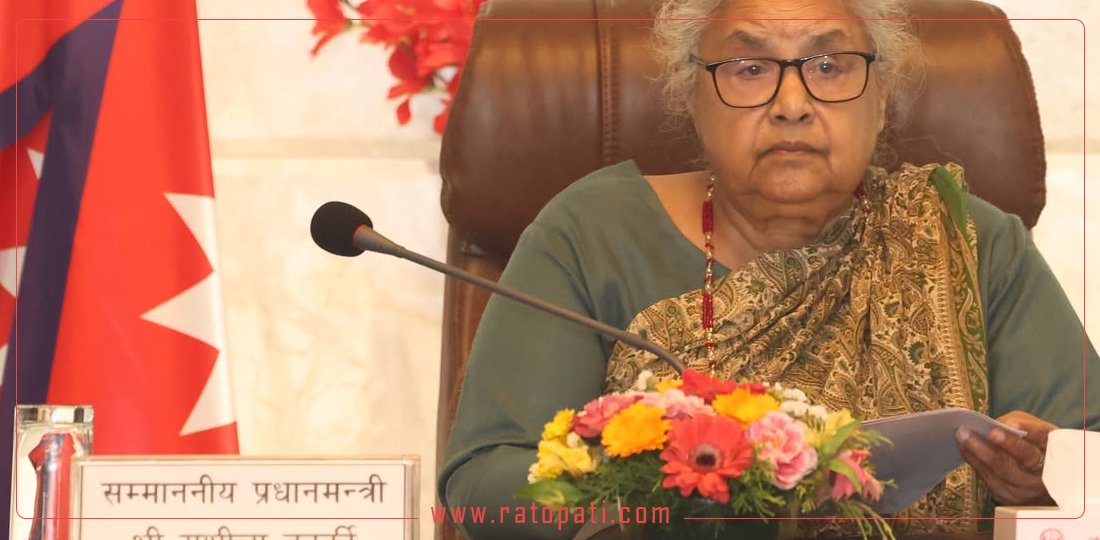
Despite all these uncertainties, Prime Minister Karki not only conducted the elections impartially in a peaceful environment, in a way that no one could point a finger at, but she also met courteously with leaders of old parties defeated in the elections, thanking them for the trust shown in the democratic practice.
She also inspired them to abandon the mentality of defeat and work for the good of the country and the people. That 'consolation' given by the Prime Minister before leaving Baluwatar has not only inspired everyone to keep the interest of the country and the people at the center of politics but has also widened the path leading the country towards political stability.
This specific news has been automatically translated by AI. As a result, there may be some inaccuracies or language errors.