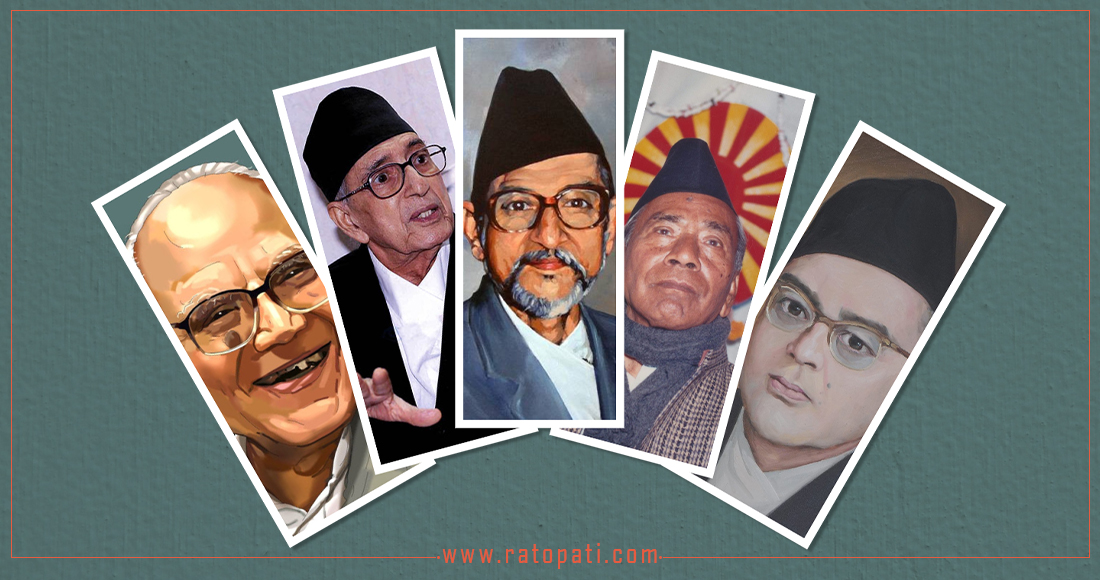
The Collapse and Potential Rebirth of Nepal's Communist Movement


There was a time when leftist ideology was the heartbeat of the Nepali people. When Pushpa Lal laid the foundation of communism in Calcutta, it was not just an ideology; it was a movement for liberation. Since the late 1930s (Bikram Sambat), a deep impression of communism was etched in the minds of millions, including myself, since childhood.
Despite repeated series of misdeeds committed by communist leaders against the communist movement, the proletariat, workers, the oppressed, and the national capitalist class, it seemed that communists were the agents of transformation for this society. From the general elections of 2015 BS to the historic mandate of 2074 BS, the Nepali people repeatedly gave communist parties the opportunity to hold the reins of power. But no matter how well a cat is covered with a fine cloth, it still meows; similarly, despite getting repeated opportunities, the entire force became extremely incompetent, unqualified, arrogant, pretentious, and irresponsible leadership, protecting only a few smugglers, corrupt individuals, and factional cronies. Consequently, even with communist support across the country, the people historically boycotted the leftist movement in the midterm elections of 2082 BS and brought the nascent neoliberal democratic force (whose ideological line is yet to be clarified) to power.
The tarnished, incompetent, and power-hungry cowardly communist leadership, along with their cronies, who have lost their communist consciousness and are continuously looting the nation and the people in the name of communism, are trying to cover up their dark deeds and incompetence under the guise of populism and foreign interference. However, no matter how much drama they stage, the fake character of the so-called experienced communist leaders will certainly be exposed, and the possibility of the communist movement reorganizing under the leadership of honest leaders will emerge. The reason why communists will flourish again in Nepal is that Nepal's diversity, poverty, and the socialist economic development model for social justice are the infallible mantras for promoting social justice in this country.
It should be remembered that the current change was not sudden; it is the result of years of ideological corruption, the downfall of leadership, and the vacuum of revolutionary programs. However, this defeat can be an opportunity for a leftist rebirth rather than the death of leftist ideology. But for that, the revolutionary cadres remaining in the so-called leftist parties must dissect the current leadership and develop new leadership.
- Death of Ideology: The First Major Crime
The biggest downfall of the Nepali communist movement is the complete dissolution of ideological clarity. At a time when communist ideology was in crisis worldwide, Madan Bhandari invigorated the communist movement by formulating the ideology of People's Multiparty Democracy. Meanwhile, Prachanda and Mohan Baidya from the Maoist faction gathered energy for revolution by talking about 21st Century Democracy and even waged the People's War. But the irony is that after reaching the government, all these principles dissolved into power politics aimed at securing power and protecting smugglers and the corrupt.
When the priority of the Communist Party shifted from the liberation of farmers and laborers to maintaining cordial relations with Britain and America, focusing on issues like MCC, SPP, and the Mahakali Treaty, and when party policies were passed through conventions based on the roadmap of NGOs, when the party's official organ began praising globalization more than Marxism, that is where the leftist movement lost its soul. What an irony that the powerful two-thirds majority government, formed under the guise of People's Multiparty Democracy, became the spokesperson for neoliberalism, advocating for the passage of a project like MCC through parliament. Whether it was KP Oli's UML or Prachanda's Maoist, they transformed into an ideologically bankrupt crowd. Despite a strong presence in the federal, provincial, and local governments, the policies, programs, and behavior of governments at any level showed no trace of People's Multiparty Democracy or 21st Century Democracy.
Governments led by such ideologically bankrupt parties disappointed the entire nation. Ideology-less leftism is merely an electoral label that can offer nothing to the people, and the same happened in Nepal. The two-thirds majority government after 2074 BS failed to implement land reform, failed to bring policies and programs to build national capital, and failed to nationalize education and health. Instead, powerful Prime Ministers started inaugurating very expensive private hospitals and private colleges. They mocked the proletariat and the poor so much that while government schools and colleges where millions of children study lack minimum facilities, the communist government claims a revolutionary image by building water fountains worth billions—what could be more right-wing than that? When given a chance, all communist governments became contractors selling international capitalist agendas. They operated the government in a race to make Nepal an unrestricted market for foreign products and Nepalis mere consumers.
Poor communist governments! They tried to create the illusion of being very development-oriented by undertaking some distribution-focused works, but the conscious public rejected their claims. They claimed to be nationalists but made crude jokes about thousands of youth being forced to leave the country for basic employment, calling it a choice. Even while mocking Nepali society and youth in a despicable manner, they continued to dream that this class would still vote for them.
- Rightward Shift of Leadership: The Second Major Crime
Another serious ailment of the Nepali communist movement is the extreme right-wing tendency of the leadership. The leadership of today's communist parties is phased out and outdated. With the leadership capacity and style of these very leaders, communist parties cannot be run in the future. Whenever the leadership of today's communist parties attained power, their competition was about who would become more right-wing and neoliberal. When outside power, they see citizenship bills as anti-national, but upon gaining power, they pass them through ordinances. When outside power, they say the Congress sold the nation's factories, but upon gaining power, they pass privatization proposals and make no effort to run any closed factories.
While the world has seen significant damage caused by communists coming to power, in Nepal, even after becoming the most powerful party by the people's vote, the communist movement was shattered due to the leaders' lust for position and arrogance. A movement that arose from the sacrifice of thousands of lives, broken families, displaced homes, and the sacrifice of youth was devastated by the arrogance and lust for power of a few individuals. Will the communist workers themselves forgive those who betrayed the communist movement in this manner? Will history forgive the traitors who crushed the embryo of a socialist system with the upliftment of the proletariat and social justice? Is there no possibility of leadership emerging within the communist party that can reorganize the communist movement again? The future of the communist party will depend on the answers to these questions.
Prachanda, who once led the People's War against feudalism and imperialism, is never forgotten by the Nepali people for passing the MCC under the guise of an explanatory note after becoming a power-sharing partner. KP Oli, who considers himself a Marxist and communist, is the one who passes policies to sell national factories. He pretends to advocate for nationalism but brings the citizenship bill through an ordinance to cling to power; fortunately, the court struck it down. They talk about socialism and an advanced society, but they use the entire party and government's capacity to protect the criminals of the Bhutanese refugee scam, Wide Body, Yeti, Omni, and Visit Visa scandals. This rightward shift of the communist leadership has demoralized communist cadres. Despite having communist support across the country, the strength and revolutionary spirit of communists are waning day by day due to incompetent leadership.
- Local and Provincial Governments Lack Vision: Murder of Opportunity
The third and most pathetic aspect of the leftist movement is the inactivity of local and provincial governments. The constitution has given significant authority to the local level. Local governments have the authority to arrange fertilizer, seeds, and irrigation for farmers. Local governments can handle everything from school curricula to local market regulation. But what did the leftist governments at the provincial and local levels do? Did they develop models of red cities or collective farming, or collective production? Did they create new opportunities for educational quality, knowledge-based economy, transformation of production relations, and the proletariat and working classes at the local level? Nothing of the sort happened. Neither development of production methods nor construction of national capital occurred; only nonsensical speeches, false assurances, and claims were made.
What they did was merely the bureaucratic work of shuffling files, just like the central government. Even in municipalities where some physical infrastructure was developed, allegations were frequently made that contracts were repeatedly given to their own people rather than winning the hearts of the general public. When asked what the chairperson of a rural or municipal committee did as a communist, they are only paving roads and installing lights, just like a Congress chairperson would.
When the people realized that the representatives of the Communist Party were no different from the representatives of the Congress and RPP, why would the people hesitate to remove them? The process of removing communists from the mainstream is the main reason for the defeat in 2082 BS. It should be remembered that the Nepali people have closely observed the stories of many countries advancing on the path of rapid development, and they have rejected proverbs and vulgar speeches.
Is the Rebirth of the Communist Movement Possible? A Revolutionary Blueprint
If a genuine communist party is to be formed in Nepal and the leftist movement is to be revived, some concrete and revolutionary steps must be taken; otherwise, nothing will remain in the name of the communist party in the coming days, only an electoral label.
1. Ideological Purification
First of all, communist parties must undergo ideological purification. Leaders or cadres who remain in the party merely to win elections, without understanding the basic principles of Marxism, Leninism, Maoism, or ideology, must be removed from responsibility. Marxism is not rigidity; it is a dynamic science. How is Marxism being creatively applied worldwide? How are development models based on Marxism being developed and implemented? How are other communist countries developing production relations? Communist party members must undergo mandatory ideological testing within the party to be initiated into discussions on how scattered communists in Nepal can be united to create momentum for development. Theoretical discussions and development models based on party principles must be mandatory in committees at all levels. It should be remembered that an ideologically empty cadre is like an army without cannons, and this is the main problem of today's communist parties.
2. Dissection of Leadership
Second, the right-wing, opportunistic, and incompetent leadership at the leadership level must be removed. The old generation of leaders who have repeatedly received opportunities have lost their time. In this changing context, they can no longer lead the communist party. The tendency of remaining lifelong central committee and politburo members and engaging in politics only for power and authority must end immediately. The 21st century is the century of knowledge, wisdom, and technology. Individuals without certain educational qualifications cannot lead the party; therefore, energetic cadres from the young age group, theoretically committed, must be brought into leadership, and only those capable of driving a development model based on Marxism should be given leadership opportunities.
3. Making Local Governments the Center of Revolution
Third, local and provincial governments must be made laboratories of revolution. Local levels where the Communist Party has a majority must be developed as model municipalities. Collective farming should be started there. Development models must be prepared to make all types of people—the poor, the landless, and laborers—owners of the means of production. Communist Party's local or provincial governments must prove through their work that they are distinctly different, pro-people, development-oriented, and creative compared to governments run by other parties. They must ensure that people feel justice at the local level by promoting reconciliation centers; for this, members of the Communist Party must be skilled and competent. Scientific education and socialist ideology must be taught in schools. Members of the Communist Party must be proficient in subjects like socialism, neoliberalism, and liberalism, and they must be able to show the people directly what a leftist government means and why a leftist government is necessary for the radical transformation of Nepali society.
4. Keeping Farmers' and Laborers' Issues at the Center
Fourth, communist parties must not forget their core voters: farmers and laborers. Recently, leftist parties have been busy pleasing the middle class and the business class. Individuals deeply involved in corruption, criminals from the Bhutanese refugee scam, culprits of the visit visa case, and those implicated in various cases were protected up to the Politburo of the Communist Party, while those known as 'Mandale' until yesterday were made eligible for parliament and ministerial posts. Such despicable acts by the leadership spread hatred towards communists in every locality. This created widespread confusion about whose party the Communist Party was, confusing the public. Now, a guarantee must be made to formulate policies and programs centering on farmers, the poor, laborers, the marginalized, and the national capitalist class. Minimum wages and social security must be guaranteed for laborers. The foundation of the Communist Party is the working class; forgetting this makes the Communist Party merely a shell.
5. A New Model of Unity
Fifth, the old model of leftist unity has failed. Now, communists from all factions must gather to form a new integrated revolutionary party. Even in this crisis, communist parties received about 2.4 million votes, which is more than 20 percent of the total votes cast. If they go to the people with the right leadership and a roadmap of correct policies and programs, it seems that the dominance of the communist party can be maintained in the next election; for this, Marxism must be creatively applied in a way suitable for the context of Nepal. Now, the new generation, not the old one, must lead the Communist Party. The agenda of that party should be the establishment of socialism and the end of the capitalist system, not an alliance with the center and the right-wing.
Conclusion: Victory, Not Annihilation
The electoral defeat of 2082 BS has dealt a major blow to the Nepali leftist movement. But history is a witness; the communist movement has always risen from defeat. Defeat is the greatest teacher. If the current communist leadership fails to introspect and correct itself, the future of the Communist Party in Nepal is bleak. But if revolutionary programs are formulated and implemented from the local level, if a new and energetic generation is brought into leadership, and if the party is ideologically purified, a strong, ideological, and revolutionary communist party can emerge in Nepal. The working class of Nepal awaits that day, but is the communist leadership ready for it? Is the current leadership generation ready to draw a roadmap for a new history and hand over the communist movement to the new generation? If they are ready, the communist movement in Nepal can survive; otherwise, no one can save it from being confined to history.
This specific news has been automatically translated by AI. As a result, there may be some inaccuracies or language errors.




_6FSvCrCShE.jpg)