Nepal's Political Crossroads: Navigating Between Ideology and Emotional Populism in the Digital Age

Looking at Nepali politics today, an uncomfortable and complex question arises—are we engaged in politics of policy, principle, and agenda, or are we trading in emotion, outrage, and grievance? In the early phase of democracy, politics was a struggle of ideas. There were ideological differences between parties, debates on policy, and voters chose their roadmap for the future.
However, with the rise of the digital age and the omnipresence of social media, politics has transformed into a 'narrative.' The winning side is no longer the one with the best policy, but the one that can most intensely 'trigger' people's primal emotions: fear, anger, revenge, and pain.
The tragic events of Bhadra 23 and 24 are the most frightening mirror of this new political era. But this mirror is not just Nepal's; it is deeply connected to the scripts of emotional rebellion being used in global politics today.
On the surface, the agitation of Bhadra 23 appeared as a spontaneous citizen voice against corruption. The placards held by the youth, the slogans chanted by students, and the atmosphere at Maitighar seemed democratic and legitimate. But as the crowd moved towards Baneshwor, its character clearly changed. Most of the youth participating in the protest were genuinely angry—unemployment, corruption, and the scarcity of opportunities had brought them to the streets.
But those youths were not the decision-makers; they were merely the instruments. Those making the decisions were controlling the 'scene' from behind the curtain. Upon reaching Baneshwor, the protest took on the form of 'infiltration.' The discussion was no longer about reform, but about 'occupation.' The unconstitutional and anarchic dream of capturing the Parliament building was made a symbol of revolution, and this is where the terrifying script of direct confrontation with the state began.
But the question is not just ‘Why were shots fired?’ The main question is—was this confrontation made inevitable?
This exact scenario was seen in Sri Lanka in 2022. The ‘Gota Go Home’ movement, which started in Colombo, was a legitimate outcry against corruption and economic crisis. But from the moment the Presidential Secretariat was occupied on July 9, 2022, the movement shifted from citizen resistance to stateless anarchy. Eventually, the government fell, but economic stability did not return; instead, the country fell deeper into debt and the siege of international financial control. Nepal's attempt on Bhadra 23 also appears inspired by the same tactic: the objective of paralyzing state institutions.
On Bhadra 23, the attack on the police and the entry of protestors into the Parliament building forced the state's security apparatus to retaliate. Shots were fired, and 21 lives were lost. But the question is not just ‘Why were shots fired?’ The main question is—was this confrontation made inevitable? As soon as the shots were fired, another narrative was immediately spread—‘Shots were fired from elsewhere too.’ Questions about who fired and why were used to spread uncertainty rather than to confirm facts. Information was weaponized not to calm the crowd, but to further incite it.
This same strategy has been repeatedly seen in Bangladesh since 2013. Especially during the 2013 ‘Shahbag’ movement and various student movements in recent years, the truth of who fired the shots was overshadowed by the intense framing that ‘the state is the murderer,’ which ultimately upset the military-civilian balance. In Nepal too, after Bhadra 23, the exact same ‘framing’ was used to demoralize the security agencies and turn the public into rebels against the state.
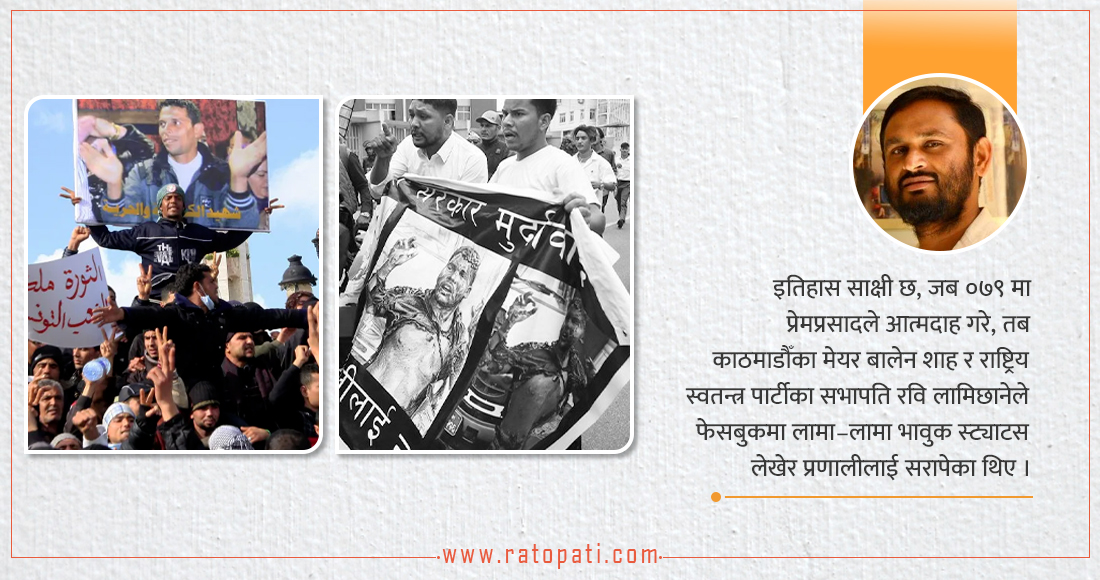
Bhadra 24 became a dark day in Nepal's modern history. Over 60 billion rupees in physical damage, 54 deaths, and the absence of state presence on the streets. But the psychological damage was greater than the physical damage. Social media algorithms added fuel to the fire. The formulas of Silicon Valley always prioritize malice, hatred, and extreme emotion because 'engagement' is the core basis of their profit. Mental triggers like ‘What if your child had died?’ completely displaced facts and logic.
Physical structures will be rebuilt, but the lost lives will never return. But a serious question was sidelined—why did people die? Who incited the crowd? Who turned anger into fire?
This same algorithmic game was widely used in the protests following the death of ‘Mahsa Amini’ in Iran towards the end of 2022. Legitimate issues of justice and rights were made so extreme through emotional clips, incomplete videos, and trigger phrases that there was no room left for dialogue. Consequently, the state became harsher, the movement was suppressed, and the space for real reform narrowed forever. The arson and looting in Nepal on Bhadra 24 were also the result of blind rage spawned by that same algorithm.
Physical structures will be rebuilt, but the lost lives will never return. But a serious question was sidelined—why did people die? Who incited the crowd? Who turned anger into fire? Before a legal answer could be sought for these questions, a verdict was delivered from the streets. The Prime Minister and Home Minister were convicted in the court of the mob. This happens not in a democracy, but only in a mobocracy. Exactly the same fate was repeated in Bulgaria between 2013 and 2020. When the anti-corruption movement reached an emotional peak, it resulted only in political instability, not institutional reform. Governments changed seven times in five years, but corruption and mismanagement remained entrenched.
All this chaos and outrage point to a specific political destination—the elections of Falgun 21. This game of converting emotion into votes, branding the state as criminal, and positioning oneself as the sole 'savior' is highly strategic. This exact practice was employed during the political crisis in Madagascar in 2009. There, fueled by emotional rebellion, the government fell and elections came, but it trapped the country in a vicious cycle of political transition and economic recession for decades. In Nepal too, while idealistic Gen Z youth are sacrificing their lives on the streets and in hospitals, the characters hijacking the movement are vying to climb the ladder of power. This is a global trend—idealists are sacrificed, and strategic players ascend to power.
When trust in state institutions is systematically dismantled and the mob seeks to become the judge, foreign intervention enters under the guise of 'assistance.' History shows this. This article is not a defense of any government, nor is it a condemnation of any movement. It is merely a warning against the political practice of weaponizing emotion to destabilize the country.
Now the question is for all of us—will we remain pawns in a narrative woven by algorithms? Or will we understand the depth of reality and make judicious decisions?
This specific news has been automatically translated by AI. As a result, there may be some inaccuracies or language errors.



_6FSvCrCShE.jpg)