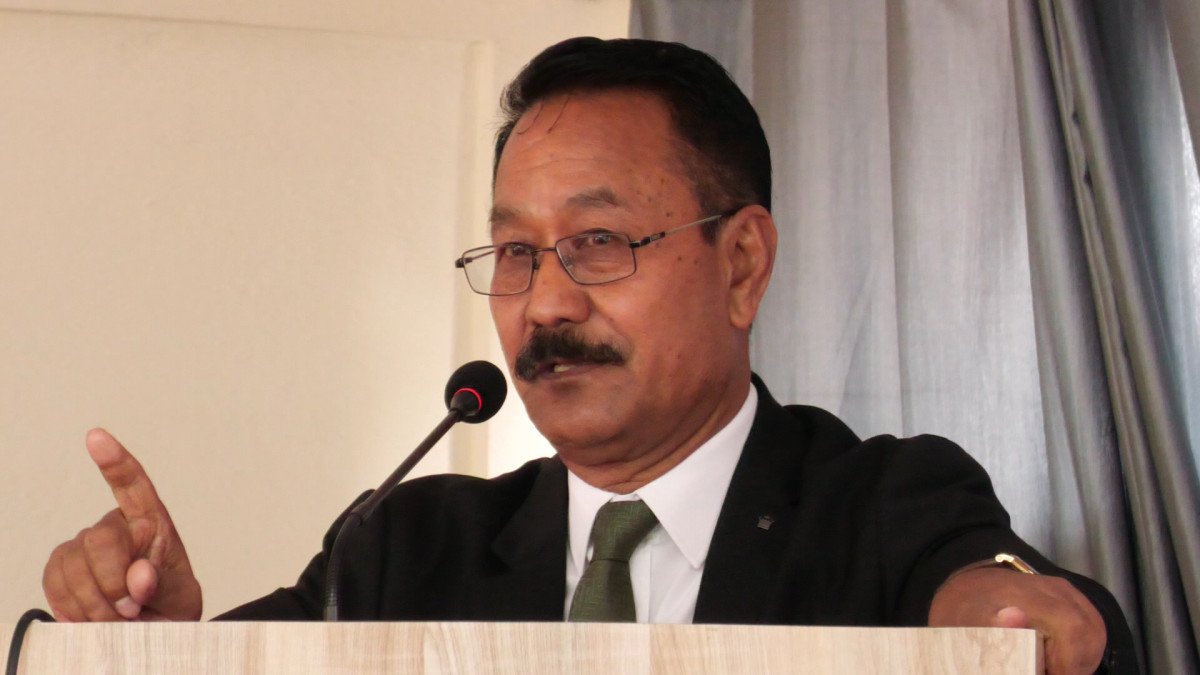
Hark Sampang's New Party Outperforms Unified Communist Party in Koshi Province Elections


A few months before the House of Representatives elections, former Prime Ministers Pushpa Kamal Dahal 'Prachanda' and Madhav Kumar Nepal were striving to continuously expand the size of the party named CPN (Unified Communist Party of Nepal) by incorporating various other parties.
During the same period, Hark Sampang, the then Mayor of Dharan Sub-Metropolitan City, was striving to form a new party under his own leadership. He was engaged in the process of forming a party from scratch.
The CPN (Unified Communist Party of Nepal), formed by incorporating CPN (Maoist Centre), CPN (Unified Socialist), and various other parties, has ultimately been surpassed by Hark Sampang's new party, the Shram Sanskriti Party, in its base area of Koshi Province.
Looking at the results of the House of Representatives elections, both in direct and proportional representation, the Shram Sanskriti Party has proven more successful in the constituencies under Koshi Province than the CPN (Unified Communist Party of Nepal).
While the Shram Sanskriti Party secured victories in three direct seats in the House of Representatives constituencies under Koshi Province, the CPN (Unified Communist Party of Nepal) failed to win a single seat. The Shram Sanskriti Party won directly in Sunsari-1, Bhojpur, and Khotang constituencies.
Similarly, the Shram Sanskriti Party has also overtaken the CPN (Unified Communist Party of Nepal) in proportional representation in Koshi Province. Across all constituencies under Koshi Province, the Shram Sanskriti Party became the fourth party in proportional representation with 279,699 votes. In contrast, the CPN (Unified Communist Party of Nepal) was limited to fifth place, receiving nearly one-third of the votes compared to the Shram Sanskriti Party. The CPN (Unified Communist Party of Nepal) received only 94,320 votes in proportional representation from Koshi Province.
The Shram Sanskriti Party became the first party based on proportional votes in Taplejung, Ilam, Bhojpur, and Khotang. The CPN (Unified Communist Party of Nepal) failed to secure even the first, second, or third position in any district of Koshi.
Overall, in proportional representation from Koshi Province, the Rastriya Swatantra Party became the first party with 840,613 votes, followed by the Nepali Congress in second place with 281,757 votes. The CPN (UML) is in third place with 280,837 votes.
This specific news has been automatically translated by AI. As a result, there may be some inaccuracies or language errors.