Adil Rashid: England's Old-School Leg-Spinner Proving His Worth in the Modern T20 Era


Unlike modern T20 spinners, this English leg-spinner excels at dismissing batters with traditional skills like flight, dip, and turn.
To understand the beauty of Adil Rashid's bowling art, you must watch him square-on. The flight of his main weapon, the leg-break, is above the batter's eye line, tempting them to step out of the crease.
But the ball seems to hang in the air and then suddenly drops due to the excessive revolutions on it. The batter, aiming to send the ball straight over the parapet, is either stumped or caught off a leading edge.
Such scenes were witnessed twice in England's recent T20 World Cup match against New Zealand in Colombo. In Rashid's first over immediately after the powerplay, opener Tim Seifert hit a six over long-on off a 53 mph leg-break while staying inside the crease.
Rashid bowled the next ball further up but slower. Seifert was tempted to play a similar shot again, but due to the ball having too much revs, it suddenly dipped. Seifert, losing his balance, was easily stumped by wicketkeeper Jos Buttler.

Left-handed batter Mark Chapman also swung his bat at a 45 mph leg-break. The ball turned in, and Buttler, standing outside the off-stump, dislodged the bails once again. As he walked back to the pavilion, Chapman threw his bat in the air, shaking his head and cursing himself for being fooled.
‘We all know he bowls slow,’ Seifert said about his dismissal, ‘but sometimes the batter's eyes get a bit too bright and they try to hit by coming out of the crease. But look, he completely deceived me in terms of pace. I even saw a statistic on TV: he is the slowest bowling spinner in this tournament. Many bowlers don't bowl slow these days. They bowl fast and skiddy balls. But bowling slow is Rashid's way. He is amazing at it, and that's why he is one of England's all-time greats. He is very clever.’
The 38-year-old Rashid is a spinner whose art was honed in an era when using the full power of the body to impart flight, drift, and significant spin was considered the norm. Speaking about his bowling in a recent interview, Rashid had said, ‘Nowadays, there are many spinners who flick the ball quickly with their fingers rather than imparting great spin.’
Spinners of all age groups respect Rashid for showing the courage to bowl slow even in the modern era. New Zealand's Ish Sodhi admitted that he lacks the courage to flight the ball significantly to extract more turn from the pitch, something Rashid possesses.

For 21-year-old English leg-spinner Rehan Ahmed, his senior colleague's bowling is a once-in-a-generation phenomenon. ‘For the last 6-7 years, most leg-spinners around the world have found success by doing the exact opposite of Rashid: bowling fast, bowling stump to stump. But it is incredible that he is so brave to bowl slow and succeed most of the time,’ Ahmed said.
‘We joke about it in the nets - he gets everyone out with that slow and fast ball. His variation makes him difficult to play: if he only bowled slow, it would be easier to play, but he can vary his pace from 40 to 55 mph, which makes him a very dangerous bowler.’
- Rashid's Magic as Shown by Statistics
So far in this World Cup, Rashid's average speed has been around 50 mph. Whereas other wrist-spinners average 54 mph and finger-spinners average 56.4 mph. While 32% of balls from other wrist-spinners and 55% from finger-spinners have been bowled at 56 mph or more, only 1% of Rashid's balls have been bowled at that speed.
Keeping the ball in the air, making it dip, and imparting good turn are important aspects of a leg-break. But the main reason for Rashid's success is the length at which he pitches the ball, especially in the area 3 to 4 meters ahead of the crease.
In this World Cup, he has bowled 22% of his balls at a 3-4 meter length, while other wrist-spinners have bowled only 16% and finger-spinners only 10% there. Rashid's percentage (34%) is also higher than other spinners for the 4-5 meter length, which is more commonly used in Test matches.
It is not surprising that batters' eyes light up when they see the ball about to land 3-4 meters further in. This gives them hope that they can clear the boundary by stepping out of the crease. This length has proven very effective for Rashid in this World Cup: when bowling there, his economy rate is 6.86 runs per over, compared to 9.72 for other wrist-spinners and 8.95 for finger-spinners.
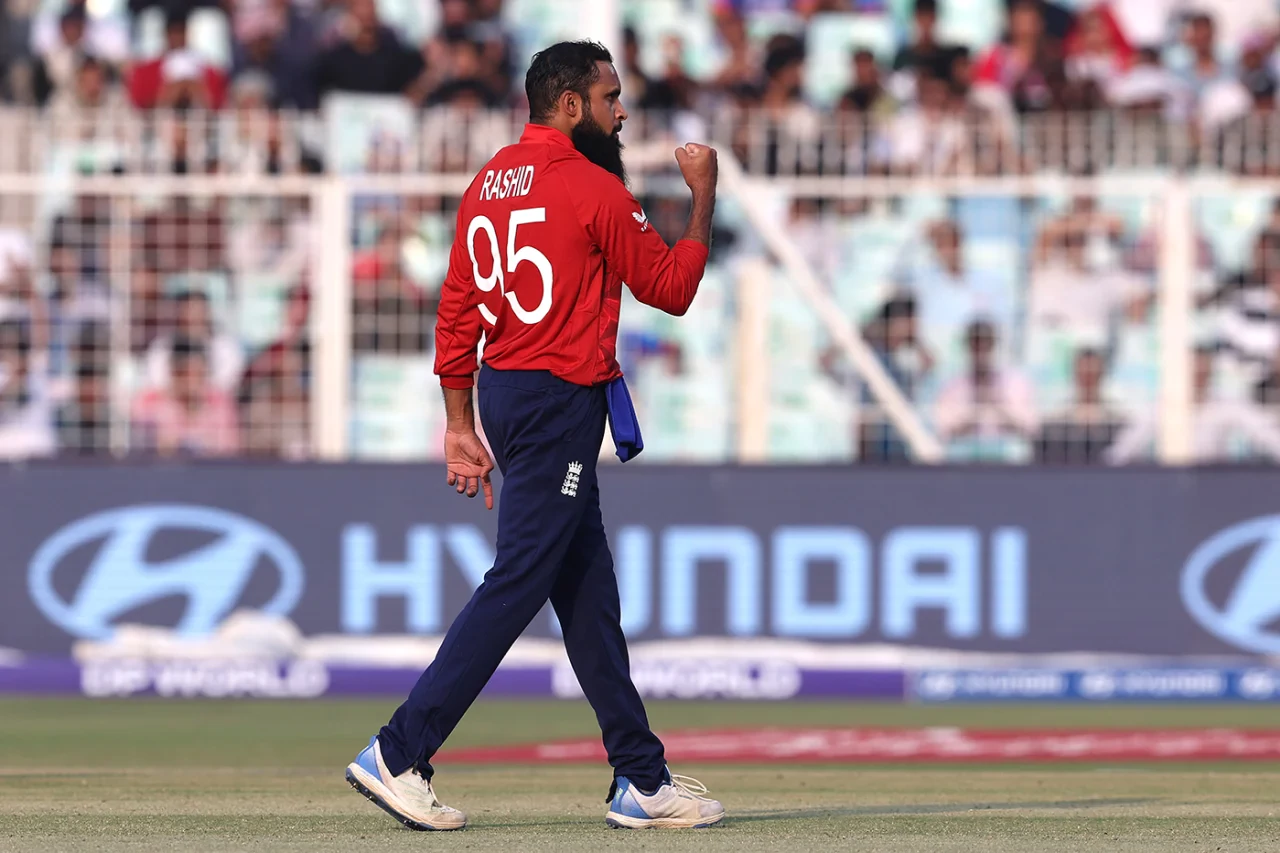
In terms of line, Rashid also differs from other spinners. His main method when bowling a leg-break is to pitch the ball in the channel outside the off-stump, similar to a fast bowler, which is different from the stump-to-stump line usually preferred by spinners. In this World Cup, other spinners have bowled 31% of their balls on the line of the stumps, while Rashid has done so only 23% of the time.
- The Challenge Against India at Wankhede
Statistics clearly show how Rashid lures batters close to danger by varying his length, bowling significantly slower than others, and adhering to the rules of traditional spin.
On Thursday, Rashid will face India in the World Cup semi-final, a team against whom he has a poor record, and at a venue where his record is mediocre. In 5 T20 Internationals played at Wankhede in Mumbai, he has taken only 5 wickets, with an economy of 9.62 and an average of 30.8.
Early last year, while playing against India here, Rashid conceded 41 runs for 1 wicket in 3 overs, where Abhishek Sharma hit him for 34 runs in just 13 balls. However, in this very World Cup, when playing against the West Indies at the same venue, he became the most economical bowler, conceding only 16 runs for 2 wickets in 4 overs.
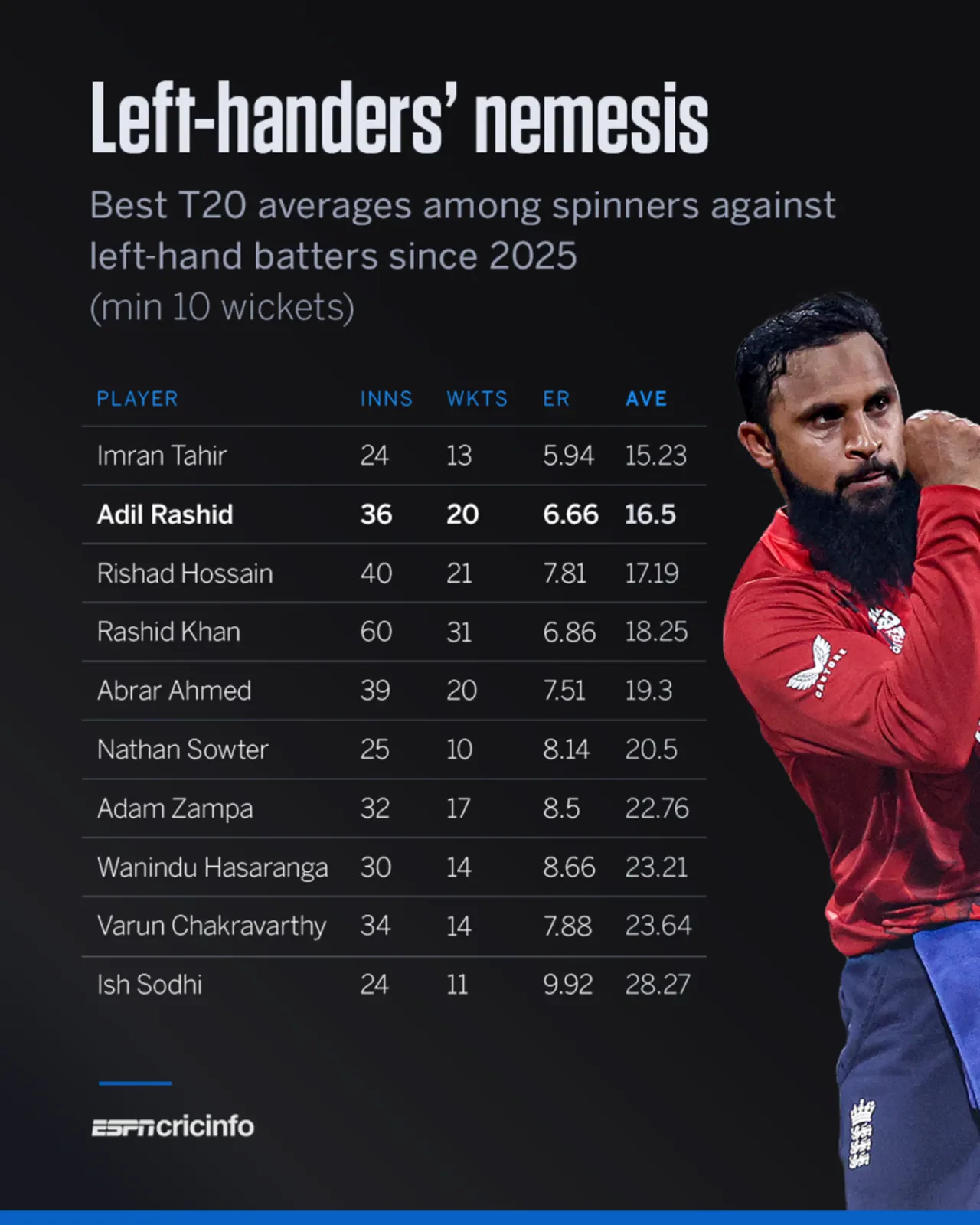
The semi-final pitch is expected to have slightly less turn but good bounce. A key battle will be between Rashid and India's left-handed batters. Rashid ranks among the best bowlers against left-handed batters in the last two years.
Since January 2025, among bowlers who have taken at least 10 wickets in T20s, Rashid has the second-lowest economy rate after Imran Tahir. In terms of runs conceded per wicket (average), Rashid's 16.5 is also the second best. For comparison, the averages of the two best spinners during this period, Adam Zampa and Varun Chakaravarthy, are 22.76 and 23.64, respectively.
During the training session on Tuesday evening, Abhishek, Ishan Kishan, Tilak Varma, Shivam Dube, and Axar Patel were all comfortably clearing the short boundaries at Wankhede. Can Rashid be England's main weapon to stop these dangerous batters?
All-rounder Will Jacks believes he can. ‘He is an excellent bowler to face in the nets because once you face him, you feel like you can play anyone, and that gives us batters confidence. He is our main weapon. He is also Captain Harry Brook's main weapon. He bowls the tough overs. Going into the semi-final, we know he is the spearhead of our spin attack. He is such an important player that we want to win this World Cup for him.’
This specific news has been automatically translated by AI. As a result, there may be some inaccuracies or language errors.