Nepal Rastra Bank Releases First Semi-Annual Macroeconomic Report, Citing Economic Recovery Amidst Lingering Risks


Kathmandu. Nepal Rastra Bank (NRB) has published its first 'Macroeconomic Report' for the first time. The central bank released the report based on data up to the end of Poush, intending to publish it regularly on a semi-annual basis.
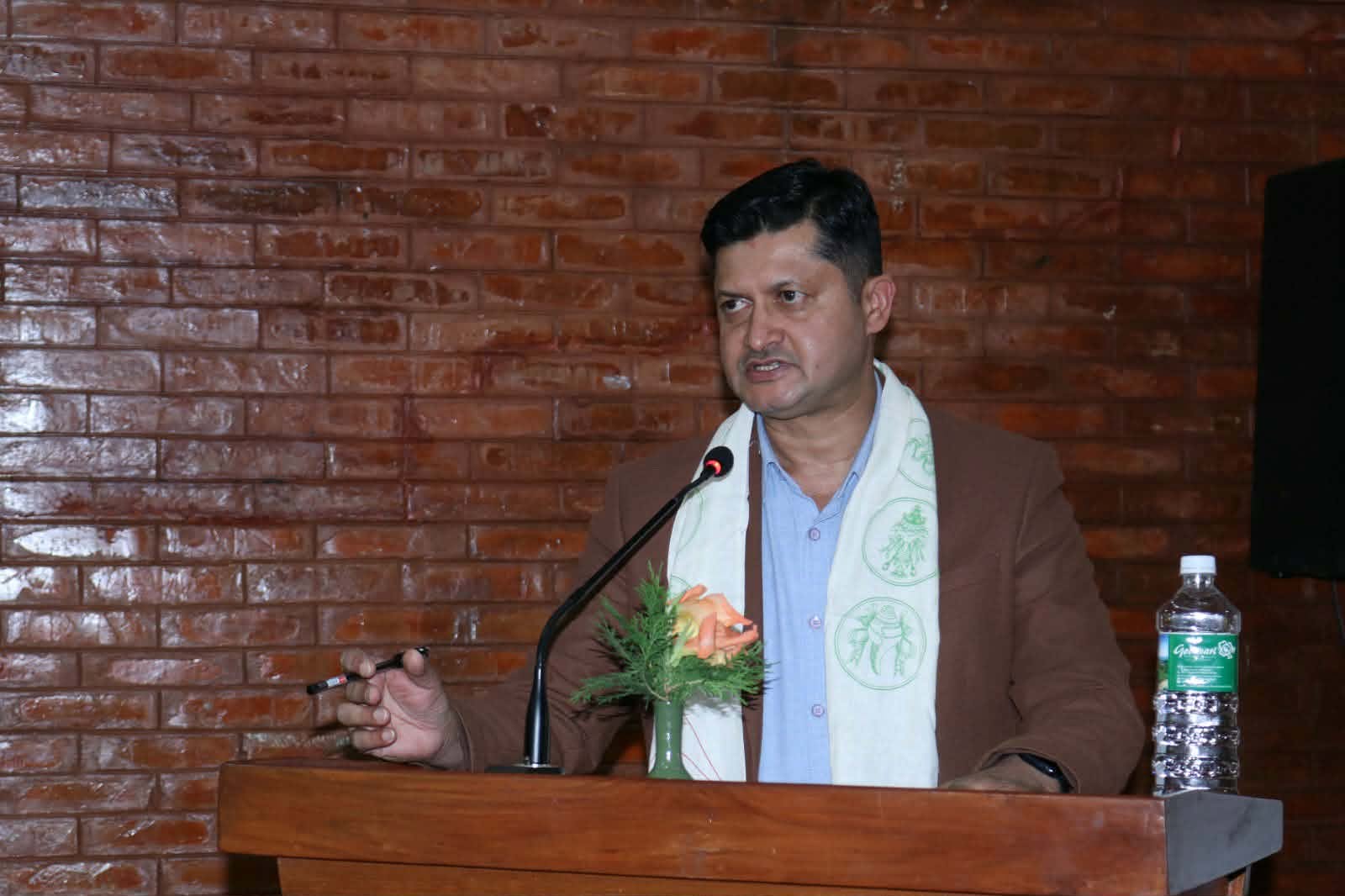
Governor Bishwa Paudel mentioned that this report was published to enhance the transparency of monetary policy and provide stakeholders with a realistic view of the economy. The report concluded that while the Nepali economy is in the process of improvement, risks still remain.
The report indicated that the economy faced challenges due to political shocks such as the earthquake, COVID-19, and the recent 'Gen Z movement'. Despite this, it noted that although the economy is in a phase of revival, uniform improvement across all sectors has not been achieved.
The central bank projected the economic growth rate for the fiscal year 2082/83 to be around 4.0 percent. This is lower than the government's annual target of 6 percent.
NRB estimates that consumer price inflation will hover around 4 percent. This is below the annual target of 5 percent. The central bank stated that the decrease in global fuel and food prices, along with falling inflation in India, has impacted Nepal.
Nepal's external sector appears to be in a very strong position, according to NRB. Foreign exchange reserves reached NPR 3.242 trillion by January, which is sufficient to cover imports of goods and services for 18.1 months.
A significant increase in remittance inflows has resulted in both the current account and balance of payments being in surplus. However, export trade appears sluggish. The report showed that while liquidity in the financial sector is ample, demand for credit remains slow.
Furthermore, banks' deposit and lending interest rates have fallen to historic lows. The policy rate has been reduced to 4.25 percent.
The central bank noted that non-performing loans (NPLs) in the banking sector remain a concern. Data shows the NPL ratio reached 5.2 percent in April 2025. Problems are particularly evident in loans to the agriculture and small and medium-sized enterprise (SME) sectors.
NRB stated that despite ample liquidity in the market, the lack of a fully conducive investment environment has prevented credit flow from increasing as expected.
The report mentioned that the political and social instability created by the 'Gen Z movement' in the first quarter of the fiscal year 2082/83 had some impact on the economy.
It is estimated that public and private property was damaged during this movement. However, the central bank expects the business environment to improve with the formation of a new government and the announcement of elections.
While some improvement is seen in revenue mobilization in the financial sector, capital expenditure remains weak. NRB indicated that the trend of development spending not happening on time and only occurring at the end of the fiscal year persists.
This specific news has been automatically translated by AI. As a result, there may be some inaccuracies or language errors.