Overloaded Truck Causes Suspension Bridge Collapse in Sankhuwasabha, Highlighting Infrastructure Risks


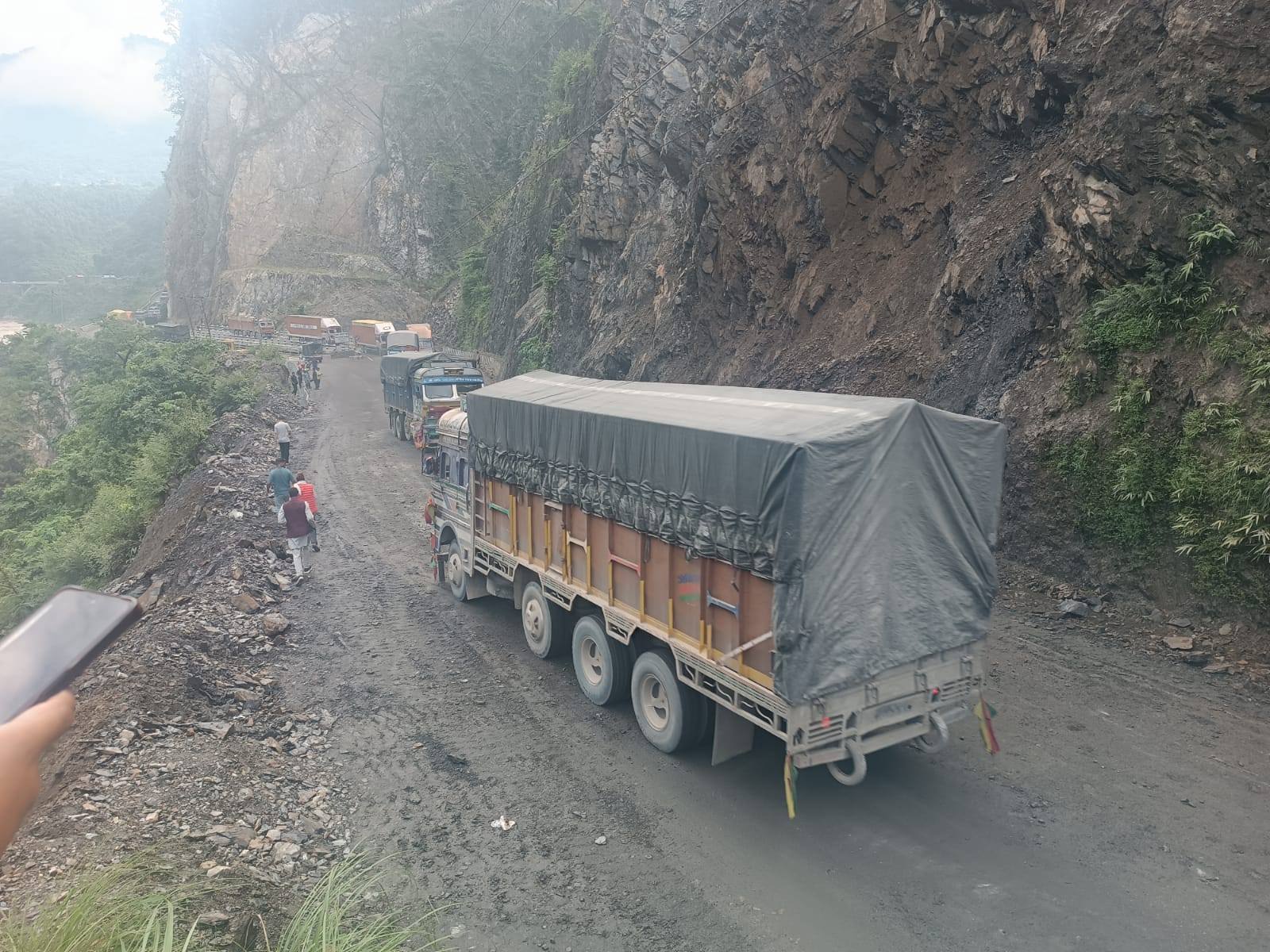
Kathmandu. A suspension bridge over the Arun River, connecting wards 5 and 2 of Makalu Rural Municipality in Sankhuwasabha, collapsed due to an overloaded cargo truck. The bridge, linking Num of Makalu-5 and Sedua of Ward-2, buckled around 9 a.m. on Saturday because it could not bear the weight of a low-bed truck carrying cement.
The truck, bearing registration number Province-03-001 Ka 2920, fell into the Arun River when the bridge collapsed, severely injuring the driver, 40-year-old Arjun Shrestha from Bahrabise Municipality-9, Sindhupalchok. The truck was transporting construction materials for the ongoing Kasuwa Hydropower Company project.
The collapse of this suspension bridge, which had only been operational for about a year, has completely blocked the Num-Sedua road section. This has directly impacted the movement of locals, tourists heading to and from Makalu Base Camp, and the transportation of daily essential goods along this route.
Gangari Lama, Information Officer at the Sankhuwasabha District Administration Office, confirmed that the bridge collapsed because it could not support the weight of the overloaded truck while crossing the river. Coordination is underway to arrange for the bridge's repair and alternative arrangements, with discussions particularly focused on repair responsibilities with the Kasuwa Hydropower Company.
This is the second incident of a suspension bridge collapsing over the Arun River. Previously, on Magh 29, 2078 BS, a suspension bridge at Amrang, connecting Num (Ward-5) and Walung (Ward-1) of Makalu Rural Municipality, had collapsed. At that time, three overloaded trucks carrying construction materials for the under-construction Iphsuwa Hydropower also fell into the river.
On Poush 26, 2081 BS, a bridge along the East-West Highway at Dumkibas collapsed while an overloaded Indian truck was crossing.
Saroj Sitoula, Acting Chairman of the Nepal Transport Entrepreneurs' National Federation, stated that vehicles plying with loads exceeding their capacity pose a serious challenge to the safety of the country's road infrastructure and human lives.
_3QbKRm6H1W.jpg)
Sitoula noted that vehicles are freely moving with loads double the capacity that Nepal's roads and bridges can handle. "A vehicle with a 20-ton capacity is currently carrying up to 40 tons of goods," he said. "Whether it's government cargo or hydropower materials, carrying loads beyond capacity reduces the lifespan of roads from 20 years to just 3 years."
According to Chairman Sitoula, the weight measurement centers (weighbridges) established by the government in various locations for load capacity testing are merely symbolic. He claimed that government weighbridges in places like Ramnagar are not functioning effectively.
"Weighbridges are installed, but vehicles are not actually weighed there. Overloaded vehicles are released based merely on signals," he said. "The state should strictly monitor the weighbridges after installing them, but this is not happening."
He added that vehicles entering from the border with India are often excessively overloaded, putting bridges in border areas at risk.
- Overloading is the main reason for bridge collapse and increased accidents
Sitoula cited past bridge accidents in areas like Dumkibas in Nawalparasi as examples, emphasizing that the damage to the Arun River bridge in Sankhuwasabha is also a result of extreme negligence. He stated that overloading causes potholes in roads, bridge collapses, and significant loss of life and property.
Sitoula commented that it is unfortunate that despite repeated directives from the Department of Transport Management, there is no compliance in practice. He said, "The department issues directives, but the implementation side is zero. Accidents like this are repeatedly occurring because there is no action or monitoring against those who violate the rules."
Similarly, Rajendra Bikram Baniya, Chairman of the Nepal Truck Transport Entrepreneurs' Federation, also accused government agencies of serious negligence, stating that overloading is the primary cause of the poor condition of roads and bridges.
He argued that this problem is even more severe in mining areas where tippers and trucks carrying sand, stones, and gravel often carry loads far exceeding standards, as there are no weighbridges in those areas. He contended that even though the government directed that such materials be carried based on 'cubic meters,' this is not being followed, and vehicles leaving mines already overloaded are damaging roads and bridges.
According to Chairman Baniya, the Federation has initiated the installation of 18 weighbridges across the country to regulate truck load capacity, but the Traffic Police and the Department of Transport Management have shown little interest in their effective use and controlling overloading.
_fzwRP54CK4.jpg)
- Allegations of 'Settlement' against Traffic Police
Chairman Baniya accused the Traffic Police, responsible for controlling overloading, of operating through 'settlements' (under-the-table deals). "Traffic police sit two to three kilometers ahead of our weighbridges, and even when they know a vehicle is overloaded, they issue a minor fine of 1,500 rupees and let it go," Baniya said. "There is an economic transaction behind releasing a vehicle carrying an overload of 30-40 thousand rupees for a minor fine. In many places, police even collect monthly payments from trucks."
He stated that compliant entrepreneurs are suffering because police tend to check strictly only those trucks that do not pay the monthly dues, while those who pay are let go without inspection.
_pjthv74new_qc9cRdJAjv.jpg)
- Government Weighbridges Abandoned
According to Baniya, private sectors operate weighbridges at 18 locations nationwide. He noted that these weighbridges would be sufficient if the government regulated them properly. However, he complained that the government is neglecting this aspect.
Baniya informed that the government-owned weighbridge at Ramnagar in Chitwan has been out of order and abandoned for the past three months. "It has been three months since the government's weighbridge broke down, and no one is interested in fixing it," he said. "Traffic police sit there just to issue tickets; load control is not happening."
Chairman Baniya stressed the need for effective coordination between security agencies, the Department of Transport Management, and entrepreneurs to control overloading. He concluded that accidents like the one in Sankhuwasabha are recurring because, despite the Federation repeatedly corresponding with the Police Headquarters and the Department of Transport, and the department issuing directives to offload excess cargo, the implementation remains weak.
He demanded the mandatory use of weighbridges immediately and strict action against the guilty, noting that the Sankhuwasabha accident has once again raised awareness about the risks of overloading in infrastructure development.
- Provincial Governments' Arbitrary Standards on Vehicle Load Capacity
Recently, it has been observed that provincial governments are arbitrarily setting standards for vehicle load capacity, leading to damage to roads and bridges. In this context, on Magh 27 BS, the Department of Transport Management under the Federal Ministry of Physical Infrastructure and Transport warned against acting contrary to the law.
Section 16(3) of the Vehicle and Transport Management Act 2049 mandates that the Gross Vehicle Weight (GVW), carrying capacity, and unladen weight must be clearly mentioned separately in the registration certificate of cargo vehicles. However, based on complaints that transport offices under all seven provincial governments were setting arbitrary standards, the Federal Department of Transport Management issued a strict warning against acting arbitrarily against the Act and directives.
According to the Department, transport offices under the provinces have been found to issue permits for cargo vehicles with capacities exceeding their actual weight based on financial dealings. The Department pointed out that such illegal activities lead to the destruction of roads and bridges and cause a large number of accidents. Such activities have been frequently observed recently in districts including Birgunj, Biratnagar, Bhairahawa, and Mahendranagar.
The Department wrote to the Ministries of Transport and Physical Infrastructure of Koshi, Madhesh, Bagmati, Gandaki, Lumbini, Karnali, and Sudurpaschim provinces on Magh 27 BS, warning of strict action. The Department had previously written to all seven provincial governments on Magh 11, 2080 BS, and Ashar 12, 2082 BS, directing them not to mention the gross weight, load capacity, and unladen weight of cargo vehicles arbitrarily against the Act.
Clause 9(a) and 13(a) of the Directive on Regulation of Cargo Vehicle Load Capacity 2074 (Amendment) also stipulate that the gross weight that must be maintained while operating on roads must be clearly indicated. Despite repeated correspondence and requests from the Department, provincial governments have been found to act arbitrarily, ignoring these directives.
The Department has directed the immediate correction of actions contrary to the provisions made by the Act and the Directive, and to clearly mention the gross weight and load capacity of the vehicle on the vehicle registration certificate, route permit, and inspection certificate issued by the offices. To monitor this issue, letters have been sent to police offices and traffic offices across the country through the Nepal Police Headquarters, as well as to the Nepal Transport Entrepreneurs' National Federation and the Nepal Truck Entrepreneurs' National Federation. The Procedure for Regulation of Cargo Vehicle Load Capacity 2074 determines the maximum gross weight and axle load capacity for vehicles with different types of axles.
This specific news has been automatically translated by AI. As a result, there may be some inaccuracies or language errors.