Communist Vote Share Expected to Decline in Upcoming Federal Elections Amid Governance Criticisms

Kathmandu. It is being estimated that the communist vote share may decrease in the House of Representatives election scheduled for February 21. Despite long periods in power since the establishment of the Federal Democratic Republic in 2065 BS, the communists are accused of failing to work towards good governance, social justice, and prosperity.
The communist-led government has also been accused of brutally suppressing the peaceful demonstration organized by the 'Jenji' on Bhadra 23 against corruption and mismanagement. K.P. Oli, Chairman of CPN-UML, was the Prime Minister with the support of the Nepali Congress, the largest party in the dissolved House of Representatives.
Following the death of 23 'Jenji' activists from security forces' bullets during the demonstration at the Parliament Building in New Baneshwor on Bhadra 23, angry protestors caused destruction on Bhadra 24. After protestors destroyed the Singha Durbar central administrative building, the Supreme Court, and the Parliament Building, then-Prime Minister Oli resigned and fled to a safe location with the help of the Nepali Army. Following the government's ouster through the uprising, the interim government formed under the leadership of former Chief Justice Sushila Karki dissolved the parliament and announced elections.
While traditional parties have been facing accusations for two decades since the establishment of the Republic for failing to meet public expectations while in government, there is a political buzz that the communists might suffer the most significant loss in this election. As communist rule collapses globally, Nepal is considered a fertile ground for it. However, the communists appear most unpopular due to the 'Jenji' movement.
Political analyst Mumaram Khanal alleges that Oli himself is the originator of the 'Jenji' movement. He analyzed that deep impacts have been made on politics because of Oli.
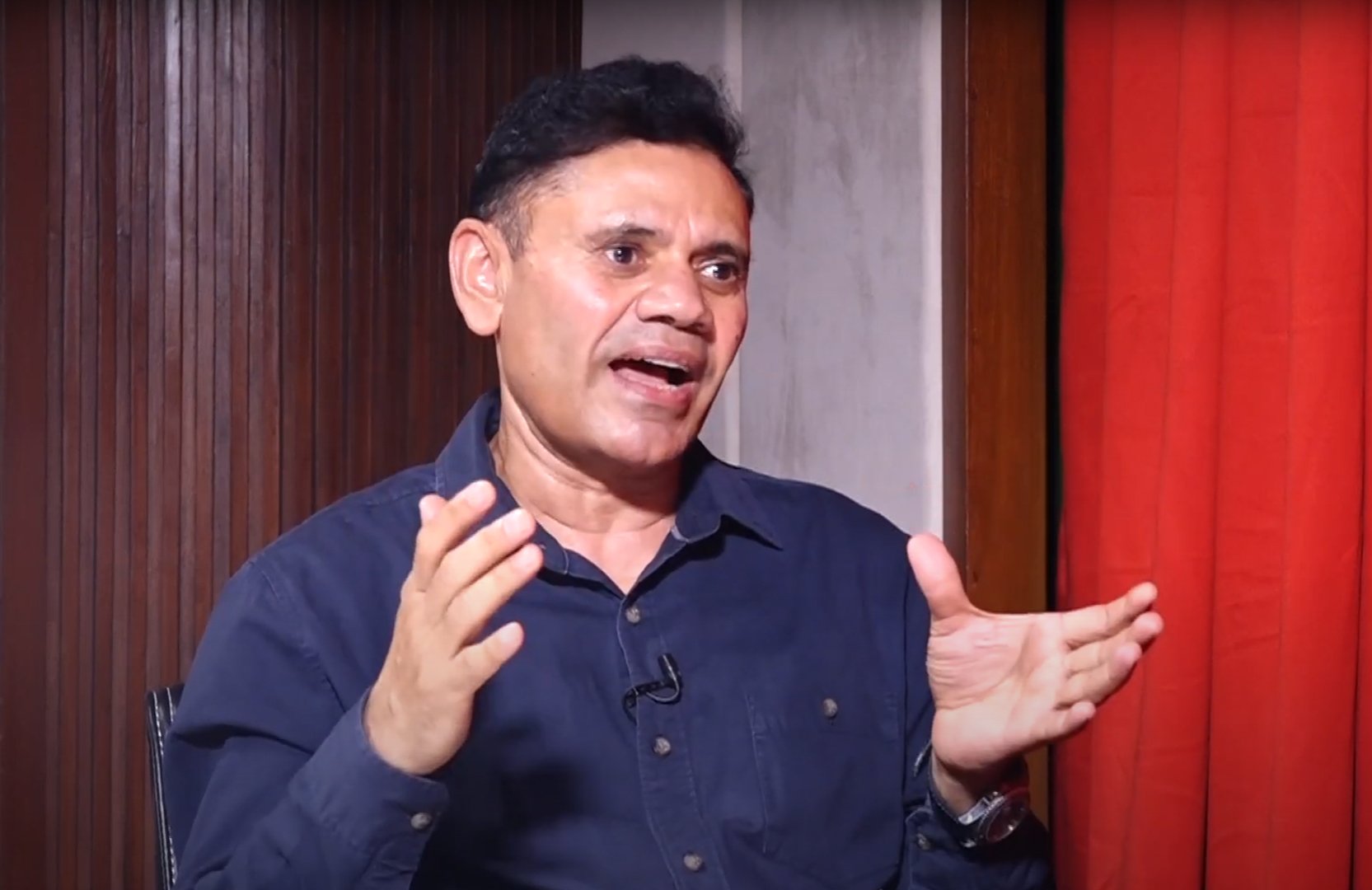
“Mr. Oli has, in a way, become the originator of this process. All these incidents happened during his tenure as Prime Minister. This has deeply affected politics. Old parties are unable to even speak due to the emergence of new political parties,” he told Ratopati. “Glorifying things other than capitalizing on history is likely to yield the opposite result. Communist villains have gathered people to self-approve and have made themselves self-proclaimed leaders.”
Khanal states that when the faction supporting the Fourth General Convention of the Communist Party of Nepal and the faction supporting the Jhapa movement of 2028 BS united in 2075 BS, leftist cadres felt a sense of fulfillment. When that party dissolved, the votes that had been entrenched for years have now moved towards alienation, according to Khanal.
“When the Fourth General Convention and the Jhapa movement came together, leftist cadres understood it as a complete unity. Due to its dissolution, a segment of votes that was entrenched and never changed within the leftists has become so loose that more people are alienated even in the stronghold of the leftists. They served the leftists for so long that leftist leaders became the most corrupt, dynastic, and individualistic. The largest number of leftist voters are those who can erase that anger and seize power,” he said.
Another analyst and professor, Krishna Pokharel, says that the Oli government became infamous for failing to tackle the 'Jenji' movement properly. “The problem was within the country. Because it was not handled properly, the massacre of youth that occurred brought the blame onto a communist Prime Minister, regardless of the brand,” he says.
He analyzes that the previous attachment to CPN-UML has significantly decreased due to the suppression of the 'Jenji' movement, putting the party in an extremely defensive position in the elections.
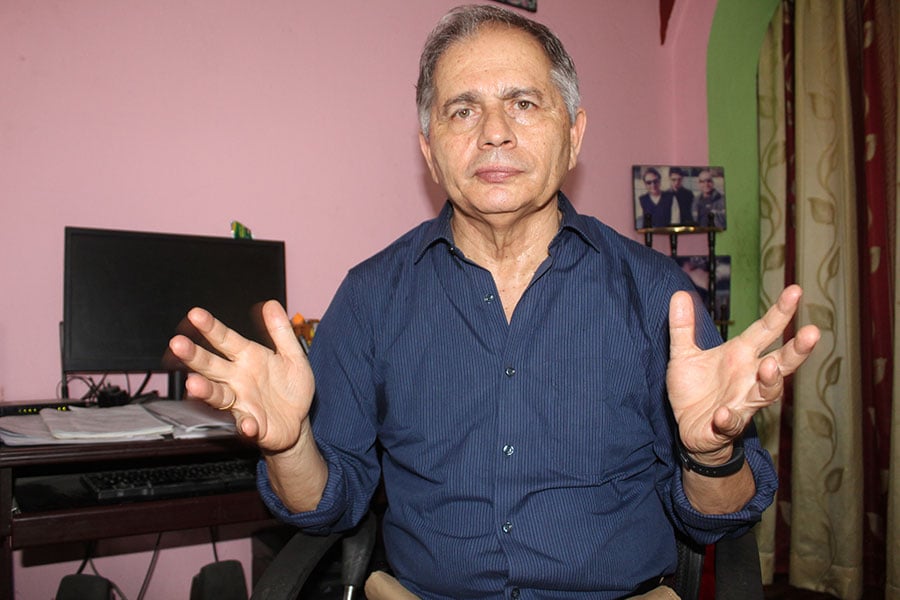
Pokharel further states that the true support base of the other major leftist party, the CPN, remains untested, even after gathering small and large components for re-branding. “Whether the organizations that truly had a support base have come together, or if this is just a collection of scrap materials—the election results will tell. But currently, the condition of CPN or the former Maoists has been declining with every election,” he said.
He analyzes that the splintering of a small faction of CPN to form the Progressive Democratic Party might have some impact on the elections. Therefore, he suggests that the overall leftist vote share is likely to decrease in this election.
“Overall, it appears that the leftist vote will decrease in this election. Overall, the vote share of the mainstream political parties will decrease,” he said.
He adds that not only the leftist vote but also the vote share of other traditional political parties like the Nepali Congress and Madhes-centric parties will decrease this time. However, he understands that the Nepali Congress has managed to somewhat prevent losses by changing leadership and re-branding under Gagan Thapa.
“Rather than saying the leftist vote has decreased or the democratic vote has increased, the overall vote share of those parties that used to call themselves mainstream political parties will decrease. Among them, the Nepali Congress has managed to save itself the most. Because Gagan Thapa, Bishwa Prakash, and others took a risk by holding a special general convention, that party has been refreshed somewhere,” Pokharel said.
He states that the possibility of the communist party reuniting or transforming after the election is impossible because of Oli. He suggests that if Oli is defeated in the election, unification among all leftist components might become possible.
_9XhwTihge8.jpg)
“The biggest problem for the communists in Nepal right now is K.P. Oli, who considers himself the biggest leader. As long as he remains, there is no possibility of all those leftists coming together in CPN-UML,” he said. “Oli is the main factor behind the current debacle of the leftists. If he loses this election, there is a possibility that CPN-UML and the remaining leftists could unite. If that happens, the party can dust itself off and rise again.”
The communist movement in Nepal has a long history. Communist parties played a significant role in the political revolutions of 2007, 2017, 2037, 2046, 2052, and 2062/63 BS. After the Communist Party of Nepal was established by founding General Secretary Pushpa Lal Shrestha in 2006, four members won seats in the first general election held in 2015.
_rQTqJ72kZf.jpg)
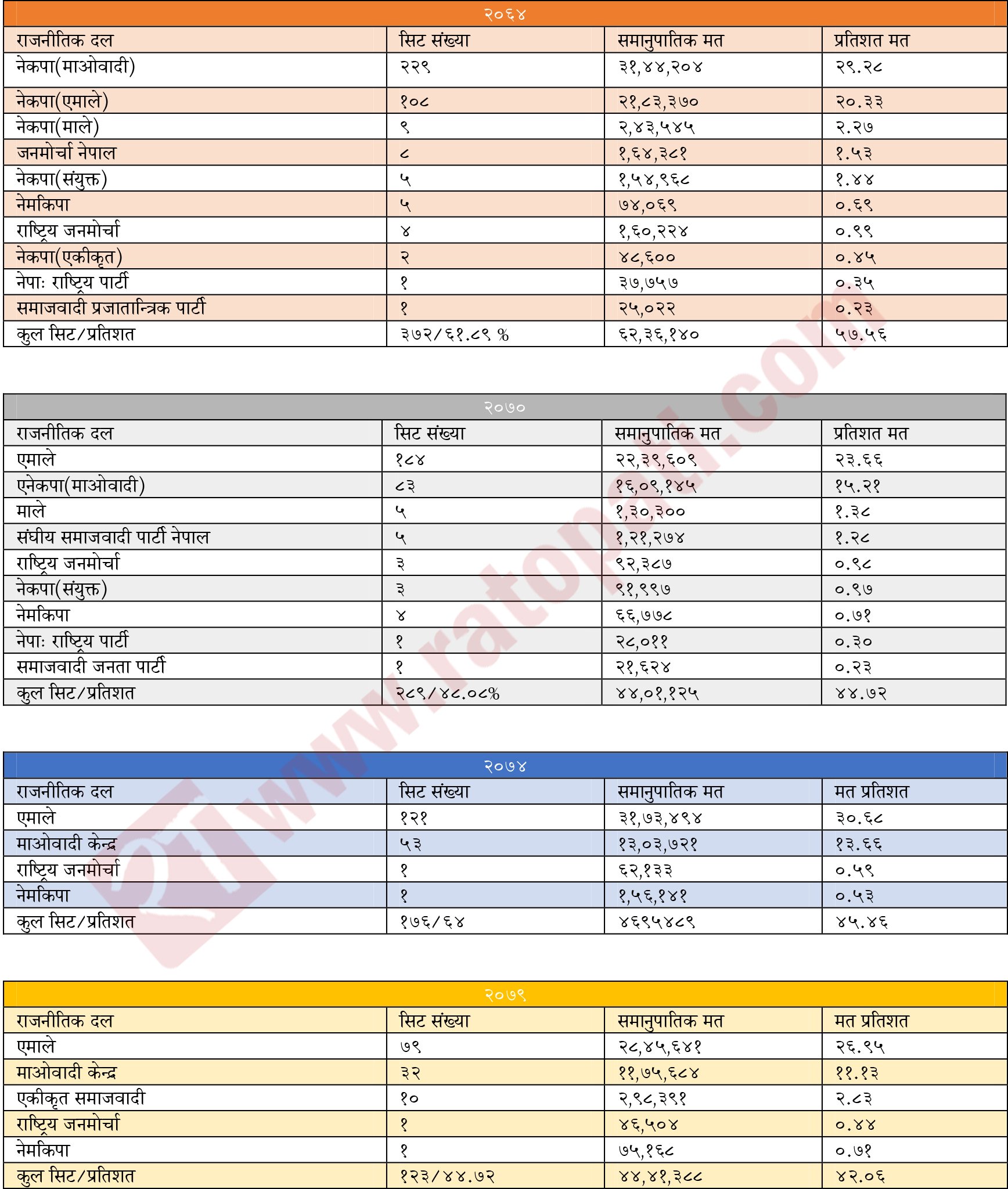
Due to King Mahendra overthrowing the elected government and banning political parties in 2017, the communist movement experienced various ups and downs. Since the political change of 2046 BS, the leftists have had a strong presence in every parliamentary election. The decision and role of the Communist Party were crucial in overthrowing the traditional monarchy in 2062/63 BS. In the first Constituent Assembly in 2064 BS, leftists had 62% representation. In the second Constituent Assembly in 2070 BS, their popular vote dropped to 48%. In the 2074 election, the then CPN-UML and CPN (Maoist Centre) formed a leftist alliance, resulting in 64% representation in parliament.
After the dissolution of CPN in 2077 BS, the popular vote shrunk to 45% in the 2079 election. While CPN-UML's popular vote has seemingly increased in every election since 2064 BS, the overall Nepali communist party's standing appears to be declining. The fact shows that the leftist vote share has declined in every election overall. With elections being held under special circumstances now, the expected leftist vote share is generating significant curiosity in political circles.
This specific news has been automatically translated by AI. As a result, there may be some inaccuracies or language errors.
_cvUCBlwFTZ.jpg)