Scientists Uncover New Theory on Origin of Saturn's Moon Titan and Its Rings After Massive Collision

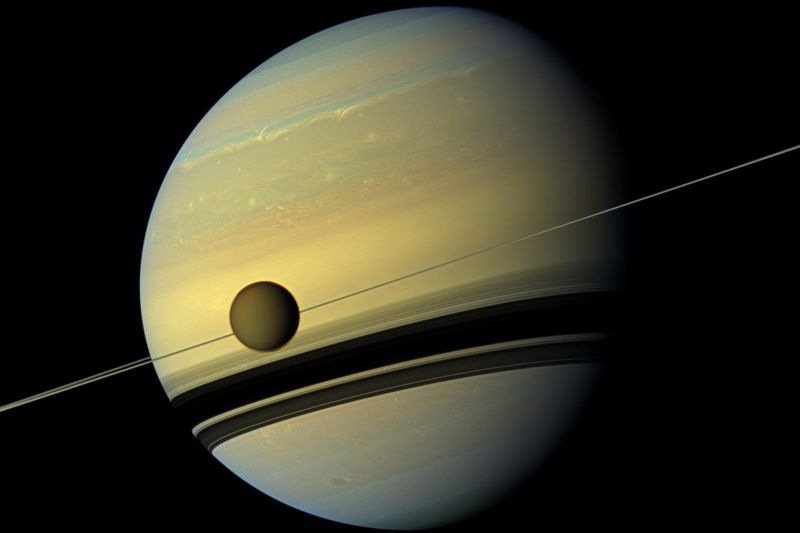
Kathmandu. Scientists have discovered new facts regarding the origin of Saturn's largest moon, 'Titan,' and the beautiful rings visible around it. A recent investigation has revealed that about 500 million years ago, another unknown moon of Saturn collided with Titan, and the current form of Titan was created from that massive impact.
This study, soon to be published in 'The Planetary Science Journal,' has helped solve many mysteries within Saturn's system. According to Matja Cook, the lead author of the study and a scientist at the SETI Institute, Titan is half the size of Earth and larger than the planet Mercury.
Its gravity is so powerful that it shakes and tilts Saturn itself. According to this new theory by the researchers, the unknown moon that collided with Titan 500 million years ago was later absorbed into Titan itself.
It is speculated that Saturn's other small and oddly shaped moon, 'Hyperion,' was born from this collision. Hyperion is either a fragment ejected from that collision or a body formed from debris accumulated around Titan, body.
According to scientists, the attractive rings seen around Saturn are also a result of this chain of collisions. The disturbance caused when Titan and the other moon collided is believed to have caused the inner small moons to crash into each other, and Saturn's rings formed about 100 million years ago from the dust and ice fragments ejected from this process.
Previously, astronomers believed that Saturn was tilted due to the gravity of Neptune, but data sent by the Cassini spacecraft indicated the role of a 'lost moon' there. In 2022, astronomers claimed that a lost moon named 'Chrysalis' caused Saturn's rings to form, while the current new research refines that, confirming that the collision between Titan and 'Proto-Hyperion' was the main cause.
This research also clarifies the fact that Titan is moving away from Saturn at a rate of 11 centimeters per year. If this process continues, there is a possibility that Titan could completely exit Saturn's orbit in the future.
NASA's Dragonfly rotorcraft is set to depart for Titan in 2028, scheduled to land there in 2034 to collect soil and rock samples. Scientists expect that this mission will test this 'collision theory' in a laboratory setting and turn further pages of Saturn's mysterious history.
This specific news has been automatically translated by AI. As a result, there may be some inaccuracies or language errors.