Dipesh Karki: From Remote Village to Co-Founder of Leading Indian P2P Lending Platform


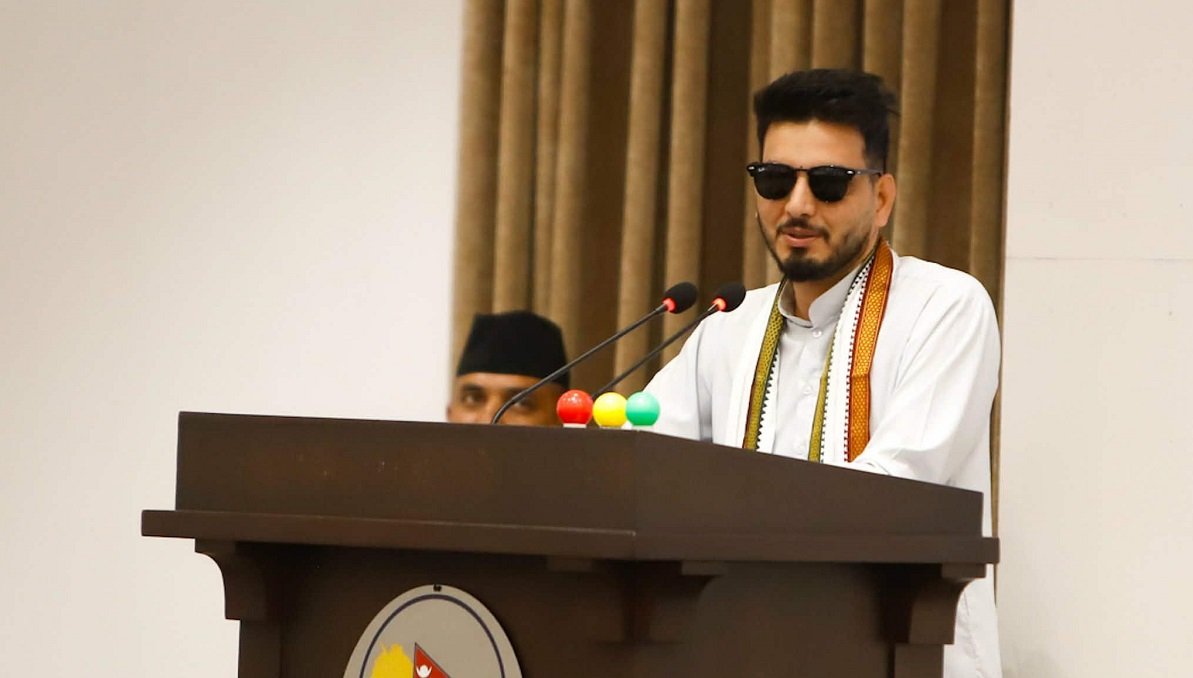
Kathmandu. Dipesh Karki, who grew up in a remote village in Khotang, is now the co-founder of India's leading 'peer-to-peer lending' platform, Lenden club. His company currently serves more than 30 million customers.
Recently, sharing his experiences with the Indian Embassy in Nepal, he elaborated on how the scholarship provided by the Indian government and his studies there shaped his entrepreneurial journey.
Born into a teacher's family in Hauchaur, Khotang district, Dipesh spent much of his childhood studying in Biratnagar. Both his parents were school teachers. However, the income of teachers alone was not enough to meet the family's needs and fulfill the dreams of their sons. Therefore, like many other families in the village, his parents also engaged in farming. Teaching in school during the day and working in the fields in the remaining time, they sold their produce to provide Dipesh and his brother with a good education.
Dipesh recalls spending much of his student life in ordinary hostels and schools far from home. Although they did not have many amenities, he says they grew up with the belief that discipline, honesty, diligence, and education can change lives.
From a young age, he had a great passion for gadgets, machines, and especially airplanes. He never considered himself the top student, but he always had a hunger to learn new things. He loved to open things up, test them, and understand how they worked. He wanted to become a pilot or an aeronautical engineer, but his family's financial situation did not make it possible.
In 2007-08, when he received the COMPEX scholarship, his life took a new turn. Securing 20th position in the scholarship exam, he got the opportunity to study Electronics and Communication Engineering at the National Institute of Technology (NIT) Kurukshetra in India on a full scholarship. He was perhaps the first person in his entire family and relatives to pursue higher education on a full scholarship. He recalls studying for only three hours a day and working hard to prepare for the scholarship.
After studying at NIT Kurukshetra, he chose the path of entrepreneurship. Initially, he co-founded an engineering software called 'Pipeiso'. Later, in Mumbai, he started 'Lenddenclub' with his partner Bhavin Patel. This platform has now become one of the largest peer-to-peer lending platforms in the world.
He drew inspiration for establishing Lenddenclub from his own childhood in his village. There was no bank or financial institution in his ancestral village. When people needed money for medical treatment, farming, education, emergencies, or family matters, they relied on neighbors, relatives, and trusted people in the community.
Long before he understood what finance was, he had seen how capital flowed through relationships, trust, and community. Later, after studying engineering and gaining technical knowledge, he realized that the traditional concept of his village could be modernized and scaled up. He says that Lenddenclub is an attempt to take the trust-based transactions in Khotang to millions of people through technology.
His experience after reaching Kurukshetra was eye-opening. There, he had the opportunity to interact with students from all over India, Non-Resident Indians, and international students, as well as a large campus, advanced laboratories, and new technologies.
The biggest lesson he learned there was that education extends far beyond the classroom. There, he reconnected with his childhood dream of aviation by becoming a founding member of the 'Suryakiran Aeromodelling Club'. He also became the first certified RC (Remote Control) flyer in the college. In addition, the teamwork and problem-solving skills learned while holding leadership roles in various clubs and programs greatly helped him later in his entrepreneurship.
Dipesh states that India's startup ecosystem and its digital transformation have played a significant role in growing his company. In India, the digital identity system, financial inclusion, and digital payment infrastructure have transformed the way services are delivered.
This transformation laid the foundation for innovation for fintech companies like Lenddenclub. He also mentions that the progressive policy formulated by the Reserve Bank of India (RBI) for peer-to-peer lending has played a crucial role in the company's development.
Dipesh acknowledges that college mentors, seniors, and professors played a significant role in his success. While running his first startup, Pipeiso, he learned that selling technology is much harder than building it. He believes that only continuity and long-term thinking lead to success. He says, 'Any problem seems big only as long as your determination to solve it by breaking it down into smaller parts is not bigger than the problem itself.'
Dipesh advises Nepali students who are currently receiving or wish to receive the COMPEX scholarship in the future not to use the scholarship merely to obtain a degree. 'Use it to broaden your horizons,' he says, 'Learn globally, build globally, and contribute to your own place.'
Stating that there are immense possibilities in Nepal, Dipesh has emphasized that the next chapter should be about innovation, research, and entrepreneurship. 'We must introduce Nepal not only as the land of Sagarmatha, Buddha, Pashupatinath, and Gurkhas, but also as a country that produces world-class scholars, researchers, innovators, and entrepreneurs,' he said.
Dipesh continues to work with policymakers, entrepreneurs, and regulators from both countries. He aspires to use his experience of a boy from a teacher's family in a remote village in Khotang receiving a scholarship to build the world's largest digital lending infrastructure, to create opportunities for the future generations of both countries.
This specific news has been automatically translated by AI. As a result, there may be some inaccuracies or language errors.


_iL3K2wYemS.jpg)