Young Craftsman Revives Ancestral Khukuri Making in Bhojpur Amidst Migration Wave

Bhojpur. Amidst the growing trend of youth migrating abroad, the younger generation is becoming active in creating self-employment opportunities in their own localities and preserving ancestral professions. Gyanendra Bishwakarma of Bokhim, Bhojpur Municipality-5, has dedicated himself to the craft of making Khukuris while staying in his village.
He has continued this profession taught by his forefathers. Bishwakarma, who has studied up to the bachelor's level, mentioned that although he was one of the many youths planning to go abroad in search of better opportunities, he decided to do something in this field after seeing his ancestral profession begin to face a crisis. "I have taken up this profession with the goal of becoming self-employed while preserving the ancestral trade," he said, "Even though I have the ability to do other work, I have chosen this profession."
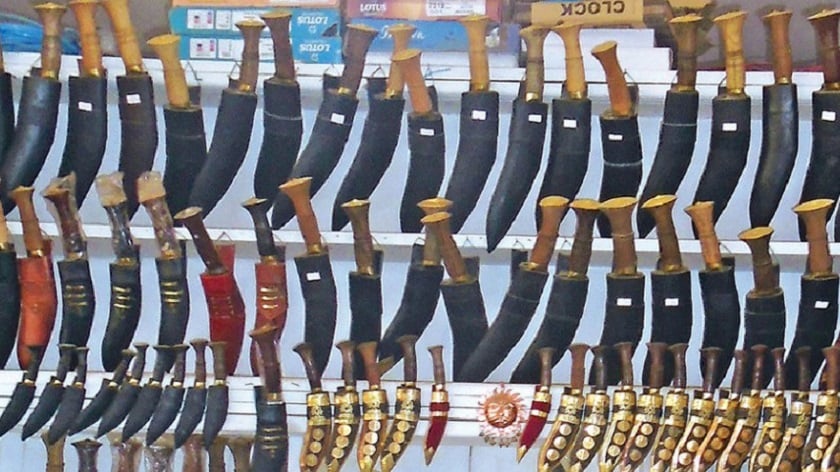
He manufactures Bhojpur Khukuris in Sirupate, Kothimoda, Banspate, Buduna, and Tinpaate shapes, and also makes swords, kattis, and other items according to demand. He states that the Bhojpur Khukuri, handcrafted in the traditional style, has a distinct identity in the market. The Khukuris, prepared with hard work using quality steel, reach various districts across the country, and some items are exported through personal requests.
He expresses a sense of pride in the Khukuri making process, despite the hard work and time it requires. "This is not just a profession; it is our identity," he said, "I am working with the determination to earn income from this while preserving the profession." According to him, this profession can only survive sustainably if skills are transferred to the new generation. For that, he believes support in training, technology, and market management is necessary.
He notes that income could increase further if the products manufactured by the industry operating in the village could be delivered directly to external markets. He currently complains that problems are being created due to a shortage of raw materials, price hikes, and limited market access.
He believes that the artisan profession will become more organized and attractive with state support in the easy availability of raw materials, modern equipment, skill development training, and marketing. He remains continuously active in this profession with the goal of continuing the ancestral skills and attracting the new generation towards it.
This specific news has been automatically translated by AI. As a result, there may be some inaccuracies or language errors.