Devotees Celebrate Holi with Colors During Mithila Madhyamik Parikrama at Kanchanban

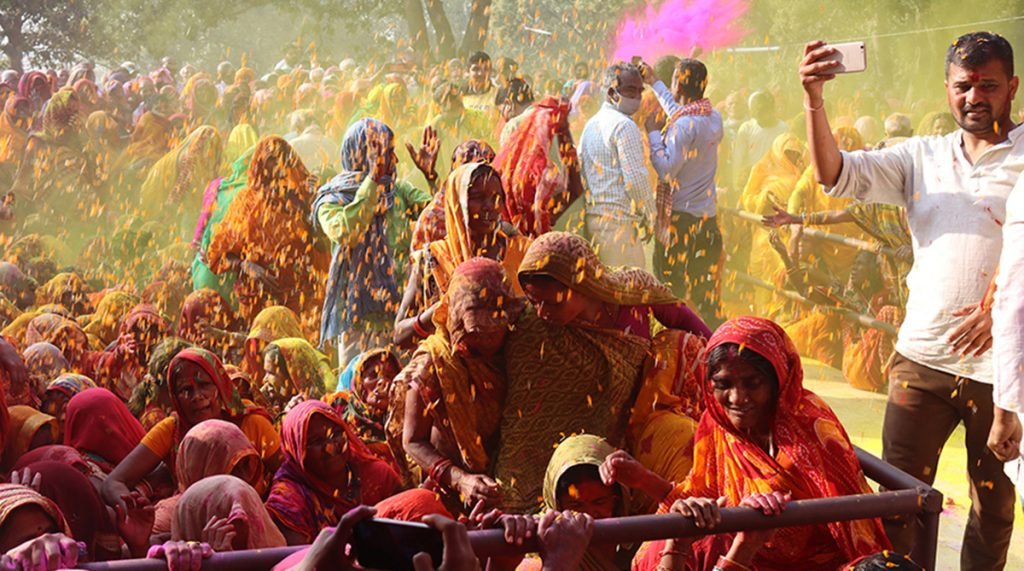
Dhanusha. Devotees participating in the Mithila Madhyamik Parikrama, the great congregation of Mithila, celebrated Holi with great joy on Monday by exchanging colors and 'abir' (colored powder) upon reaching Kanchanban in Mahottari district.
Devotees and ascetics participating in the Parikrama traditionally play Holi every year after reaching Kanchanban. Following this tradition, they played Holi during the rest period of the Parikrama this year as well. Devotees who reached Kanchanban with the palanquin (Dola) of Mithila Bihari joyfully celebrated the Holi festival by applying colors and 'abir' to one another. The Holi celebration in Mithila is considered to have begun with the playing of Holi at Kanchanban.
The Parikrama, which departed from Dhruvkund, reached Kanchanban in Harihanmari, Bhangaha Municipality-9, Mahottari on Monday to celebrate Holi. The Parikrama travelers entering Kanchanban were grandly welcomed by Bhangaha Municipality. Mayor Sanjeev Sah stated that arrangements for entry gates, pandals, and accommodation were made at various points to welcome the participants, and a Holi Milan ceremony and cultural program were organized, complete with arrangements for 'puwa' (a sweet dish), kheer, 'sarbat' (sweet drink), 'abir', and flower garlands.
He mentioned that the Holi celebration at Kanchanban is made special by the significant participation of Mahants (chief priests) of local monasteries, various social and cultural activists, as well as individuals associated with the political sector.
Locals say that the Holi celebration here is becoming more organized every year as a symbol of religious faith and cultural unity. This year, the Chief Minister of Madhes Province, Krishna Prasad Yadav, also participated on this occasion.
Mayor Sah informed that there is a religious belief that Lord Ram and Sita played Holi by exchanging colors and 'abir' in Kanchanban during the Treta Yuga. According to him, the tradition is for the Parikrama, which started from the Mithila Bihari Temple in Kachauri, Dhanusha, to reach Kanchanban on the eighth day to play Holi and spend the night there.
The Mithila Madhyamik Parikrama, considered the great congregation of Mithilanchal and the world's longest religious foot march, which began on Falgun 4, had previously reached Dhruvkund via Hanumanagarhi, Girijasthan in India, Matiyani, Jaleshwar, and Madai in Mahottari.
Mayor Sah informed that the Mithila Parikrama, which officially covers a 15-day journey, started from Janakpurdham, the ancient capital of Mithila, led by two main palanquins: Kishoriji (Goddess Janaki) from the Agnikund of Janakpurdham and Lord Ramchandra of Mithila Bihari from the Kachauri Math of Mithila Bihari Municipality, accompanied by religious processions, bhajans, and kirtans.
After Kanchanban, the procession will proceed to Parwata, Dhanushadham, Aurahi, Bishaul, Kalyanashwar, and return to Janakpur on the day of Fagu Purnima. Thousands of participants join this Parikrama, which is traditionally organized under the leadership of Mithila Bihari.
The Parikrama journey, which stands as a symbol of religious, cultural, and traditional harmony between both Nepal and India, covers 15 resting places, including 13 in Dhanusha and Mahottari districts of Nepal and two in India.
It is the tradition for the co-travelers of this journey to cover a total of 133 kilometers on foot, comprising 107 kilometers in Nepal and 26 kilometers in India. The religious belief is that participating in the Parikrama destroys sins and injustices committed through thought, word, and deed, leading to the fulfillment of desires and salvation (Moksha).
This specific news has been automatically translated by AI. As a result, there may be some inaccuracies or language errors.
_Y6v0INQnzs.jpg)