RSP Leader Balen Shah Unveils Election Manifesto for Jhapa-5 Constituency


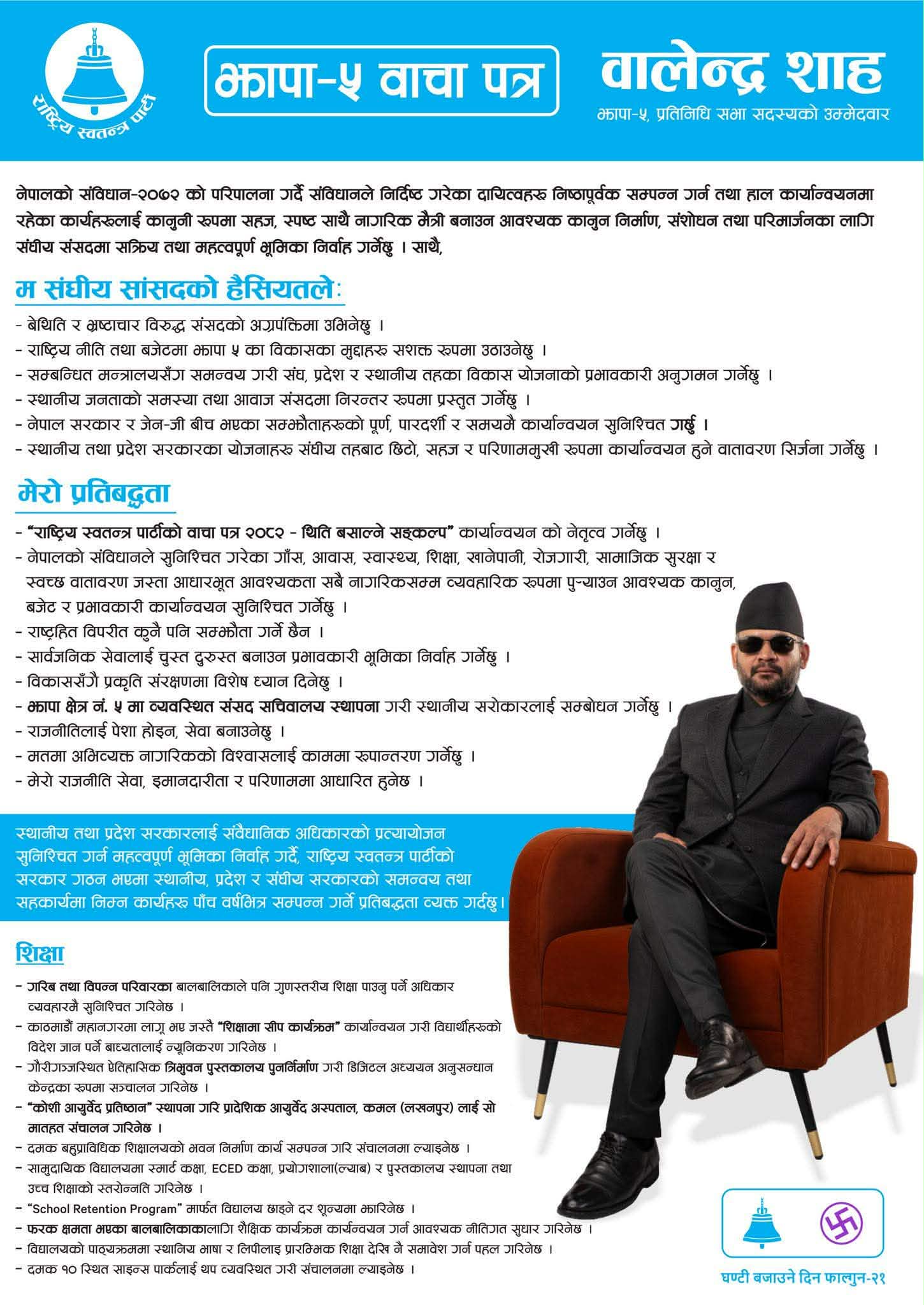
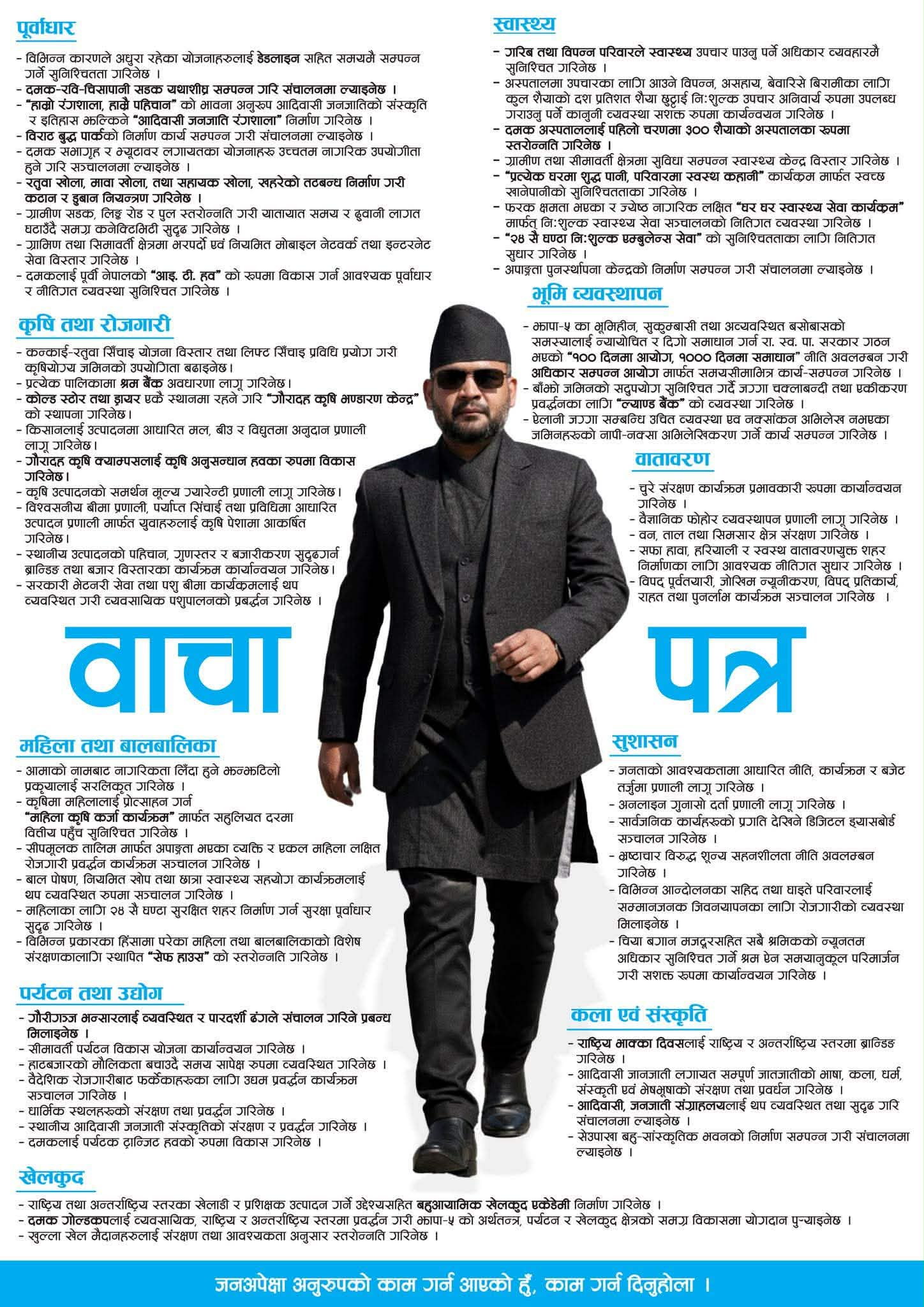
Jhapa. Balendra Shah (Balen), the candidate for the House of Representatives from Jhapa Constituency No. 5, has made public his election manifesto. The manifesto put forth by the senior leader of the Rastriya Swatantra Party and Prime Ministerial contender Shah primarily encompasses agendas ranging from lawmaking in the federal parliament to radical transformation in local education and health sectors.
The manifesto states that the fundamental rights specified by the Constitution of Nepal 2072 will be practically implemented. High priority has been given to enacting necessary laws and managing budgets to deliver basic necessities guaranteed by the Constitution, such as food, shelter, clothing, education, health, and employment, to the doorsteps of the citizens. A commitment has been expressed to stand at the forefront of the parliament to raise concerns against corruption and malpractice.
‘While adhering to the Constitution of Nepal-2072, I will faithfully fulfill the duties specified by the Constitution and actively and significantly contribute in the federal parliament for the necessary enactment, amendment, and revision of laws to make currently implemented works legally simple, clear, and citizen-friendly,’ the manifesto states.
He has written in the manifesto, ‘I will not compromise on matters against national interest. I will play an effective role in making public services efficient and prompt. I will pay special attention to nature conservation alongside development.’
With the objective of bringing revolutionary change in the education sector, this document commits to implementing the ‘Skill in Education’ program, which proved successful in Kathmandu Metropolitan City, in Jhapa as well. This is expected to help students become self-reliant from the school level and reduce the compulsion for foreign employment. Furthermore, the plan to bring the dropout rate to zero through a ‘School Retention Program’ by establishing smart classrooms, laboratories, and libraries in community schools appears very attractive.
Equal attention has been given to the conservation of local physical infrastructure and heritage. Points such as transforming the historic Tribhuvan Library in Gauriganj into a digital research center, establishing the Koshi Ayurveda Academy in Kamal, and completing and operationalizing the building of the Polytechnic Institute in Damak deeply address local needs. The plan to further organize the Science Park located in Damak-10 signals the development of this area as an educational hub.
The manifesto also pledges to establish an organized parliamentary secretariat in Jhapa-5. This will serve as a bridge to reduce the distance between the parliamentarian and the citizens and directly convey local grievances to the parliament.
This specific news has been automatically translated by AI. As a result, there may be some inaccuracies or language errors.
_Y6v0INQnzs.jpg)