Pokhara Squatters Await Land Deeds as Election Promises Fail to Materialize Near Bus Park


Pokhara. Prakash Rana, 58, has been living in Shivtola near the Pokhara Bus Park for nearly 50 years. His parents breathed their last while hoping to receive land ownership documents (Lalpuja).
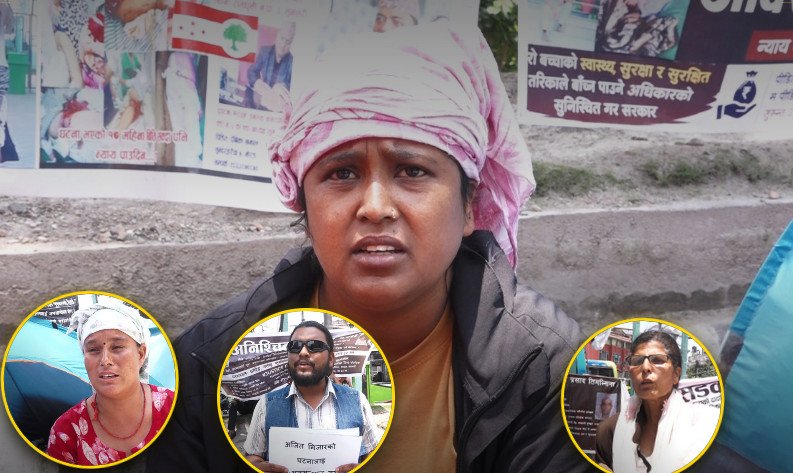
Prakash's grandchildren are now fighting for the same land deeds. "We have been living here in Pokhara since 1979 (2036 BS). Our parents passed away. Now it's almost our turn to go," he says, "During elections, leaders come and promise us land deeds. Political parties have kept us only as a vote bank in the Bus Park area."
Rupa KC of Krishna Tole, right behind the Bus Park, shares a similar plight. The situation she found when she married into the settlement 26 years ago remains the same today. Some vacant lands back then are now filled, and the settlement has become denser. "The place is the same as when I got married," she says, "My mothers-in-law passed away while hoping for land deeds. Half of our lives have been spent here. We have no hope of getting the deeds."
Candidates are busy campaigning door-to-door for the House of Representatives election scheduled for February 21 (Falgun 21). However, the squatters living around the Bus Park feel no excitement. They have seen hundreds of candidates in elections since the Panchayat era. All promised land deeds. Those promises have never been fulfilled. "They have kept people entangled with mere talk for 50 years. Leaders come and say they will provide land deeds or build the Bus Park in a couple of months. Once elected, they never look back," Prakash added.
The construction of the Bus Park and the resolution of the squatter problem become an agenda for political parties in every election. As soon as the election ends, the issue fades. Candidates are currently campaigning with the same old promises. Rupa complains that political parties have only used the residents here. "We are always kept under threat. We fear eviction if we don't vote. Even if we vote, they don't care after winning," she said. "Leaders come, give only assurances. There is no hope they will do anything now." The government does not even have an exact statistic on how many squatters are in that area. According to Rupa, some squatters have left after earning money, and others have bought the shacks of those who left.
In 2032 BS (1975 AD), the then Chief of Pokhara, Shankar Raj Pathak, conceived the Pokhara Bus Park and acquired the land. This land, initially 200.5 Ropanis, has shrunk to less than 60 Ropanis over 48 years. Neither the Bus Park has been built, nor has the squatter problem been resolved. Birbhadra Acharya, a founding member and former chairman of Sahara Club Pokhara, complains that both tasks have failed due to a lack of political will. "Pokhara has already been declared the tourism capital. But there is a negative sight at the first step where tourists alight," he said. "We feel ashamed seeing this. This ugly scene of the Bus Park is disgracing Pokhara itself."
Even knowledgeable people say that political parties use the residents of the Bus Park area as a weapon. According to them, while some residents are genuine squatters, others have come looking for better living conditions. "There are some genuine squatters, and some are 'Sugam Basi' (residents from better-off areas). Some have come because they couldn't bear the hardship in their villages," says a leader from within the Bus Park area. "The government should study properly and differentiate between squatters and 'Sugam Basi'. Genuine squatters should be given land deeds quickly so the Bus Park can be built."
The then Chairman of the Pokhara Valley Town Development Committee, Prakash Mohan Khanal, had conducted a land study. That study also showed that the actual vacant area of the land had significantly shrunk. After being elected Mayor in Pokhara Metropolitan City, Man Bahadur GC formed a committee to resolve the squatter problem.
The committee formed under the coordination of the then Chairman of Pokhara-16, Jeevan Acharya, also submitted a report. However, the report was not implemented. Before that, a committee coordinated by the then Ward Chairman of Pokhara-9, Ram Raj Lamichhane, had gathered the actual data of the squatters. According to that report, it was recommended to manage 194 households in Krishna Tole, 96 in Gantantrik Tole, and 35 to 40 households in Shiva Tole. Among them, 98 percent of the households have obtained squatter identity cards. They state that they are not against the construction of the Bus Park. "If we had been managed properly, we would have moved long ago," said Rupa, who is also the chairperson of the mothers' group. "We are ready to move anywhere if the Bus Park is built. But the political parties are not ready to build the Bus Park." They suggest that the government should be strong enough to build the Bus Park, as land outside the squatter settlement has been sold multiple times.
"Verbal assurances are not enough. Manage us in A, B, C models wherever there is vacant land," Prakash added. "Let the Bus Park be built, and let our shelter be secured. What else are we asking for? Asking for shelter is a fundamental right, isn't it?"
As the election on February 21 (Falgun 21) approaches, candidates are entering the settlement. This time, local residents want written commitments from the candidates. More than 200 concrete houses have been built on the Bus Park land without map approval. Currently, it is estimated that there are more than 500 squatters there.
This specific news has been automatically translated by AI. As a result, there may be some inaccuracies or language errors.