Lessons for Nepal from Bangladesh's Election: Navigating Political Realities and Geopolitics

February 2026 became a turning point in the political history of South Asia, one that will be remembered for years to come. The results of the recently concluded general election in Bangladesh have not only altered the power structure but have also changed the way developing and geopolitically constrained nations like ours think.
After the long-ruling Sheikh Hasina left the country, the unprecedented fervor seen on the streets and the movement led by the new generation, dubbed Gen Z, led many to believe that Bangladesh would completely fall into new hands and the era of the old guard was over. However, when the ballot boxes opened, the story took a different turn. This election has clearly shown that convincing people to run the government is many times harder than stirring up the streets.
It is no small matter that the party of Tarique Rahman, who spent 18 years in exile abroad, won a massive majority, while new faces like Nahid Islam, who led the revolution, were reduced to just 6 seats. This result holds up a mirror to Nepal's politics and answers many unanswered questions.
A Chance for Nepal to Understand Politics
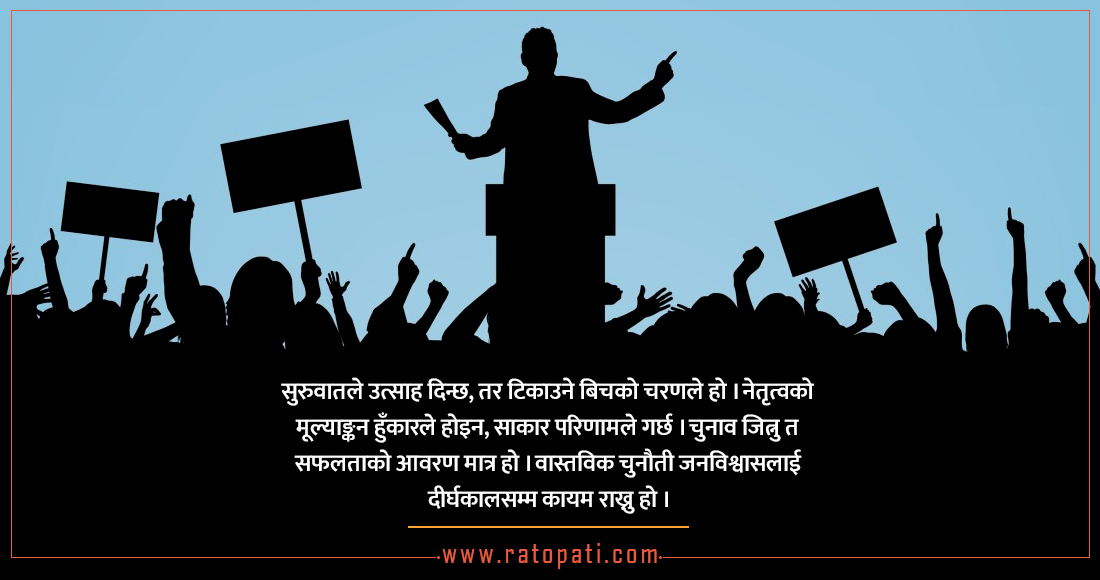
The first and most serious lesson Nepal must learn from the events in Bangladesh is the 'crisis of trust'. It is an art to gather people on the streets by abusing old leaders, burning their effigies, or claiming the system is flawed. But if there is no clear roadmap on how to run the country's economy and improve foreign relations the morning after, the public will not trust the newcomers either.
The new generation in Bangladesh did protest, but their actions, such as vandalizing the historic statue of Sheikh Mujibur Rahman, looting the Prime Minister's house, and attacking those with differing opinions, scared the public. Seeing those scenes, ordinary citizens and middle-class families felt that if the country fell into their hands, it would descend into chaos and the rule of law would cease to exist. Therefore, the people voted for the party that was experienced, even if they were the old guard or slightly tarnished.
New parties or independents emerging in Nepal must understand this in time. Applause might come once based on insults and the 'No Not Again' slogan, but winning votes and surviving in politics requires maturity. If winning elections and running a country depended only on stunts, live videos, or viral content, those youths in Bangladesh would be running the government today and not sitting in the opposition.
Ambiguity of Ideology and the Coalition Trap
Another important aspect is that of ideology and morality. To win the election, the new party in Bangladesh compromised its ideals by aligning with Jamaat-e-Islami, considered fundamentalist. This alienated the educated, liberal, and progressive people in the cities. They questioned why those who spoke of democracy yesterday were now aligning with extremism.
In Nepal too, there is a trend of aligning with anyone and doing whatever it takes to get into power for the sake of winning elections. But the people are not fools. This is a good example of how the public punishes those whose words and actions do not match. New forces must not lose their originality. If those who came promising an alternative to the old parties compromise with the old styles and wrong elements, their longevity will be short. The results from Dhaka have taught us that shortcuts in politics do not lead to the destination.
Yunus's Accusations and Tarique's Diplomatic Maturity
Amidst this political transition, the role and statements of Nobel laureate Muhammad Yunus, who ran the interim government, also need review. He is an expert in economics but not a politician, as his words at the time of his resignation showed. Unable to manage the country's internal security and administration, he tried to escape by blaming the neighboring country India in a very roundabout yet objectionable manner.
In Nepali politics too, the statements made by ministers in the citizen government often appear irresponsible. It was diplomatic immaturity for a person holding the position of head of government or a responsible post in Bangladesh to blame a neighbor or advance conspiracy theories to hide his own failures and weaknesses. His statement unnecessarily chilled relations between the two countries. But, conversely, the experienced leader Tarique Rahman, who won the election, showed remarkable maturity.
His statement immediately after winning was very balanced. He said that for us, relations with both Delhi and Pindi—India and Pakistan—are equally important, but our first priority is the interest of Bangladesh. He did not want to spoil relations by digging up the bitter history or border issues with India, nor did he want to provoke India by showing closeness to Pakistan. This is the main thing Nepali leaders must learn. Our habit of abusing India to seek votes and incite cadres, only to become subservient after gaining power, does not serve the nation's interest. One must be restrained in word choice and balanced in behavior, just like Tarique.
Geographical Compulsion and the Reality of Neighbors
Another big and complex truth we must not forget is that neighbors cannot be changed. Whether it is Nepal, Bangladesh, Bhutan, or Sri Lanka, we are all within or around India's sphere of influence in this South Asian geography. The politics in our region have changed. Governments have changed in all countries except India and Bhutan. New and different priorities have emerged, but the neighborhood has not changed.
This is not anyone's wish; it is a compulsion dictated by geography. We have seen with our own eyes the economic crisis Sri Lanka faced by leaning towards China and provoking India, or the impact on tourism and the economy in the Maldives after 'India Out' slogans. Bangladesh is also surrounded by India on three sides. It has no choice but to move in tandem with India or address India's security concerns. The people of Bangladesh understand this truth. Perhaps the choice of BNP is also based on understanding the reality of geography and neighbors.
The vote must have changed after seeing that the new forces, instead of building relationships, were set to damage them. The reality in Nepal is exactly the same. No matter how loudly we talk about nationalism, ultimately, everything from the salt cooked in our kitchens to the gold, and from the medicine a patient takes to the fuel for vehicles, comes via India's route. Therefore, we cannot achieve development by ignoring or provoking India's legitimate security concerns.
It is time to understand the reality that there can be no peace at home or trade by fighting with neighbors. We have problems and border disputes with India, but those issues must be resolved by sitting at the table, not by burning tires on the streets or abusing on social media.
Trilateral Common Issues and the Path of Regional Cooperation
In the changing political landscape of South Asia, Nepal, India, and Bangladesh cannot afford to walk alone. It has become imperative to emphasize trilateral cooperation. These three countries are so interconnected by geography, culture, rivers, and economy that the problem of one becomes the problem of another. In such a situation, it is wise to move forward for mutual benefit by turning each other's problems into opportunities. Trilateral cooperation should begin in the energy sector because this sector directly affects the economies of all three countries.
Energy cooperation is the most important common issue for the three countries. Nepal has immense potential for hydropower, while Bangladesh faces an extreme energy shortage, and India lies between these two countries. Nepal's electricity cannot reach Bangladesh without using India's transmission lines. Therefore, Nepal must take India into confidence and make energy trade to Bangladesh a core component of the trilateral strategy. This will help Nepal expand the market for its hydropower, ensure a reliable energy supply for Bangladesh, and help establish India as a regional energy hub.
This trilateral energy cooperation will provide economic benefits to all three countries and add a new dimension to regional development. Transit and connectivity networks are the second important issue. For a landlocked country like Nepal, the ports of Mongla and Chattogram in Bangladesh can serve as alternative routes to the sea. For this, the Fulbari-Banglabandha corridor in India needs to be facilitated.
When Nepal's agricultural and commercial goods reach the global market via Bangladeshi ports, Nepal's economy will gain new momentum. Similarly, Bangladesh can utilize Nepal as its natural market. This connectivity network will expand trade for all three countries and strengthen regional integration. Climate change is the third important common issue.
Melting glaciers leading to floods submerge Bihar in India and Bangladesh, following Nepal. A joint mechanism is needed to face this common natural challenge. The impact of climate change is not limited to one country but affects all three equally.
All three countries must work together on flood control, irrigation management, and environmental protection. Only such a joint effort can effectively address the challenge of climate change in this region. Prominent Indian diplomats and scholars have repeatedly emphasized that the prosperity of South Asia depends on connectivity, urging India to adopt a benevolent role as the elder brother rather than the domineering attitude of a big brother.
Nepal's Prosperity in Dhaka-Delhi Friendship
Nepal has a specific interest: the better the relationship between India and Bangladesh, the more beneficial it is for Nepal. Some might think that if relations between India and Bangladesh sour or tension increases between them, Nepal can benefit. But this is a completely wrong and suicidal thought. If mistrust arises in the relationship between India and Bangladesh, India might tighten restrictions on the Chicken's Neck or Siliguri Corridor, citing security reasons.
In such a situation, the dream Nepal has of selling electricity to Bangladesh or reaching the sea using their Mongla and Chattogram ports could all be jeopardized. Our geopolitical reality is that Nepal wants to transition from being landlocked to being sea-connected and diversify its energy trade, and for this, a strong relationship between Dhaka and Delhi, like water and milk, is indispensable. Whether Nepal uses the Mongla and Chattogram ports of Bangladesh or sells its hydropower to the Bangladeshi market, the only route is Indian territory.
A structure like BBIN will also help regional transport and transit. This structure, which is virtually inactive despite being signed, might be prioritized by the new government in Bangladesh. Its activation will support the tourism market in Nepal. A dream of Nepal's prosperity will only come alive when the two big pillars of the neighborhood, India and Bangladesh, move in sync.
Silence of Parties and Diplomatic Immaturity
While talking about a new government and new priorities in Bangladesh, we in Nepal are making a mistake. Although we see prosperity in the peace and stability of Bangladesh, the major political parties in Nepal have not yet formally respected or congratulated the new and clear mandate given by the people there. We ourselves are on the verge of elections, and our parties are boasting about the agenda of running the government with a majority. But tomorrow, after winning the election and reaching power, these same parties will have to discuss bilateral interests with Bangladesh for energy trade or transit.
Our diplomatic immaturity is clearly exposed by the inability to respect such a major change in a neighbor's house or the stinginess in offering congratulations. We must also observe that even India, which has colder relations with us and was most affected by the change in government, has shown great warmth in moving relations forward with the new mandate and leadership. While Delhi is trying to offer warmth to Dhaka, it is entirely wrong for a close friend like us, whose hearts and relations are connected even if geography is not, to ignore the change in Bangladesh in this manner. If this mistake is not corrected in time, we might face a moral crisis when extending a hand of cooperation tomorrow.
BIMSTEC, SAARC, Multilateral Diplomacy, and India
In today's world, one cannot succeed by walking alone or getting stuck only in bilateral relations. The game of major powers is increasing in South Asia. In such a time, to be safe and increase our bargaining power, we must revive and activate regional forums like SAARC and BIMSTEC. Not only this, but we must keep many doors open, such as the Global South or the Shanghai Cooperation Organisation, practicing multi-door diplomacy. The more options we have and the more forums where we can voice our concerns, the stronger we become.
If one power tries to oppress, there is a way to speak elsewhere and seek help. This prevents any single country from acting arbitrarily towards Nepal. For this, India must also abandon the arrogance of a big brother and adopt a parental and benevolent role like an elder brother. India's welfare lies in walking along with smaller neighbors and appeasing them. Otherwise, Delhi must also understand that a house cannot remain safe when fire breaks out in its own courtyard.
Finally, Let Our Vote Not Change Even If Our Mind Does
A serious question stands before us now: whom to give the 'vote' to—those who only seek to win power, or those who can win 'politics and the future of the country'? The time has come to distinguish this. We harbor resentment and frustration towards the old parties. We are tired of the same old faces and the same grating speeches. We have a kind of visual fatigue. But in this critical hour, the Nepali people need to pause, stand firm, and think with a cool head to draw a conclusion.
The situation demands that we momentarily suppress emotion and anger. We must keep in deep consideration what the state of the country will be tomorrow if we change our vote while our mind changes. The people of Bangladesh put this wisdom into practice. Their minds had changed, and perhaps they were not happy with the old faces either. But they understood that changing their vote could send the country into a ditch.
Because they did not change their vote even though their minds changed, Bangladesh is now preparing to set off on the path of development again. Good things will happen there now; there is no scope for bad things. Therefore, it will be wise for us to make decisions using discretion, not by being swept away by emotion. (The author Sabin Dhamala is associated with News Agency Nepal. Author Dhamala regularly writes on contemporary politics, policy advocacy, analysis, and parliamentary affairs.)
This specific news has been automatically translated by AI. As a result, there may be some inaccuracies or language errors.


_HSVUbGHJpC.jpg)