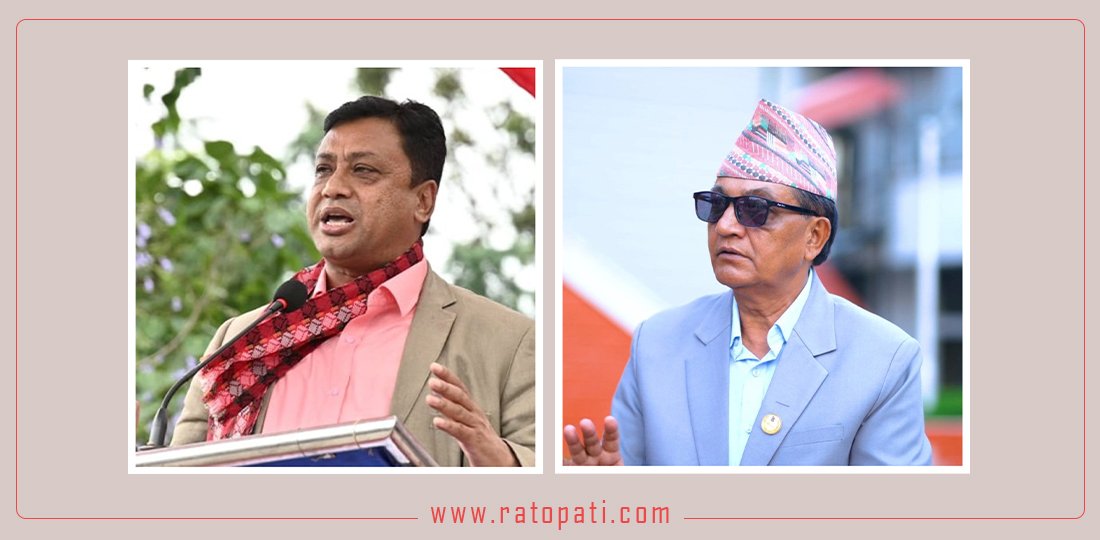
Former PMs Complain About Inability to Complete Full Term Amidst Nepal's History of Political Instability

Kathmandu. Former Prime Minister KP Sharma Oli lamented that he had to become Prime Minister four times to complete a single term (five years). Oli expressed this grievance on Monday while campaigning door-to-door to voters in his constituency, Jhapa-5.
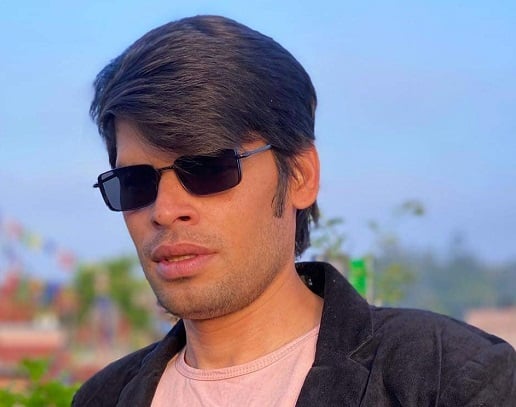
Oli struggled to answer questions from voters asking what he accomplished during his multiple tenures as Prime Minister. Having won the previous six elections by a large margin, he is now actively visiting voters' homes to listen to their grievances and problems after facing a challenge from Balen Shah, a senior leader of the Rastriya Swatantra Party (RSP).
Oli accused his opponents of toppling his government whenever he tried to work. "They cannot tolerate it even if I work a little, and they immediately dismantle it. They don't let me do patriotic work. To bring development, simply standing firm is not enough; one must move forward. Work was underway for that. I would start, and then they would topple the government. I would start again, and they would topple it again. I had to become Prime Minister four times to complete one term," Oli complained.
Oli, who is the Chairman of the CPN (UML), is the same person who served as Home Minister in Manmohan Adhikari's popular government in 2051 BS. After the traditional monarchy fell due to the 2062/63 People's Movement, he became Deputy Prime Minister and Foreign Minister in Girija Prasad Koirala's interim government.
Elected as Chairman at the 9th General Convention of the UML in Ashar 2071 BS, he successfully became Prime Minister four times in 2072 BS, 2072 BS, 2078 BS, and 2081 BS. Oli, who is contesting elections for the eighth time in the elections on Falgun 21, has won all except the 2064 BS election.
When he first became Prime Minister after the promulgation of the new constitution of the Federal Democratic Republic of Nepal, Oli was very popular as a nationalist leader during the undeclared blockade imposed by neighboring India. In the 2074 BS elections, the two major leftist parties, UML and CPN (Maoist Centre), formed an alliance and contested. The leftist alliance, which secured nearly a two-thirds majority in the federal parliament, could not sustain the government for five years.
The leftist government, formed by the merger of UML and Maoist, collapsed after three years, four months, and 27 days due to a power struggle between the two chairmen, Oli and Prachanda, within the Communist Party of Nepal. At that time, Oli was heavily criticized for dissolving the parliament twice, citing internal party disputes. However, the Supreme Court overturned the Oli government's decision, preventing the dissolution of the parliament.
Oli, who built an image as a nationalist leader by incorporating the Nepali territories of Kalapani, Limpiyadhura, and Lipulekh into the political map and getting it ratified by parliament, is seeing a continuous decline in his popularity graph. Having become Chairman for the third term at the party's 11th General Convention held in Kathmandu in the last week of Mangsir, UML has put him forward as its candidate for the next Prime Minister.
During his last tenure as head of government, 23 people were killed in the peaceful demonstration led by 'Genji' against corruption and irregularities on Bhadra 23. In anger over the unarmed 'Genji' being killed, on the following day, Bhadra 24, protestors set fire to state's central administrative building Singha Durbar, the Supreme Court, the Parliament building, and other public and private properties across the country. The 'Genji' uprising caused the collapse of the Congress-UML coalition government led by Oli. Political circles suggest that the suppression of the 'Genji' uprising could deal a major blow not only to Oli but also to the party.
Not only Oli, but former Prime Minister Sher Bahadur Deuba is also among those who have become Prime Minister multiple times since the political change of 2046 BS. Even when he was supporting the government, Deuba was severely beaten at his home during the 'Genji' uprising. The Nepali Army struggled to rescue Deuba and his wife, former Foreign Minister Dr. Arzoo Rana.
He is the only person to have won elections continuously from 2048 BS to the 2079 BS elections. Deuba, considered a master player in power politics, was elected Congress President twice. In a special convention held in Kathmandu in the first week of Magh as his last term was ending, Deuba was removed from the post, and General Secretary Gagan Thapa was elected President. Deuba, who intended to contest as a House of Representatives candidate from his home district Dadeldhura for the last time, did not receive a ticket after Gagan came to power. However, the dispute regarding official recognition is currently under consideration by the Supreme Court.
Deuba, considered the 'Sher' (Lion) of the Sudurpaschim Province, played a major role in securing all 18 constituencies for Congress, except Darchula, in the 2048 and 2056 BS elections. Deuba served as Home Minister in Girija Prasad Koirala's government in 2048 BS. He successfully became Prime Minister five times in 2052 BS, 2058 BS, 2061 BS, 2074 BS, and 2078 BS. Deuba, who was waiting to become Prime Minister for the sixth time in Ashar 2083 BS, saw his dream shattered by the 'Genji' uprising. Deuba, who repeatedly reached executive positions from a common man, has lost political power and party authority in a humiliating manner.
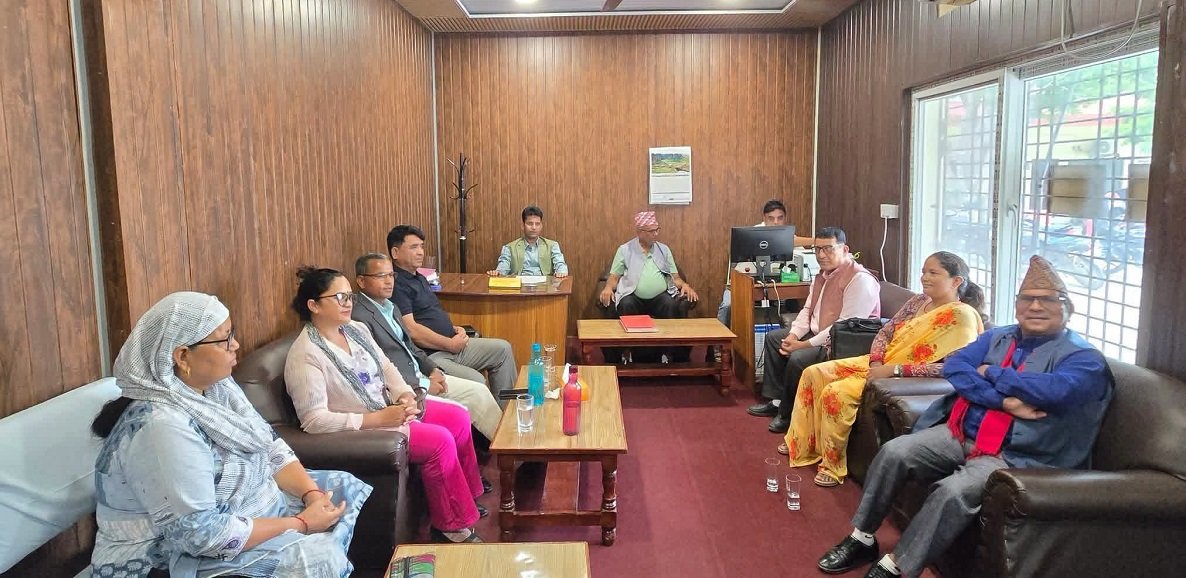
In a meeting of the Congress Central Working Committee held at the central office in Sanepa on Ashoj 28, he complained that despite becoming Prime Minister five times, he never got to work for a full term overall. "I was the Prime Minister of the country five times. But overall, I never got to operate for a full term," he said.
Political analysts suggest that the narrative that nothing happened during Deuba's tenure, who dedicated his life to Nepal's democratic movement, press freedom, social justice, and the strengthening of a liberal economy, is exaggerated. Nevertheless, Deuba could not escape the accusation of failing to perform well despite having opportunities for ending corruption and irregularities and ensuring political stability. Deuba is among the leaders who struggled a lot in the democratic movement but did not receive due credit. He is accused of increasing the buying and selling of MPs, corruption, and irregularities when he first became Prime Minister in 2051 BS.
Pushpa Kamal Dahal 'Prachanda', the coordinator of the Communist Party of Nepal, who became the first Prime Minister of the Republic of Nepal in 2065 BS, has consistently stated that he could not work according to public expectations while in government due to political instability. The Federal Democratic Republic was established in the country according to the agenda of Prachanda, who waged an armed insurgency against the then Royal regime from 2052 to 2062 BS.
Having won elections continuously in 2064, 2070, 2074, and 2079 BS, he became Prime Minister for the second time in 2073 BS and the third time in 2079 BS. Prachanda, Chairman of CPN (Maoist), which became the first party by winning 229 seats in the first Constituent Assembly election, faces accusations of neglecting martyrs, the disappeared, the injured, and the families of the disappeared in line with the spirit of the People's War.
He is accused of failing to play a leading role in good governance, social justice, and prosperity despite leading the government multiple times. However, he played a significant role in the main tasks of the peace process: army integration and constitution drafting. During his most recent tenure as head of government, he made positive efforts towards good governance, social justice, and prosperity.
However, the Prachanda government fell on Ashar 17, 2081 BS, after Congress and UML formed a new ruling coalition. He appealed to the public to give his party a majority in the current elections, claiming that foreign and domestic powers prevented him from working well while he was in government. Prachanda, who is a candidate from Rukum East, is currently on a door-to-door campaign.
Since the establishment of the Republic, these three individuals have taken turns leading the party and the government. The main leaders were also the primary targets of the 'Genji' uprising. Professor Lokraj Baral states that while political instability causing problems in the overall development of the country is one aspect, as Oli, Prachanda, and Deuba claim, the main problem is the leaders' self-interest in power and struggle for authority.
"It is a battle of personalities; self-centered politics is the main reason for the current situation. KP Oli, Prachanda, Sher Bahadur—all had self-centered, self-serving politics, leading to internal party conflicts. They could not govern the state properly. Perhaps it won't happen as much now," he said.
Baral states that the struggle for power and authority seen within political parties since the democratic movement of 2007 BS has prevented any government from completing its full term. Nepal's democratic movement can be analyzed in three phases.
Especially after the restoration of the multi-party system in 2046 BS, the general public had faith that political stability, social justice, physical infrastructure, and economic prosperity would advance. The Nepali Congress secured a majority in 2048 BS and 2056 BS. However, the country suffered a great loss because the party could not manage internal disputes. The Congress had a single-party government after the restoration of the multi-party system.
In 2051 BS, Prime Minister Girija Prasad Koirala's motion of thanks in parliament failed due to internal strife within the Congress. In anger, he dissolved parliament and announced mid-term elections but lost the majority. Analyst Baral explains that the party, seeing the potential for further setbacks, went into the 2056 BS elections by putting the saintly leader Krishna Prasad Bhattarai forward as the prospective Prime Minister, thus regaining a majority. According to him, the 36/74 dispute within Congress prevented the government from lasting long.
On one side, there was extreme conflict within the ruling Congress, and on the other, the state apparatus was collapsing due to the Maoist armed insurgency. After King Birendra's entire lineage was wiped out in the Royal Palace Massacre on Jestha 19, 2058 BS, King Gyanendra seized power by dissolving the popularly elected government. However, he too could not sustain power for long.
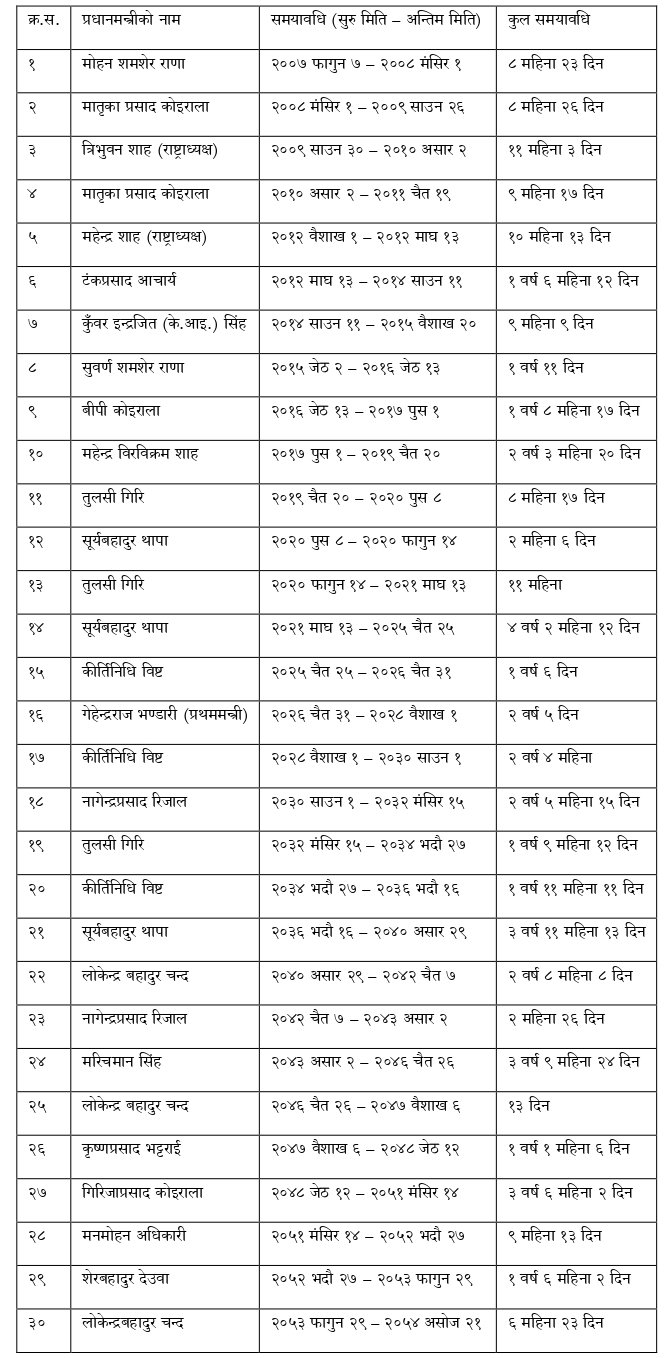
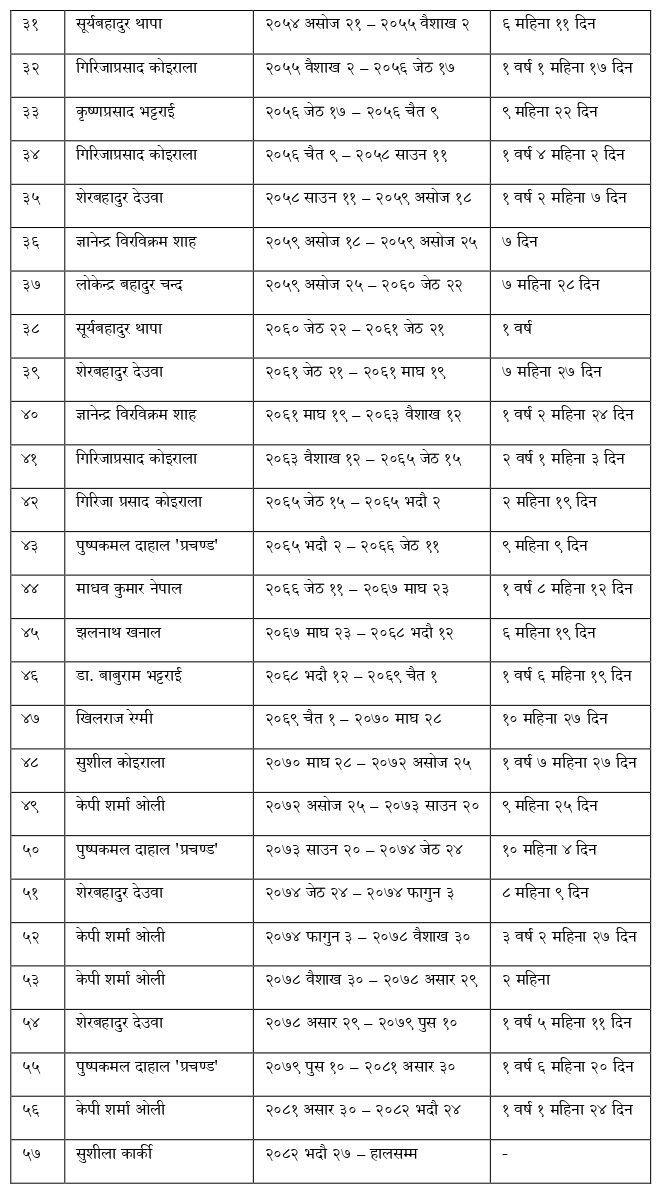
The 12-point agreement was reached in 2062 BS between the then-rebel Maoists and the seven parliamentary political parties, who were angered by Gyanendra's autocratic move. Based on this, the People's Movement of 2062/63 abolished the monarchy. In the 34-year period from 2048 BS to 2082 BS, 31 governments were formed. None of these governments could complete their full term.
Interestingly, even during the non-party Panchayat period imposed by King Mahendra after overthrowing the popularly elected government on Poush 17, 2017 BS, the government could not complete its full term. In the 30 years until 2046 BS, 16 governments were formed. In the 10 years from 2007 BS to 2017 BS, 9 governments were formed. In the 75 years since the establishment of democracy, 57 governments have been formed.
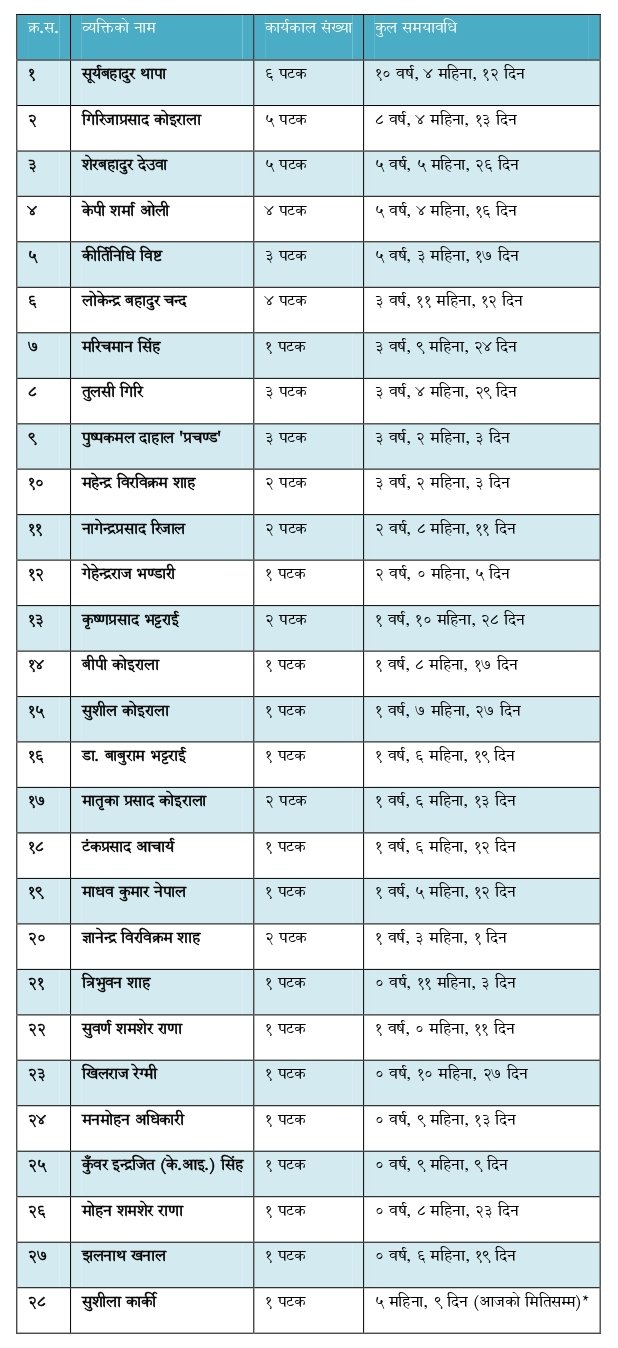
Analyzing the tenure of political leaders, non-political individuals, and the direct rule of the King who led all these governments, 28 Prime Ministers have taken office multiple times. Among them, Surya Bahadur Thapa has served as Prime Minister the most times. He served as the country's Prime Minister 6 times, totaling 10 years, four months, and 12 days. The shortest tenure as Prime Minister so far belongs to Jhalanath Khanal.
Who Served as Prime Minister for How Long?
This specific news has been automatically translated by AI. As a result, there may be some inaccuracies or language errors.