Pilot Error Cited in Fatal Simrik Air Helicopter Crash in Sankhuwasabha

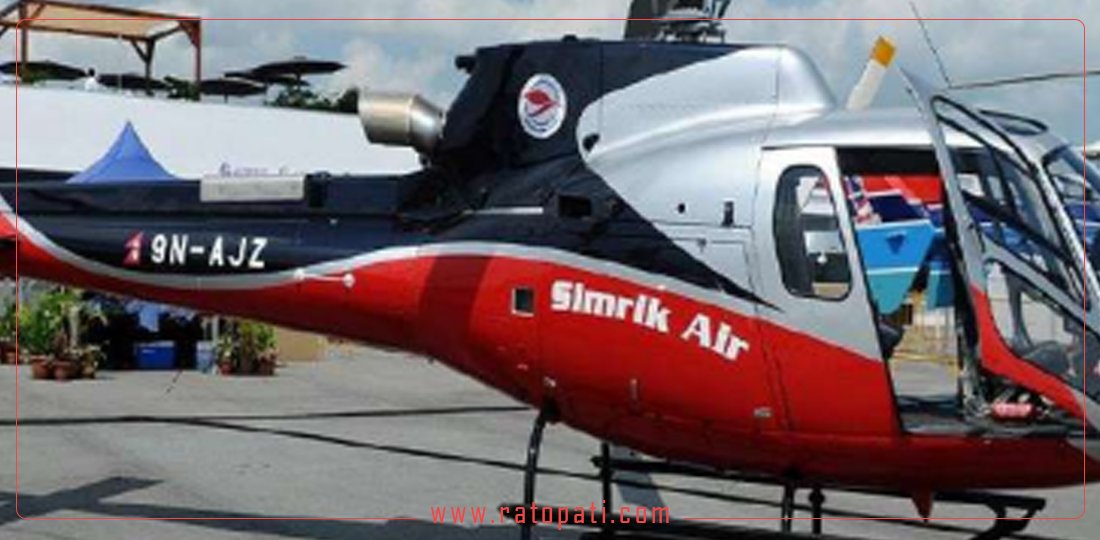
Kathmandu. Pilot error has been found to be the cause of the Simrik Air helicopter crash that occurred two years ago in the Makalu-Barun area of Sankhuwasabha.
This was revealed in the final report prepared by the accident investigation commission formed by the government. The accident took place on Baisakh 22, 2080 BS.
According to the report, the helicopter was in a state of skid contact partial hover when the accident occurred. This is a condition where the helicopter has not fully landed on the ground.
In other words, the helicopter is still flying, but one or both of its skids are touching the ground to some extent. The committee concluded that the problem arose because the pilot exerted excessive control to maintain balance in this situation.
The AS 350 B3e helicopter, registration 9N-AJZ, which was deployed for transporting materials for the Upper Arun Hydropower Project, had already completed 16 flights on the day of the accident. During the 17th flight, the pilot decided to keep only the left skid touching the ground after failing to find a suitable spot for a full landing to unload materials and disembark personnel.
According to the report, the helicopter's load balance suddenly shifted while unloading materials and personnel. The pilot attempted to correct this by using cyclic control to prevent the helicopter from tilting to the left.
However, the pilot over-controlled the helicopter, causing it to become further unstable, and the rotor struck the top of a nearby drilling machine. After the rotor strike, the helicopter fell about 8 feet and overturned.
One local assistant aboard the helicopter died at the scene in the accident. The report mentions that the assistant had not been given any training or information regarding helicopter operations. The pilot was seriously injured in the accident, and one passenger sustained minor injuries.
The commission stated that there was no role for technical malfunction or weather in causing the accident. The report highlighted that there are no written standards for skid contact partial hover and that the pilot lacked specific training for this maneuver.
The commission recommended that for future safety improvements, all helicopter operators must create and get approval from the Civil Aviation Authority of Nepal (CAAN) for an SOP to conduct this training.
Furthermore, the report stated that during sling operations, pilots must only carry trained personnel aboard the helicopter, and CAAN should study pilot training needs to develop a curriculum and guidelines for such special operations.
This specific news has been automatically translated by AI. As a result, there may be some inaccuracies or language errors.


_iL3K2wYemS.jpg)