Jhapa-based Writer Deepa Dahal Discusses Feminism, Social Ills, and Her Work in 'Nine Questions'


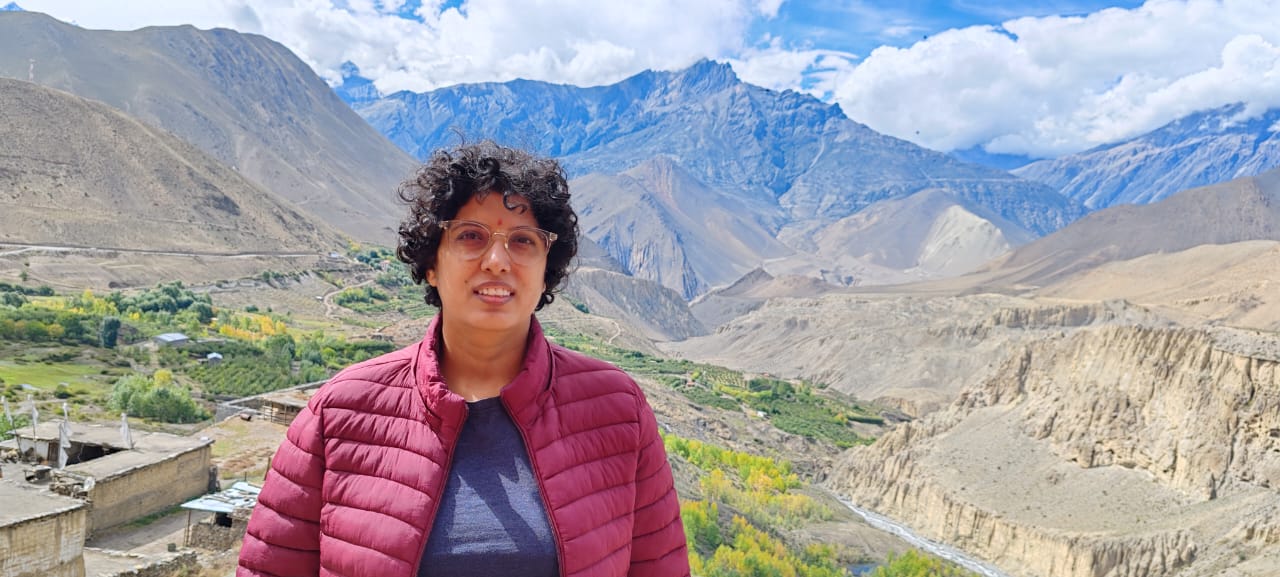
Deepa Dahal from Jhapa, who enjoys writing stories and poems, is active in promoting reading culture and women's rights issues. In her poetry, she rebels against the distorted patriarchal system, while in her stories, she highlights the pain and struggle women face in society. She came before her readers in 082 with the story collection 'Vijayini'. Rama Subedi interviewed her for Ratopati's 'Nine Questions' series:
1. How much do you agree with the saying that every writer/literary figure writes for a specific purpose?
One does not enter the creative field with a set purpose like in other professions. As one continues to pursue their interest, it gradually takes a definite shape. The purpose of writing is formed when the writer/literary figure stops focusing on mere interest or whim and starts writing with a sense of responsibility.
However, I do have a purpose for writing and speaking. Where social evils, superstitions, and blind faith prevail, where the state's laws deny equal existence to citizens, and where the very foundation of the family is built on unequal agreements, it becomes a duty to raise a voice against every injustice happening to oneself and those like oneself. One must speak out about the injustices one has felt, seen, known, and understood. These are also the subjects of my writing.
2. What was the main inspiration that attracted you to writing?
I haven't identified a concrete reason that attracted me to writing. However, sometimes when I look back at my school days in solitude, I feel that some of my insecure feelings and inconveniences are the inspiration for writing. If there hadn't been a continuous association with literature to preserve that inspiration, this journey would not have covered this much distance.
3. What theme repeatedly appears in your writing?
What theme repeats in my writing is perhaps something the readers or critics would say. Since I am deeply moved by human emotions, I write stories of living people. Those people whom others consider less human, and those people who consider themselves weak.
4. If you had to name one work that jolted you, whose name would you mention?
I have many favorite books. Madanmani Dixit's 'Madhavi' is one of them. It shows a world of literary imagination from which it is difficult for the reader to escape. The book depicts the story of ancient times, how state power, patriarchal power, and religious power dominated the development of human civilization, and what the condition of women was like then. The struggle and unwavering stance of the novel's main character, Madhavi, who does not bow down to her father or lover for her self-respect, teaches one to carry the dignity of being a woman and a human simultaneously.
5. What do you think of the current debate in Nepal's literary market?
Generally, the graph of the commodity market is always on the rise. The size of the book market can also be seen expanding in the same way recently. However, the results could have reached greater heights as the necessary work for that remains pending. Firstly, reading books is considered a hobby here; reading has not become our culture. Secondly, the recent generation is reading books digitally in the English language, which Nepali literature seems unable to capture.
Literary debates are currently taking place nationwide. One can be hopeful that this will lead to the advancement of Nepali literature and writers, and it will also play an important role in developing a reading culture.
6. What was the last work you read? How was this work? Please tell our readers about it.
The last work I read was Seema Abhas's novel 'Mahayug'. Through a Pahadi Brahmin woman, it shows the problems women have faced in the past and present simply for being women, while the expected world for women in the future is depicted through a Yakshini. This novel is a beautiful imaginary journey taken through the path of reality. It can show the dream of building a new era for women.
7. Should a literary figure only show the problems present in society, or should they also provide solutions?
In a backward society like ours, every human is struggling with some problem or another. Moreover, women and sexual minorities face additional hardship based on their gender. As for whether a literary figure should only show problems or also provide solutions, the answer also depends on our perspective towards literature or literary figures.
What do we expect from literature or literary figures? Even today, there is a large number of women in our country who are not even aware that they are being marginalized based on gender. They silently accept the problems and discrimination, calling it fate. Where the society itself is lagging, literature can spread out the dried remnants of problems and make the victims confront their sorrows. This is a solution in the form of primary treatment.
8. Has our society been able to understand the level of awareness among women? If so, what effect has it shown on society?
The level of awareness among women has been increasing at a natural rate in recent years comparatively. While women are somewhat more aware of economic self-reliance, they are still lagging in terms of political, social, and religious awareness. This has obstructed the progress of all humankind.
9. Now let's talk about your latest work, 'Vijayini'. Why do you think readers should read this work?
This is a difficult question for me. Why one should read a work is determined by the reader according to their interest and purpose of study. However, if I must recommend from the writer's perspective, 'Vijayini' is a collection of stories whose main issues are the discrimination, violence, and oppression that women have normalized. Therefore, my hope is that women can empathize with the suffering of other women and raise their voices together against it.
My objective is for the stories to prompt readers to delve into the hidden roots of the problems faced by women and marginalized communities. Reading, in any case, broadens the scope of knowledge. Vijayini is a collection of stories written by analyzing social realism and the psychological aspects of people. It helps in understanding people who are like oneself or those who have a different gender and sexuality.
This specific news has been automatically translated by AI. As a result, there may be some inaccuracies or language errors.