Navigating Nepal's Political Crossroads: The Clash Between Extremism and Stability


The biggest problem in Nepali politics right now is not just the inability to distinguish between right and wrong, but also the inability to separate politicians from actors. Looking at the election field, it seems some are presenting policies, some are acting out dialogues, some are reciting revolutionary poetry, and some are showing development trailers. Until Falgun 21, everyone considers themselves a winner. But only time will decide who the winner is on the morning of the 22nd. This uncertainty is the biggest identity of this election.
This election is not ordinary. It is like a baby being born prematurely—outside the regular cycle, risky but full of possibilities. In past elections, alliances, politics of riding on shoulders, and ticket exchanges were common. But this time, all major parties have entered the field alone. In many constituencies, voters are seeing candidates with all symbols after decades. This in itself is a significant turning point in political history.
What is even more significant is that it is almost certain that nearly two-thirds of the faces in parliament will change after this election. Old names, old styles, and old rhetoric will gradually exit. A new generation, new language, and risk-taking figures will enter. Nepal has rarely seen such widespread transformation. As historian Francis Fukuyama stated, when institutions become old and society becomes new, conflict is inevitable. Nepal is currently at that juncture.
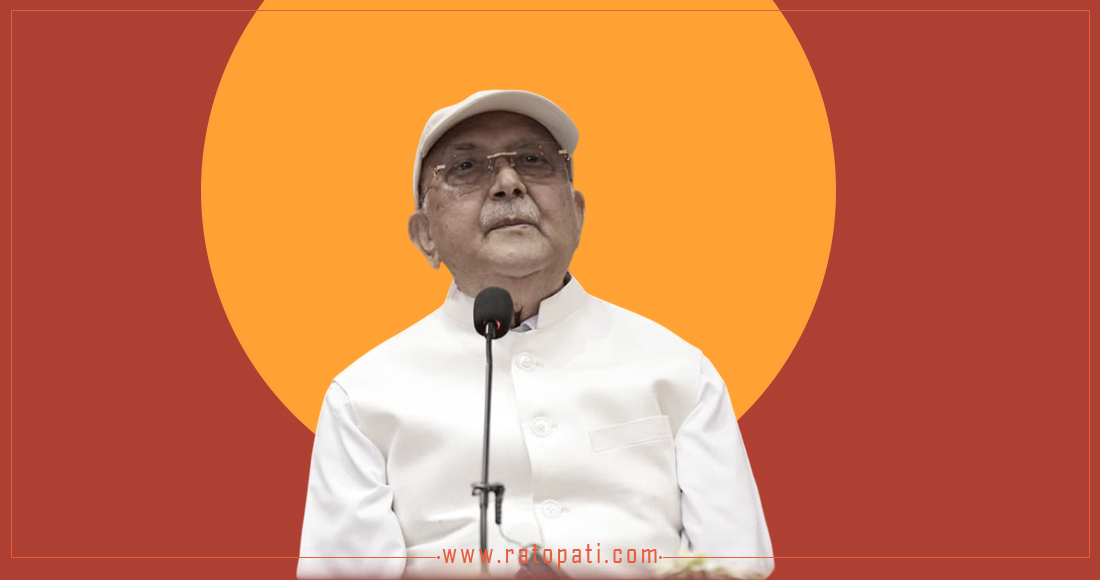
However, along with this change, a danger has grown in parallel—extremism. Current Nepali politics is being pushed towards two extremist poles. One pole is represented by KP Sharma Oli, and the other is symbolized by Balen Shah. Both figures represent a political mindset that cannot stand at the midpoint and considers their own truth as the absolute truth.
The Oli-Balen tussle seen after becoming mayor has now reached the national election. The question here is, which extremism will the public accept?
KP Oli is an old and experienced player of extremism. Institutional power, linguistic attacks, and emotional nationalism have always been his weapons. Balen Shah stands at the exact opposite pole—anti-establishment, rigid, uncompromising, and filled with the self-belief that 'I am right.' Despite different ideologies, the tendency is the same. This election is fundamentally a clash between these two extremes.
The Oli-Balen tussle seen after becoming mayor has now reached the national election. The question here is, which extremism will the public accept? Political philosopher Karl Popper says, 'Extremism becomes dangerous when it stops self-reflecting.' Both poles appear to be heading towards this risk right now.
But history has also shown that sometimes another extremism is necessary to end one form of extremism. The French Revolution, the Indian Independence Movement, and even Nepal's 062/063 movement—in all of them, a new extremism was used to dismantle the old one. In this sense, Balen's extremism cannot be entirely rejected. If Balen has become the necessary figure to end the old political extremism, it is natural for the public to support it.
Gagan Thapa adopted precisely this strategy within the Nepali Congress. To break the deeply entrenched extremism within the party, he presented himself as another form of extremism. At that moment, such a campaign was necessary. Extremism is not always wrong; sometimes it is a transitional medicine.
But the problem starts where the medicine is made into a long-term diet. The country cannot run on extremism forever. Running a country requires balance, understanding, dialogue, and institutional knowledge. This is where the comparison between Balen and Gagan begins.
Gagan Thapa stands in a different place. He is the bridge between the old and new politics. He has seen closely both how power operates and how it corrupts. Among contemporary Nepali leaders, he is the one who best understands the pulse of the time.
KP Oli is speaking a language of fatigue today. Just as Sher Bahadur Deuba lost respect within the party, he has chosen the path of forced exit, losing the opportunity for an honorable departure. Therefore, discussing Oli's extremism is now unnecessary. Time is trying to close that chapter. Balen's massive mandate is needed to close it.
But with the end of Oli's extremism, another question arises—who will run the country now? From here, the debate of 'Balen this time' and 'Gagan this time' begins. Both figures have presented themselves as prime ministerial candidates. Balen is new to politics, and the argument that he has no contribution is just an old political excuse. The fact that a 34-year-old youth has the capacity to shake the country is significant. He is educated, has support, and has courage. All these must be acknowledged.
But Gagan Thapa stands in a different place. He is the bridge between the old and new politics. He has seen closely both how power operates and how it corrupts. Among contemporary Nepali leaders, he is the one who best understands the pulse of the time.
Running a country is not just about being intellectual or popular. It requires leadership that understands international relations, institutional continuity, economic structures, and administrative psychology. The Prime Minister's post is not a laboratory. The country pays the price for experiments here. In this sense, today's need is clear: Balen to end extremism, Gagan for balance. Balen should use his massive mandate to bid farewell to old politics from parliament. Gagan should lead the country towards unity and stability.
This era belongs to Balen, but this moment belongs to Gagan. In the course of time, Balen will also be ready. But today, the hand that should steady the country must be Gagan Thapa's.
In the context of Nepal, viewing Balen and Gagan not as competitors but as sequential successors will be mature politics.
Balen is not a product of ideology; he is a product of anger. This needs to be understood. Leaders born from ideology become institutionalized; leaders born from anger become individualistic. This is where the risk begins. But again, history has shown that sometimes, without anger, the old structure cannot be dismantled.
In the context of Nepal, the extremism represented by Balen is a resistance against the old political structure. Without this resistance, the Oli-Deuba-Prachanda style of politics will not bid farewell. Therefore, Balen's massive mandate is not just a personal victory; it is a political message that the old style is no longer acceptable.
Nepal today is at a juncture where it must shift from charisma to logic. This is why Balen should not be rejected but placed in the right position. In parliament, with a strong public mandate, in the role of breaking the old politics. The Prime Minister's post is not for charisma; it is a post for coordination. Here, the army, administration, diplomacy, and economy—everything must be kept in balance. Gagan Thapa shows this capability. He understands both the street and the parliament. He understands the language of agitation as well as the grammar of policymaking.
In the current world order, the most dangerous thing for a small country is to be swayed by emotion. Emotion can win elections, but it cannot run a country. This is why many countries seek a technocratic or balanced leader after a charismatic one.
In the context of Nepal, viewing Balen and Gagan not as competitors but as sequential successors will be mature politics. First, to dismantle the old structure, Balen for that. Then, to build a new stable structure, Gagan for that.
This specific news has been automatically translated by AI. As a result, there may be some inaccuracies or language errors.