Good Governance: Is It Just an Election Slogan or a Governing Reality in Nepal?


Elections are called a festival of democracy. However, one of the most frequently repeated words in this festival is – good governance. Good governance shines in every party's manifesto, every candidate's speech, every poster, and every slogan. The question arises: Is good governance merely an election slogan or a genuine will to run the administration?
Looking at Nepali politics, good governance has often become the ornament of speeches but has failed to become the soul of governance in practice. Therefore, why the issue of good governance arises in elections, how it arises, and why it fades away has become a subject of serious deliberation.
The general meaning of good governance is an administration based on transparency, accountability, participation, and the rule of law. But in electoral politics, good governance has become a word of custom, which anyone can stretch as they wish. For some, good governance is an anti-corruption slogan; for others, it is the speed of service delivery; and for some, it is merely a claim of 'we are cleaner than others'.
In reality, good governance is the ethics of power utilization, where power becomes a tool to serve the people, not a weapon to exploit them. Although good governance appears to be a common agenda during elections, this issue gradually fades as power gets closer. In the games of alliances, power-sharing, balance of power, and self-interest, good governance is the first thing to be sacrificed.
At the center of good governance is corruption control. But in Nepali politics, corruption has become like a shared secret. Everyone knows, but no one openly admits it.
In the election campaign, good governance often becomes a means of negative comparison – 'We are honest, they are corrupt'. But honesty is measured neither in the manifesto nor in the slogans. If good governance were truly an issue, the questions candidates should answer would be: How will public spending be made transparent? What is the institutional arrangement to prevent the misuse of power? How will security be made citizen-friendly? How will accountability be ensured from the local level to the federal level?
But unfortunately, such questions are rarely heard in electoral debates. Voters vote based on emotion, parties play with slogans, and good governance remains confined to paper once again.
At the core of good governance is corruption control. But in Nepali politics, corruption has become like a shared secret. Everyone knows, but no one openly admits it. Electoral expenses, ticket distribution, contract systems, and access to power – corruption seems to have received silent consent in all these areas. In such a situation, talking about good governance is ironic in itself.
Candidates who run expensive campaigns to win elections come under pressure to recover their investment before focusing on good governance once they attain power. This is why the electoral system itself has transformed into a structure hostile to good governance. As long as elections are not clean, inexpensive, and accountable, good governance cannot become the main mantra of governance.
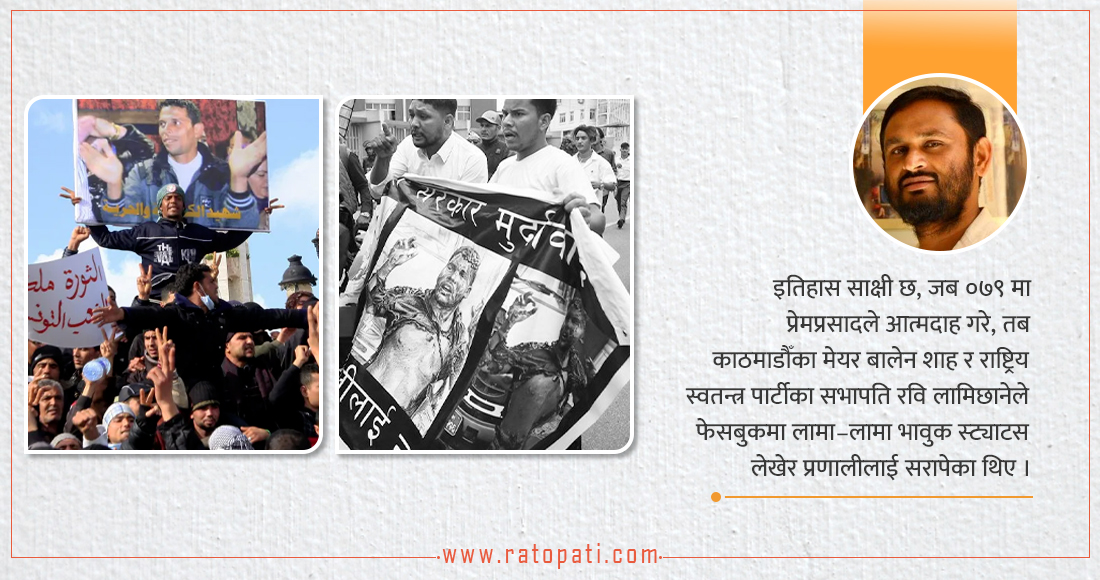
Another important aspect of good governance is citizen security. But in our electoral discourse, security is often limited to 'law and order,' not citizen rights. When the public raises its voice on the streets for its rights, the state's reaction is often repressive. This clarifies that the ruling power still views the people as a suspicious crowd rather than bearers of rights.
If good governance is truly an electoral issue, why doesn't democratic reform of the security apparatus become an agenda? Why is making the police and administration citizen-friendly confined to the last page of the manifesto? The answer is simple – talking about good governance becomes inconvenient once power is attained.
The federal system had increased the possibility of good governance. Power moved closer to the people, local governments were formed, and service delivery was expected to become easier. But in practice, federalism also fell victim to the old political culture. Power became centralized even at the local level, and partisan interests dominated over transparency.
But one cannot escape by blaming the voters. When the options look the same, when honest candidates are lost within the system, the voter becomes disheartened.
When raising the issue of good governance in elections, the question of how accountability is divided within the federal structure must be raised. If the center keeps blaming the local level, and the local level blames the center, good governance will continue to disappear in such politics of blame-shifting.
The issue of good governance does not depend solely on the morality of leaders; it is also linked to the consciousness of the voters. When voters prioritize caste, region, emotion, or momentary gain over the character of the candidate, good governance weakens. The electoral culture itself is the first lesson in good governance.
But one cannot escape by blaming the voters. When the options look the same, when honest candidates are lost within the system, the voter becomes disheartened. This very disappointment fuels anti-good governance politics.
The real test of good governance begins after the elections are over. But unfortunately, manifestos are often forgotten once the government is formed. Monitoring mechanisms are weak, parliament becomes a platform for gathering support rather than an oversight body, and the voice of the citizen is weakened again.
Otherwise, good governance will be discussed in every election, but governance will always continue under the shadow of misgovernance.
If good governance is to be brought from an electoral issue into governing practice, some fundamental changes are necessary. For example, without strict regulation of election expenses, independent and capable regulatory bodies, access to information and transparency, the real practice of separation of powers, and the protection of civil society and the media, good governance remains merely a beautiful word.
Therefore, good governance is not a slogan; it is a culture.
The raising of the issue of good governance in elections is a positive sign. But it only makes sense when it becomes a political culture, not just a slogan. Good governance is not the agenda of any single party; it is the minimum condition for democracy. Only when those who govern remember responsibility instead of power, and when winning the election becomes a commitment to serve rather than just a goal, will good governance be possible.
Otherwise, good governance will be discussed in every election, but governance will always continue under the shadow of misgovernance.
This specific news has been automatically translated by AI. As a result, there may be some inaccuracies or language errors.


_6FSvCrCShE.jpg)