Nepal Government Revises Downward Budget Estimates in Mid-Year Review Amid Spending Concerns


Kathmandu. The government on Sunday published the first mid-term review report for the current fiscal year (2082/83).
The Economic Procedure and Financial Responsibility Act mandates that the mid-term evaluation report of the budget and programs must be published by the end of Magh every year. In accordance with this provision, the government estimates the expected progress for the entire year based on the performance achieved in the first six months.
The tradition of revising expenditure estimates at the six-month mark of the fiscal year has continued in the current fiscal year as well. As in the past, the government has reduced the size of the budget presented for the fiscal year 2082/083. The report estimates that the budget expenditure will be approximately 14.04 percent less than the initial budget allocation. The government has revised its estimates for expenditure and revenue during the mid-term budget review.
For the past decade, every government formed has revised expenditure and revenue estimates six months after the Finance Minister presents the budget on Jestha 15. The practice of reducing the budget size during the mid-term review, which has been present in Nepal's budget for many years, has continued this time as well.
According to the mid-term review report, the revised capital expenditure is significantly lower compared to the initial allocation. The capital budget, initially set at Rs 407.89 billion in the budget statement on Jestha 15, has now been reduced to Rs 243.30 billion. This is a 40.35 percent reduction from the initial budget, possibly the lowest in Nepal's budget history.
In previous years, the government used to estimate expenditure to be less than 20 percent. In the last fiscal year, 2081/82, the government allocated a capital budget of Rs 352.35 billion. During the mid-term review, this expenditure estimate was revised to Rs 243.30 billion, a reduction of 15 percent.
There is a persistent tradition in recent years where the initial size of the budget presented by the government is high, but implementation based on reality is weak. The practice of governments formed over the last ten years presenting large budgets and then reducing them through mid-term reviews has become almost customary.
Looking at the past ten fiscal years, the budget size has been reduced by amounts ranging from one hundred billion to a maximum of two hundred fifty billion rupees through mid-term reviews. In the current fiscal year, expenditure is estimated to decrease by 14.04 percent.
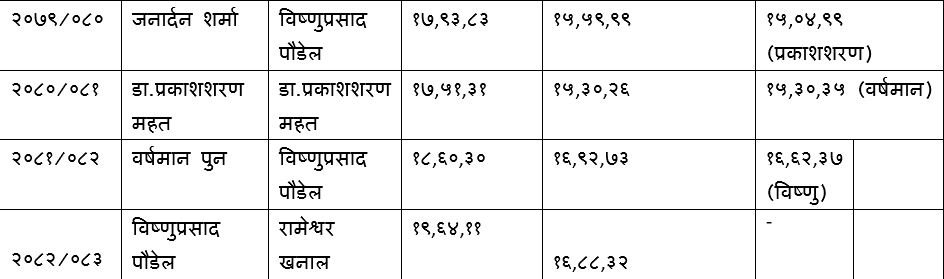
The annual increase in the budget size, followed by a reduction in size and expenditure after six months, negatively impacts the economy and appears to be eroding public trust in the government. The initial budget for the current fiscal year, presented by the then Finance Minister Bishnu Paudel on Jestha 15, was Rs 1964.11 billion. Finance Minister Ramesh Khanal, from the government formed after the J&N movement, has reduced the annual budget size by 14.04 percent through the mid-term review. This included allocations of Rs 1180.98 billion for recurrent expenditure, Rs 407.89 billion for capital expenditure, and Rs 375.24 billion for financial management.
According to the revised budget, the estimated expenditure is Rs 1125.97 billion for recurrent expenditure, Rs 243.30 billion for capital expenditure, and Rs 319.04 billion for financial management, representing 95.34 percent, 59.65 percent, and 85.02 percent, respectively, compared to the initial budget.
Finance Minister Khanal stated that the budget amount presented by Paudel could not be spent, leading to a reduction of 14.04 percent, or Rs 275.7833 billion, resulting in a revised estimated expenditure of Rs 1688.32 billion. The budget has been revised through the mid-term review not only for expenditure but also for revenue, foreign grants, and loan targets, as they are not expected to be met.
This trend of every government continuously cutting expenditure estimates six months into budget implementation, citing inability to meet targets, has been observed for the past ten years. Such annual reductions in budget expenditure estimates negatively affect the overall economy.
However, Finance Minister Khanal claimed that the overall budget size has not decreased through the mid-term review, stating that the total budget size remains at Rs 1964 billion. He said, 'If government agencies show the capacity to spend that budget, this amount can be made available. But it has been revised due to challenges in budget mobilization.'
Finance Minister Khanal also reported that the Consolidated Fund of the Government of Nepal currently has a deficit of Rs 130 billion. According to him, if the Consolidated Fund cannot provide, some control measures must be implemented, and budget mobilization must be done in the right places based on priority as much as possible.
Finance Minister Khanal informed that projects worth Rs 119 billion have been postponed after initial evaluation because they were not ready or did not appear to yield good returns.
Economists suggest that the practice of setting arbitrary limits for revenue, foreign grants, and loan targets in every budget presented by the government, only to revise the budget size downwards during the mid-term review due to implementation problems, is common. They argue that the tendency to reduce the budget size through the mid-term review is a completely wrong practice. Former Vice Chairman of the National Planning Commission, Dr. Min Bahadur Shrestha, stated that the trend of reducing the budget size through the mid-term review is a wrong practice.
Dr. Shrestha considers the reduction of the budget size during the mid-term review as an indicator of government failure. Dr. Shrestha said, 'Revising the budget means admitting that we could not meet the targets we set. The new government and parliament must end this wrong practice.'
He commented that the practice of presenting a large budget and then revising it after six months is a byproduct of coalition culture, political instability, and corruption. He noted that in the current specific situation, development works have been overshadowed as focus has been concentrated on elections and security management. Dr. Shrestha believes that the unfortunate political instability, with 32 governments formed in 35 years, prevents any government from working with a long-term vision.
According to Dr. Shrestha, the budget formulation process itself becomes tainted in a multi-party system, especially with coalition governments. 'There are flaws in budget preparation,' Dr. Shrestha said. 'Parties in a coalition bargain by threatening to topple the government if their programs are not included, which leads to forcefully adding programs to inflate the budget size without considering the actual ground reality of resources and means.' He stated that it is natural for an unrealistic budget prepared under political pressure without secured resources not to be implemented. He also concluded that another main reason for budget revision is the dishonesty observed in revenue collection.
He claimed that the main reasons why revenue collection is limited to 12-13 hundred billion rupees, despite the Nepali economy having the capacity to collect 20 hundred billion rupees when it is sluggish, are lack of effort and corruption. 'A new cycle of illicit collection runs with every change of minister, which prevents funds from accumulating in the government treasury,' he alleged.
Dr. Shrestha pointed out that on one hand, revenue collection is low, and on the other hand, the capacity to spend has also declined. 'When there are no resources, there is no backup, and work stops. On the other hand, both the zeal and effort to perform in the employee structure and leadership have disappeared,' he said.
Similarly, economist Keshav Acharya states that the regular trend of contingency in the mid-term review every year erodes credibility in the government. He commented that cutting the budget size through the mid-term review is harmful to the economy. 'The situation arises from the tendency to include projects in the budget formulation process that are as large as possible, including those of senior leaders and ministers, projects without DPR, feasibility studies, and resource assurance. Our budget formulation process itself is unscientific and impractical,' he said.
Economist Acharya also stated that the government's practice of presenting a large budget every year and then reducing it after six months is political dishonesty and technical weakness. He believes that reducing the budget size is not just a minor technical adjustment but an insult to the public and parliament.
According to Acharya, the main reason for budget revision is the tainted budget formulation process itself. Projects that have not been adequately discussed or prepared in the National Planning Commission and the Ministry of Finance are included in the budget based on political access in the middle of the night. 'Economic and technical aspects are not considered when preparing the budget; plans are selected politically,' Acharya said. 'Plans emerge from the pockets of powerful leaders. New plans are forcefully inserted by typing 5 to 10 new plans while sitting until 12 or 1 AM. The bureaucracy also pushes in plans without study, saying 'yes' to please the leaders.' He analyzed that projects hastily included without preparation are not implementable, leading to the situation where the budget cannot be spent after six months and the size must be reduced. Acharya also argued that the lack of subject-specific knowledge and experience among ministers currently in government has also contributed to the failure in capital expenditure.
'Except for Finance Minister Khanal, many lack experience in government operation and development administration,' Acharya said. 'Ministries have failed to monitor capital expenditure, and budgets are allocated to projects that are not ready, whose implementation is impossible.'
Likewise, economist Dr. Ramesh Paudel also stated that in Nepal, those presenting the budget tend to present large budgets to appear populist, but the inability to implement them leads to the compulsion to reduce the budget. He mentioned that the problem also arises because one government presents the budget, and another government comes into power at the time of implementation. He added, 'The trend of reducing or reallocating the budget has been ongoing for decades. Its repetition has also contributed to excessive budget cuts.'
Which Minister Reduced the Budget Size and By How Much Over Time?
Less than a month after the current fiscal year began, the J&N movement took place in Nepal. The then KP Oli government fell due to the J&N movement on Bhadra 23 and 24. Following the fall of the Oli government, a government was formed under the leadership of former Chief Justice Sushila Karki. Five months have passed since the government was formed. In these five months, Finance Minister Khanal conducted the mid-term review of the current fiscal year's budget.
In the last 11 years, one government has presented the budget, and another government has reviewed it. Only a few finance ministers have revised their own budgets.
Finance Minister Khanal reduced the budget of Rs 1964.11 billion, presented by the then Finance Minister Bishnu Prasad Paudel for the current fiscal year, by 14.04 percent. He revised the estimated expenditure downwards by about Rs 200 billion to Rs 1688.32 billion.
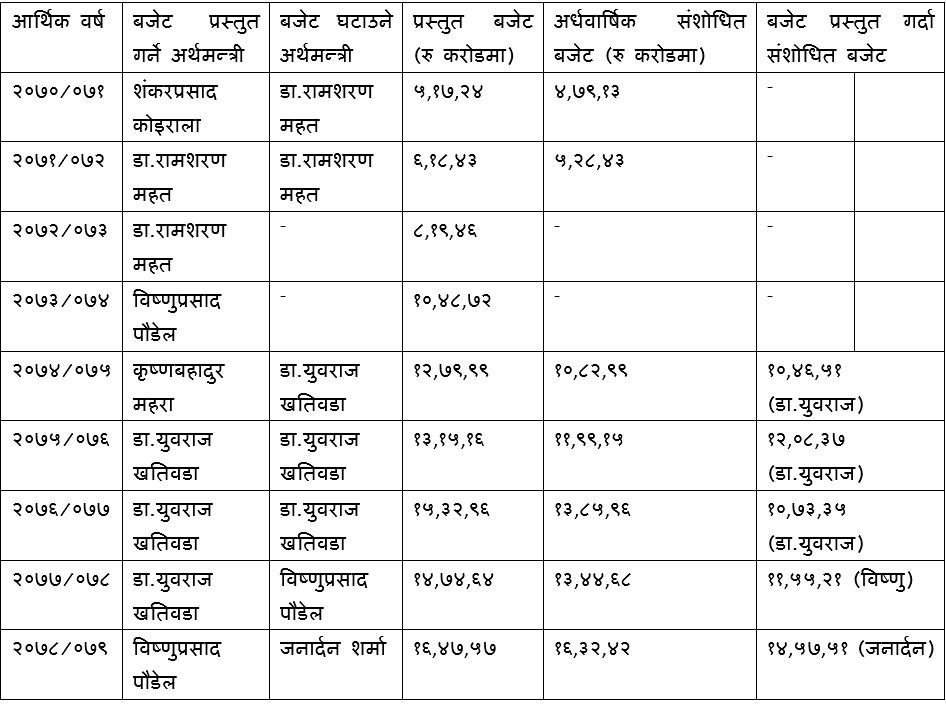
For the fiscal year 2081/82, the then Finance Minister Bishnu Prasad Paudel reduced the budget size by Rs 200 billion, resulting in a revised estimated expenditure of Rs 1692.7335 billion. Finance Minister Paudel alone had cut the budget through the mid-term review three times in the last ten years. In the current fiscal year 2077/078, he revised the budget size of Rs 1464.74 billion, presented by the then Finance Minister Dr. Yuba Raj Khatiwada, downwards by over one hundred billion rupees to a revised estimate of Rs 1344.68 billion. Furthermore, when presenting the budget for fiscal year 078/79, he revised it again, estimating expenditure at only Rs 1155.21 billion.
Similarly, in the fiscal year 079/80, Finance Minister Paudel reduced the budget by nearly two hundred fifty billion rupees through the mid-term review, which was a budget revision of about 13.59 percent. In 2080/081, the then Finance Minister Prakash Sharan Mahat also cut the budget by 12.63 percent during the mid-term review.
In 078/79, the then Finance Minister Paudel presented the budget through an ordinance on Jestha 15, but after the change of government, the budget presented through the ordinance was made public by the then Finance Minister Janardan Sharma through a replacement bill at Rs 1632.83 billion, which was Rs 14.74 billion less than what former Finance Minister Paudel had presented.
The then Finance Minister Dr. Khatiwada also cut the budget he himself presented, citing a shortage of resources for 077/78 compared to 076/77. In the fiscal year 070/71, the budget presented by the then Finance Minister Shankar Prasad Koirala was reduced by Dr. Ramsharan Mahat through the mid-term review.
Similarly, the then Finance Minister Dr. Ramsharan Mahat himself slashed the budget he presented for the fiscal year 071/72; the budget presented when he tabled it was Rs 618.46 billion, which he reduced to Rs 528.43 billion through the mid-term review.
Finance ministers thereafter have continuously revised and reduced the budget size through mid-term reviews. In the fiscal years 072/73 under Dr. Ramsharan Mahat and 073/74, no budget revision was found.
In 074/75, the budget of Rs 1279.99 billion presented by the then Finance Minister Krishna Bahadur Mahara was cut by over Rs 200 billion by Finance Minister Dr. Khatiwada.
Projection of Economic Growth Rate at 3.5 Percent
It appears that the reduction in capital expenditure and the election-centric budget spending will affect economic growth.
The government had estimated an economic growth rate of 6 percent through the budget for the current fiscal year.
However, based on the economic indicators and budget implementation status for the first six months, the government has projected that the country's economic growth rate for the current fiscal year will be limited to 3.5 percent, a reduction of 2.5 percent. The government estimates lower economic growth due to factors such as the decrease in paddy production, area, and productivity, sluggishness in the construction sector, and a downturn in real estate transactions.
In the last fiscal year, the GDP growth rate was 4.6 percent. The revised estimate for the same period last year shows a growth of 2.9 percent in GDP at basic prices. At a press conference on Tuesday, Secretary of the Ministry of Finance Ghanshyam Upadhyaya stated that economic growth in the first six months has been better compared to the same quarter last year. He mentioned that although capital expenditure has been low recently, the overall economy is showing signs of improvement. He said, 'The economic improvement looks positive, which is a quick recovery in a short time.'
Furthermore, Upadhyaya stated that there has been significant progress in mobilizing domestic loans. According to him, 49.08 percent of the annual target, amounting to Rs 177.6669 billion, has been mobilized as loans. The Ministry of Finance reported that foreign aid commitments worth Rs 65.39 billion were received during the review period, with grants accounting for 49.44 percent.
Economist Acharya, however, stated that the economic growth rate will be affected because the current fiscal year's budget spending is heavily focused on elections. He said, 'Low capital expenditure affects the economic growth rate. This situation appears to bring stagnation to the overall economy.'
This specific news has been automatically translated by AI. As a result, there may be some inaccuracies or language errors.