Political Battle Heats Up in Parbat as Parties Vie for Trust Ahead of General Elections


Baglung. Political parties in Parbat are striving to win the trust of the public according to their respective strategies for the upcoming House of Representatives elections. The Nepali Congress has already achieved a 'hat-trick' by winning three consecutive elections in Parbat: the 2056 parliamentary election and both Constituent Assembly elections.
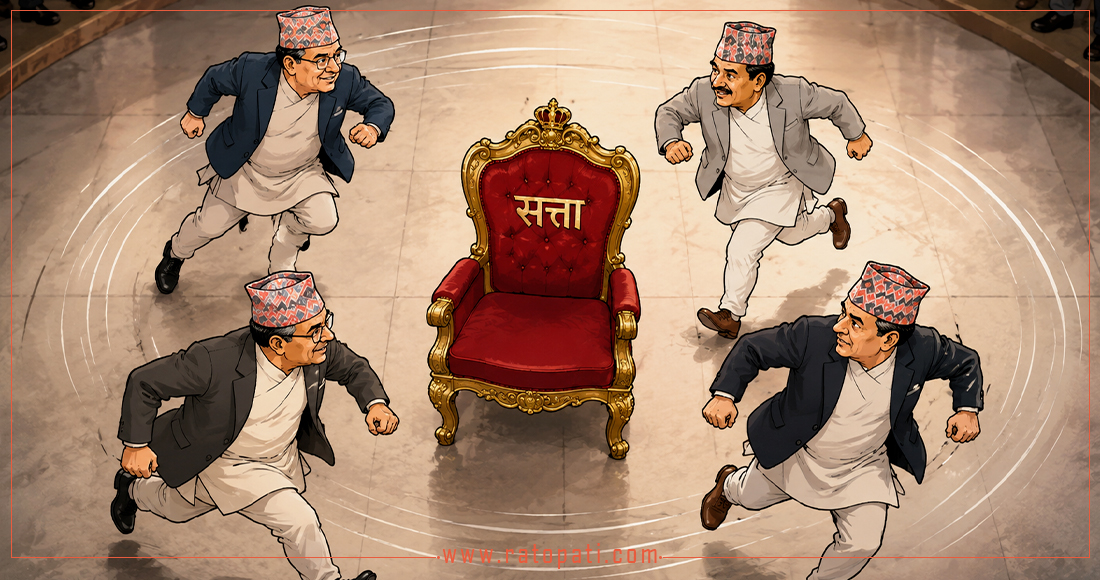
Since then, Congress has failed to make a 'comeback' in the parliamentary elections in Parbat. CPN-UML, victorious in the 2074 and 2079 parliamentary elections, is entering the fray aiming for a 'hat-trick'. However, the Rastriya Swatantra Party (RSP) is also advancing its campaign with the support of young voters to prevent UML from completing its 'hat-trick'.
There are 17 candidates, including those from various parties and independents, contesting in Parbat, which has only one electoral constituency. Thirteen political parties and four independent candidates are currently busy wooing voters.
The Nepali Congress candidate, Arjun Prasad Joshi, is a familiar face here. Joshi achieved a 'hat-trick' by being continuously elected in the 2056 parliamentary election, the first Constituent Assembly election in 2064 BS, and the second Constituent Assembly election in 2070 BS.
CPN-UML candidate Padam Giri is also a familiar face. He defeated Congress candidate Joshi with the support of the Leftist Alliance in the 2074 parliamentary election. In the 2079 election, Giri secured his second victory, defeating Joshi, who was the joint candidate of the five-party alliance including Maoist and Unified Socialist, by a margin of 2,263 votes.
Giri is now aiming to complete his victory 'hat-trick'. However, he faces a strong challenge not only from his perennial rival Joshi of the Congress but also this time from Sagar Bhusal of the RSP, who is riding a wave of change.
The Communist Party of Nepal has nominated Manahari Sharma as its candidate in Parbat. However, looking at past election results, the popular mandate of the parties now unified under the Communist Party of Nepal does not appear competitive here.
In the 2074 election in Parbat, UML's Giri received 39,275 votes, while Congress's Joshi received 26,819 votes. In the 2079 election, even as the joint candidate of the five-party alliance, Joshi, who was defeated by UML by a margin of 2,263 votes, received 27,609 votes, while UML's Giri was elected with 29,872 votes.
At that time, Rastriya Swatantra Party's Jal Bahadur Purja Pun had secured 4,173 votes.
According to the 2079 vote count, in the proportional representation category in Parbat, CPN-UML received 25,314 votes, and Nepali Congress received 18,817 votes. CPN (Maoist Centre), now part of the Communist Party of Nepal, received only 7,036 votes, and the then-Unified Socialist received 861 votes. RSP, on the other hand, received 9,679 votes in the proportional representation category.
Fear of the New for the Old, Reliance on Youth for the New
As in other districts, in Parbat this time, there is a possibility that new parties might benefit from the competition between the old parties. Due to the polarization within Congress following the General Convention, Congress faces a challenge in securing its traditional vote base, while UML, which has been challenging the change sought by the Gen Z movement, faces an equally big challenge in swaying voters towards its own viewpoint.
Manahari, who worked closely with the then-CPN Chairman Pushpa Kamal Dahal 'Prachanda' for a long time, is striving to win the trust of voters by highlighting his contribution to the development of Parbat while working with Prachanda. However, a weak organization appears to be a challenge for him too.
RSP, which secured over four thousand votes in the direct election and over nine thousand votes in the proportional representation category in the 2079 election without a strong organization, is now aiming to turn the results in its favor by spreading the wave of change. The growing 'craze' among the younger generation for RSP has become a challenge for the established parties.
The Biplav-led Communist Party of Nepal (Maoist), which boycotted elections for a long time, has also fielded a candidate in Parbat. Krishna Bahadur BK is the candidate from that party. It appears that various leftist leaders might support BK.
Similarly, Bhimlal Neupane of Rastriya Janamorcha, Yambhadur Chochangi Pun of Ujyalo Nepal Party, Durgabahadur Malla of RPP, Elina Suwal of Nepal Workers and Peasants Party, and Pabitra Malla of Aam Janata Party are also in the electoral arena.
Local Election Results of 2079
In Parbat, which has two municipalities and four rural municipalities, Nepali Congress won Kushma Municipality, Phalebas Municipality, Jaljala Rural Municipality, Paiyun Rural Municipality, and Bihadi Rural Municipality, while CPN-UML won Mahashila and Modi Rural Municipalities.
In Kushma Municipality with 14 wards, Nepali Congress won wards 1, 2, 4, 5, 7, 8, 9, 14; UML won wards 3, 6, 10, 11, and 13; and an independent candidate won ward 12.
In Phalebas Municipality with 11 wards, Nepali Congress won wards 1, 3, 4, 6, 9, 10; and UML won wards 2, 5, 7, 8, and 11.
In Jaljala with 9 wards, Nepali Congress won wards 6 and 8; CPN-UML won wards 1, 2, 3, 4, 5; and CPN (Maoist Centre) (now Communist Party of Nepal) won wards 7 and 9.
In Paiyun Rural Municipality with 7 wards, Nepali Congress won wards 1 and 7; and UML won wards 2, 3, 4, 5, and 6.
In Mahashila Rural Municipality with 6 wards, Nepali Congress won ward 5, while UML won wards 1, 2, 3, 4, and 6.
In Modi Rural Municipality with 8 wards, Nepali Congress won wards 4, 5, 6, while UML won wards 1, 2, 3, 7, and 8.
In Bihadi Rural Municipality with 6 wards, Nepali Congress won wards 2 and 4; UML won wards 1, 3, 5; and CPN (Maoist Centre) won ward 6.
This specific news has been automatically translated by AI. As a result, there may be some inaccuracies or language errors.