National Pride Projects Lagging: Mid-Year Review Shows Dismal Financial Progress

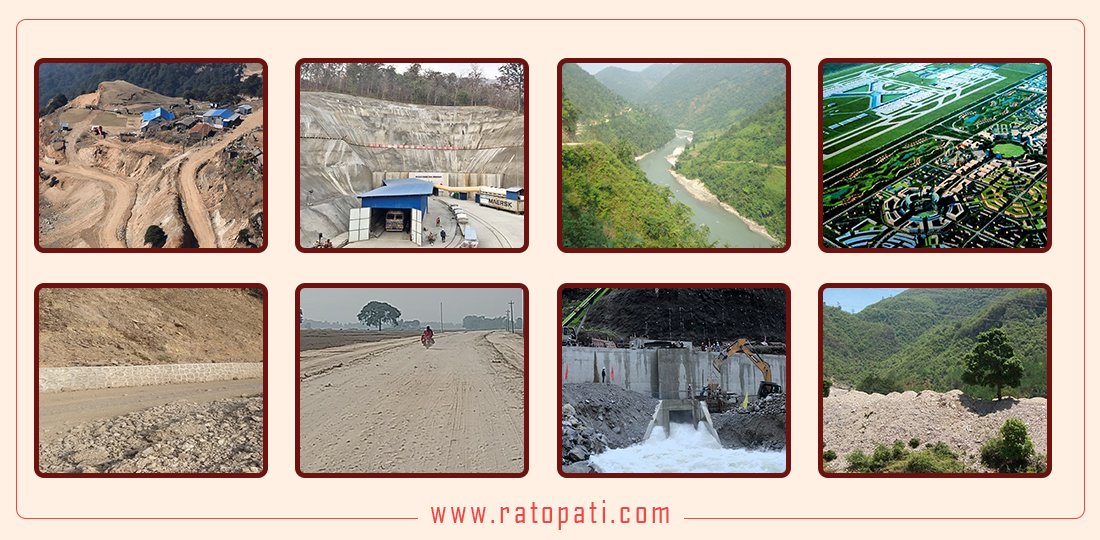
Kathmandu. The financial progress of National Pride Projects, which hold strategic importance for the nation's economic transformation, appears dismal. According to the mid-year evaluation report for the current fiscal year 2082/83 published by the Ministry of Finance, the expenditure against the budget allocated for these pride projects is significantly low.
Statistics confirm that despite being prioritized by the government, the pace of implementation is moving at a snail's pace. The government had allocated a total of NPR 67.0864 billion for 23 pride projects for the current fiscal year.
However, by the halfway point of the fiscal year, i.e., by the end of Poush, only NPR 10.3939 billion has been spent. This accounts for a mere 15.49 percent of the allocated budget. While the government aimed to boost capital expenditure and create employment through these large-scale projects, this progress during the mid-year review period raises serious questions about the government's targets.
The number of National Pride Projects, which began with 17 projects in the fiscal year 2068/69, has now reached 27. Among them, the Upper Tamakoshi Hydropower Project, Gautam Buddha and Pokhara Regional International Airports, and the first phase of the Melamchi Water Supply Project have been completed and are operational.
Currently, the remaining 23 projects are in the implementation phase. These projects were selected based on criteria requiring a minimum cost of NPR 50 billion, national security or strategic importance, and a significant contribution to job creation.
The physical progress of the projects also shows mixed results. Based on data up to the fiscal year 2081/82, the physical progress of the Pushpalal (Mid-Hill) Highway has reached 81.73 percent, while the Postal Highway shows 74.35 percent progress. However, the progress on the nationally important Kathmandu-Terai Expressway (Fast Track) remains slow, with the Ministry of Finance reporting only 42.13 percent physical achievement.
The government had categorized these projects as strategically important from economic, social, cultural, and national security perspectives, aiming for them to contribute to the country's long-term economic growth and structural transformation. However, the report points out that the old problems of land acquisition and compensation distribution, legal complexities in forest area utilization, lack of coordination among government agencies, and local-level obstructions have halted the momentum of the projects.
To resolve these issues, the Ministry of Finance has suggested some corrective measures. It has concluded that in the future, contracts should only be awarded after completing the Detailed Project Report (DPR) and land acquisition processes as preparatory work for the projects. Furthermore, there is a recognized need to establish a separate legal and administrative structure for the pride projects and ensure fixed tenures for project chiefs by preventing frequent transfers. Due to the failure to resolve these problems in a timely manner, the timeline for National Pride Projects continues to be extended over years, leading to escalating costs.
This specific news has been automatically translated by AI. As a result, there may be some inaccuracies or language errors.