
Former Maoist Activist Manarishi Dhital Seeks 'Final Showdown' in Jumla Elections

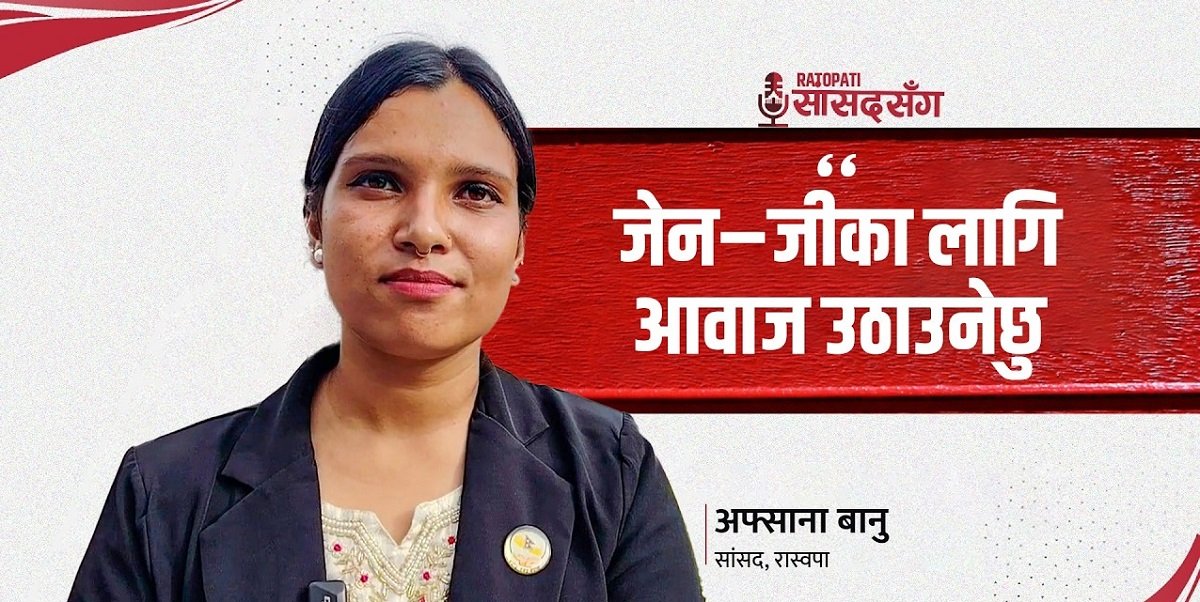
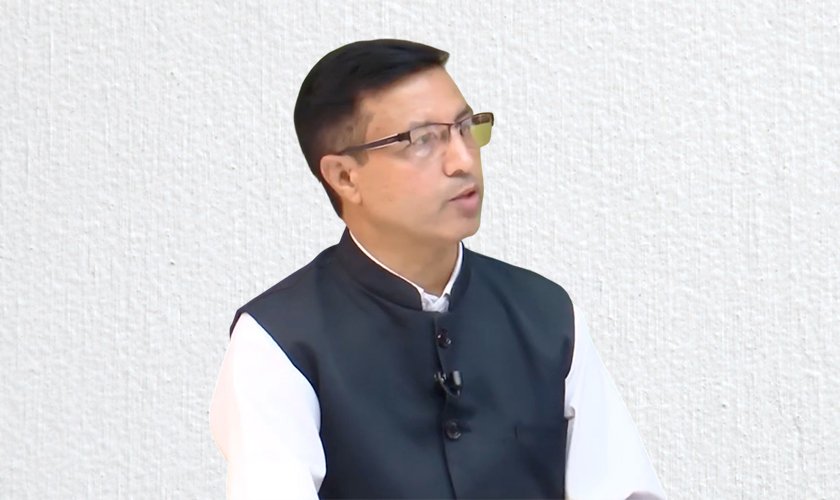
Kathmandu. Manarishi Dhital was active in Maoist politics for 30 years. Dhital, who has established an identity as a writer and journalist, is now a candidate from the Progressive Democratic Party (PrloPa) in Jumla for the upcoming elections.
He has published ten books compiling his experiences from the decade-long People's War, during which he was imprisoned multiple times. Dhital was interviewed by Ratopati for its ‘War or Peace’ segment focusing on the elections. Presented here is the edited excerpt of the interview (the full version can be viewed in the video):
Why did you choose Jumla for the elections?
Jumla is my motherland. The love for one's motherland is truly deep. I was forced to leave Jumla at the age of ten. Yet, wherever I went, every dream I saw was of Jumla. I felt that after being nurtured and understood by Jumla for those ten years, my remaining duty must be dedicated to Jumla. The condition of the children there then is the same as it is now, I realized. My mother and father passed away there. The flames from their cremation still inspire me to go to Jumla. Our party also made a decision for me to go to Jumla.
You lived in Australia, one of the most developed countries in the world. A person who could have lived a life of prosperity has returned to Jumla. Why did you choose the path of hardship again?
This is not hardship. I chose politics after my level of consciousness developed. In 2052 BS, the People's War was chosen. The path to liberation was a distant prospect. After that, it was either the path of death or the path of jail. By coincidence, I couldn't choose death. But I did go to jail. Wherever I went—jail, jungle, or abroad—I determined my political and social duties. As part of that duty, my motherland and the soil that nurtured me are calling me. No matter what good life I saw elsewhere, I didn't feel a separate attraction to that life.
Rather, the life left behind, the friends with whom I grew up in childhood, are still struggling in their own ways. I found their struggle beautiful. After that, I felt like collaborating with them, and realizing that my own life's duty remains, I felt like walking that path again.
You left the party where you invested your prime years?
Ten years were a phase of intense struggle. Another ten years were spent in the peace process phase. In the next ten years, a new constitution was formed. After that, it was thought that the path to peace and prosperity would move forward smoothly. The subsequent ten years also passed. In the last decade, I was forced to think more deeply.
Especially in the decades of '72 and '82 BS, democracy and republicanism were hijacked by a different system. We didn't even realize when that system was established. And, the ones who established this system turned out to be our respected leaders. They transformed the party and democracy into a 'leader-centric system' (Netatantra). Freedom of expression ceased within the party. The party became the center of many evils and corruption. Then, a situation arose where it was difficult to stand before the public and say we are workers of that party and those leaders. I feel that our own leadership team created all this. Therefore, after shedding the burden of 30 years, I have embarked on a new journey against the 'leader-centric system'.
Coming to Kathmandu from Jumla at the age of ten must have been a risk. Joining the war in 2052 BS was another risk. Going from Kathmandu to Australia must have been another kind of risk. After 40 years, returning to Jumla and taking another risk, don't you feel that way?
I like risk. Also, I think my friends and well-wishers say that because they love me too much. They might have said that because I prefer to walk the path of risk. But I don't call it a path of risk for myself again.
Why not?
To be honest, I was imprisoned. But I did not suffer the extreme torture that many of my friends endured. There might have been mental torture, but I did not suffer physical torture. In that regard, I doubted whether I was a true revolutionary or not. Because I would ask myself what I would have done if I had faced the extreme torture my comrades and friends faced.
After 40 years, you sought Jumla, but has Jumla sought you?
I think Jumla has sought me. There are two or three reasons for this. There are simple people in Jumla. In a place where a narrative has been built that only individual heroes in Kathmandu or some powerful people are the saviors here, the entry of figures like me has shown that it is not so. It has been widely discussed that a simple person like me, one of our own sons, someone without money etc., can also be our leader, our representative.
Since I was born and raised here, and traveled during the last People's War, even though I haven't lived continuously, I am personally a figure loved in Jumla in a way. Because of this, as an election candidate, a discussion and conversation have indeed started in every village.
What are your key issues as a candidate in Jumla?
We are trying to convey that our representation is needed to bring the country out of the situation created after the recent youth movement. This is because many youths from Karnali participated in that movement. The debate about what the essence of the movement carried out by those youths is, and who are the people who can grasp that essence, has also started, and that is what I have primarily brought forward.
The tendency to consider leaders as gods or deities became particularly dominant in the last 10 years. That is not true. Let us keep gods or deities in their place, but the point is to establish that a leader is a human being. Secondly, leaders have become creators of such a network of corruption; the network of corruption created by the top leaders has reached down to the lower levels. That needs to be broken.
You mentioned the 'Gen Z rebellion'. Jumla's history, since the Panchayat era, appears rebellious. After the Gen Z rebellion, won't the leading party and its representatives take charge? Will you be needed?
There are friends in the field who prefer to call themselves alternative political parties. But every time, I have been in favor of revolution. Therefore, the recent youth movement, although the destruction that occurred is unfortunate, I call it a revolution in terms of consciousness. I don't delve much into who infiltrated or what happened. But the youth were trying to forcefully impose a system that the 'leader-centric system' was trying to impose on our society, and a system similar to the one we discarded in the past, where a few limited leaders and a few limited individuals controlled the entire world around them by hijacking democracy and republicanism. We had to go to end that, and we went.
The issues you mentioned are very generalized or theoretical, applicable nationwide. But won't the locals seek local issues like roads, the value of their labor, or markets for their produce?
There are many things left to be done in Jumla. I saw many incomplete things. Whether a parliamentarian can do those incomplete things, or not, is something we need to discuss again. Can a parliamentarian do it? Is it permissible? Is it within their scope? That question exists. The road from Nagma to Sinja in Jumla has not been built. There is a track, but it is difficult. The people's issue is when that road will be good. It seems water taps are installed, but water doesn't flow. Electricity poles stand in various places, but there is no electricity when needed.
Similarly, there is a problem with communication networks. There is the issue of markets for farmers' produce. We produce good apples, but it is difficult for them to reach Kathmandu. Even if they reach, it is difficult for them to get a good price. There is a public debate on how to get Marshi rice to the external or international market. There are also possibilities for animal husbandry in Jumla. Employment is a major problem. The trade of sheep's wool and tourism also have equal potential. We lack skilled manpower. Work needs to be done for that.
You have pointed out problems, problems, and more problems. When listening to previous public representatives, it seemed like nothing was left to be done in Jumla?
They used to say it as if nothing was left. I also used to hear that.
There are so many problems. People might ask you, Manarishi Dhital, what contribution have you made to Jumla so far?
I am aware of the work done in Jumla since 2063 BS. For example, the biggest achievement is the Karnali Academy of Health Sciences here in Jumla. There was also the Karnali Development Commission at one time. Dr. Baburam Bhattarai was the Prime Minister during the process of establishing both. We used to sit close to him, listen to conversations, discuss, and work on plans.
There were no concrete bridges in Jumla. Together with the youth friends there, we built concrete bridges over the Himalayan rivers connecting thousands of people. I am aware of these works. But they were built with the taxes paid by the Nepali people, the people of Jhapa or Ilam, or the taxes paid by some employee, police officer, or trader to the nation. They were built with the money from the pockets of the Nepali people. Claiming that they were built due to my contribution would be unethical. I will not say such unethical things in the future either. Personal initiative plays a role. That's all.
Your competitors appear very aggressive. You are so mild. They say elections are not won by being mild?
The people are mild. The people of Jumla are civilized and cultured. But they are also rebellious. They are conscious people. The people of Jumla no longer believe in loud slogans and empty promises. Jumla is looking for a simple figure, a mature figure, one who can build collective dreams, not personal ones. Some of my friends are moving around with crowds. They are celebrating victory rallies with garlands. This is not the time for that. The state of the country is not one where we should be celebrating happiness. Even if we win the election, it is not a situation to celebrate happiness, and right now, we are going to the people for an examination.
How can the people of Jumla believe that you won't leave Jumla again?
If I win, I might have to dedicate less time to Jumla, because the parliament will be in session, and there will be other work. Otherwise, I wish to spend a significant part of my remaining life in Jumla. Because there are 201 villages in Jumla. I haven't set foot in all the villages yet. We also have work to do. That is not something to be done alone; it must be done together with the people.
There is an allegation that the style of campaigning focuses on criticizing each other rather than raising core issues?
Some friends are under the illusion that everything the state has done, they have done themselves. They engage in cheap popularity stunts like, 'We made the name of Jumla district very famous internationally. Before this, Jumla wasn't even on the map. It wasn't in history either,' as if Jumla only existed in the last two or three years. We, however, are focusing on the real issues in our campaign. We are meeting the people, discussing, listening to their concerns, reporting them, and collectively seeking solutions to those problems.
There are talks of alliances between parties in many places. Has anything like that happened in Jumla?
On the day of candidacy withdrawal, the top leadership of the Rastriya Swatantra Party called me. They asked us to leave Jumla for them. But I told them, 'You leave Jumla for us.' Because I am the figure who accepts and establishes the recent alternative politics in Jumla. Therefore, accepting me would be better, but I said I cannot step aside. They have not accepted it. I am certain about one thing: I have integrated so deeply there now that how many votes I get is no longer my concern. I myself will vote for myself among the people of Jumla.
The Progressive Democratic Party's 'Eye' symbol will remain in Jumla until Falgun 21, isn't that right?
It is certain that it will remain in Jumla until Falgun 21. Now, it looks like it will remain for much longer.
How much concern is there that the election might not happen due to the cold weather in Jumla?
There are 110 polling booths in Jumla. There is concern that it might be difficult if it snows. But we have the ability to know that in advance. Technology now tells us what the weather will be like and when. There is currently no forecast for bad weather around Falgun 21. But if there is snowfall, it could be difficult.
Elections are becoming very expensive now. Moreover, you are contesting in a remote district. How are you managing the funds for the election campaign?
My first support base is my friends. They are working voluntarily. I don't have much of my own. I have the power of my pen. I have eight to ten books. Some friends have offered to help me based on those books. The expenses I need will likely come from the sales of my books. My friends are working as volunteers.
This specific news has been automatically translated by AI. As a result, there may be some inaccuracies or language errors.
_Eqo5W0NMVM.jpg)