Supreme Court Delays Resolving Party Split Disputes, Rendering Cases Moot
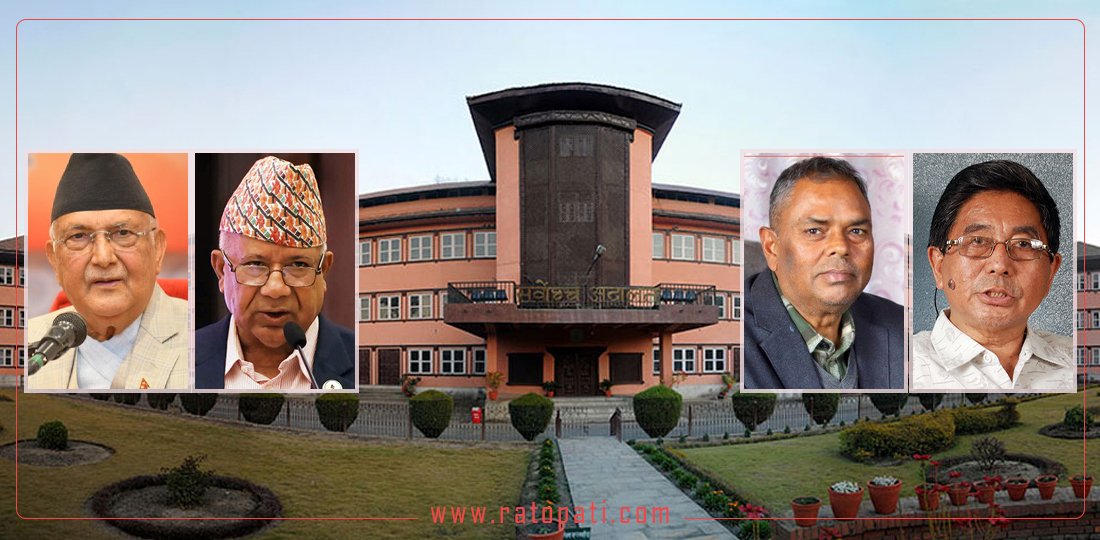
Kathmandu. The Supreme Court took four years to resolve the dispute over the official recognition of the CPN (Unified Socialist), which was formed after the split of the CPN-UML. The Supreme Court, after four years, heard the case on Poush 21 and the division bench of Justices Manoj Kumar Sharma and Sunil Kumar Pokharel dismissed the writ petition. By the time the Supreme Court dismissed the petition, the existence of the Unified Socialist party had already faded.
The dispute reached the Supreme Court after the CPN (Unified Socialist) party, led by Madhav Kumar Nepal, was registered with the Election Commission following the split from the CPN-UML on Bhadra 2, 2078 BS. After the merger of the then Communist Party of Nepal (CPN) was nullified by the Supreme Court, the UML and Maoist Centre returned to their separate existences. Shortly thereafter, the Unified Socialist was formed by splitting from the UML. Subsequently, UML Chairman KP Sharma Oli filed a writ petition making the Election Commission the respondent, questioning the legality of the Unified Socialist party. However, due to the prolonged delay in resolving the case, the Unified Socialist participated in the 2079 House of Representatives election and even joined the government.
The case pending in the Supreme Court became irrelevant after the Unified Socialist merged with the CPN (Maoist Centre) to form the Communist Party of Nepal (CPN) before the dispute over granting political party recognition could be settled.
The UML had filed a writ petition questioning the legality of the new party formed by its own lawmakers. UML Chairman Oli filed a writ in the Supreme Court on Bhadra 17, 2078 BS, demanding the removal of 14 lawmakers from the Unified Socialist. In the writ, Oli named the then Speaker Agni Prasad Sapkota and the Speaker of the Lumbini Province as respondents for questioning the legality of the party split based on the Political Parties Ordinance issued at that time.
The Unified Socialist, led by Madhav Nepal, was formed after the government amended the Political Parties Act, introducing an ordinance that allowed a new party to be registered with just 20 percent of the members of the central committee or parliamentary party.
Party Dissolved by the Time Hearing Arrived After Four Years
When the Unified Socialist, which had existed for four years, was heard in the Supreme Court on Poush 21, the purpose of the writ had already expired. The first hearing date for the case concerning the legality of the Unified Socialist was set for Bhadra 18, 2078 BS. As the bench could not convene that day, the hearing was scheduled for Bhadra 20 in the single bench of then-Justice Cholendra Shamsher Jabara, but it was listed under cases not to be heard. On Bhadra 22, Justice Jabara's bench issued a show-cause order and called for a discussion on an interim order.
On Bhadra 28, 2078 BS, the hearing for the interim order was scheduled in the division bench of Justices Deepak Kumar Karki and Meera Khadka, but it was placed on the list of cases not to be heard. On Ashoj 4, 2078 BS, the bench of Justices Deepak Kumar Karki and Kumar Chudal kept the case in the ‘under consideration’ list. On Ashoj 5, the same bench issued other orders. Thereafter, the case was scheduled through the lottery system.
On Poush 12, 2078 BS, the case under the lottery system was scheduled in the division bench of Justices Tej Bahadur KC and Tank Bahadur Moktan, but it was listed under cases not to be heard. Subsequently, the case was listed under cases not to be heard four times consecutively. Then, on Falgun 1, 2078 BS, the case reached the division bench of Justices Ishwar Prasad Khatiwada and Kumar Regmi, but it was postponed by the Office of the Attorney General that day.
On Falgun 29, 2078 BS, the division bench of Justices Ishwar Prasad Khatiwada and Kumar Chudal ordered the writ filed against Madhav Nepal and 14 others regarding the party's legality to be presented for a full hearing. Following this, the case was not heard once due to being unfit, four times due to not being listed, and once because the bench could not convene. The hearing for this case finally took place on Poush 21, 2082 BS, by which time its relevance had completely vanished.
JSP-Nepal Split Dispute Pending in Supreme Court
This dispute reached the Supreme Court via the Election Commission after the Janata Samajbadi Party Nepal, led by Upendra Yadav, split to form the Janata Samajbadi Party. Currently, a writ filed by Upendra Yadav against the Election Commission regarding the JSP recognition dispute is pending in the Supreme Court.
According to the Election Commission's records, the Janata Samajbadi Party Nepal was registered with the Election Commission on Asar 25, 2077 BS. While party chairman Upendra Yadav was on a foreign visit, Ashok Kumar Rai and 7 other lawmakers split the party and applied to register a party named 'Janata Samajbadi Party' with the Election Commission on Baisakh 23, 2081 BS. The Election Commission registered the party and recognized the lawmakers.
Upendra Yadav approached the Supreme Court on Jestha 29, 2081 BS, against the decision of the Election Commission. Leaders from Yadav's faction claim that the Election Commission should not have recognized the split lawmakers by registering a new party due to a legal vacuum. Most of the lawmakers who split from Yadav's party have either joined some older parties or former lawmakers have joined new parties, leaving only a small group, including Ashok Rai, in the current Janata Samajbadi Party. However, the Supreme Court has yet to resolve this case. The related case is pending in the full bench of the Supreme Court.
Political Turmoil Caused by Ordinance Manipulation
Immediately after the Deuba government issued the Political Parties Ordinance in Bhadra 2078 BS, the regulations related to political parties were also amended. Although the ordinance was repealed, the provision in the regulations based on the ordinance, requiring 20 percent representation for party division, was not revoked. The Janata Samajbadi Party was registered by the Commission based on the provision in the Political Parties Regulations (Second Amendment) issued on Bhadra 3, 2078 BS. However, the Commission officials were not unanimous regarding that decision.
Some held the view that since the ordinance itself was repealed, the provision in the regulations based on it was automatically void. However, others opined that since no part of the regulations had been repealed so far, it was permissible to register a party based on those provisions.
The Commission registered the party and recognized the lawmakers, citing that 46.66 percent of the lawmakers endorsed the formation of the new party. Upendra Yadav, Chairman of the Janata Samajbadi Party Nepal, questioned the very process. His writ petition filed in the Supreme Court stated: ‘It was wrong to register a new party against the law when registration of a separate new party should have been refused due to the absence of law.’
Yadav's Question: Can a party be registered based on regulations when the provision in the Political Parties Act has been repealed?
Any party that completes the legal procedures can be registered with the Election Commission. However, the main issue of contention now is whether the lawmakers of a party formed by splitting another party will receive recognition. The Constitution stipulates that lawmakers who abandon the party they were elected from will be removed from office. However, Section 33 of the Political Parties Act envisioned a provision where if a party split into a new party or merged with another party with an extent of division larger than a certain percentage, the lawmakers' positions would remain intact.
The main question is whether the provision of that Act applies now, given the repeated changes through ordinances. The Election Commission registered the party based on the Political Parties Regulations, ensuring the lawmakers' positions remained intact. However, Upendra Yadav argues that since the provision in the Act has been repealed, registration based solely on the regulations is invalid.
According to the law on political parties, there are three ways a political party can be registered: by forming a new party and registering it with the Election Commission, by splitting from an existing party, or by merging two or more parties to form a new one.
Section 33 of the Political Parties Act, 2073 BS, contained provisions regarding the status of federal and provincial lawmakers who join a new party formed by splitting an existing one.
Initially, the original Act stipulated that lawmakers would receive recognition only if 40 percent of the central committee members or parliamentary party members of a party formed a new party. Later, during KP Sharma Oli's government, this was amended through an ordinance. When Sher Bahadur Deuba was the Prime Minister, another ordinance was introduced to grant recognition to the group of lawmakers led by Madhav Nepal, who had split from the UML. That ordinance added a provision where lawmakers would receive recognition if 20 percent of the central committee members or parliamentary party members split the party. That provision is now defunct after the ordinance was repealed.
This specific news has been automatically translated by AI. As a result, there may be some inaccuracies or language errors.
_cvUCBlwFTZ.jpg)