Electoral Fever Rises in Nepal Amidst Mass Youth Emigration for Overseas Jobs

Kathmandu. The country is currently engulfed in an election atmosphere. Candidate registration for the House of Representatives elections, scheduled for February 21, was completed across all constituencies last Tuesday.
The Election Commission provided election symbols to the candidates on Friday. A total of 3,438 individuals have filed their candidacies nationwide. The hustle and bustle of the elections have increased across the country.
Candidates have begun visiting homes. Leaders who have rarely visited villages are now reaching every hamlet with their agendas to seek votes. Discussions about the upcoming elections are widespread, from door-to-door canvassing to every street corner and social media.
The elections are taking place under unusual circumstances, following the political change achieved through the momentum of the 'Gen-Z movement' for good governance and an end to corruption held on Bhadra 23 and 24.
Several political parties have entered the electoral arena declaring their aim to establish new and alternative political parties and youth leadership in the upcoming elections. Some political parties have even announced their prime ministerial candidates before the elections began, which appears to be a new practice compared to the past. However, despite slogans promoting good governance and a prosperous Nepal through new youth leadership, the outflow of young people migrating abroad has not stopped.
Candidates and party workers are reaching villages to solicit votes. But the villages only have houses; the voters are absent. Many young people have concentrated in urban centers, and those who have moved to cities are still leaving the country for foreign employment or studies.
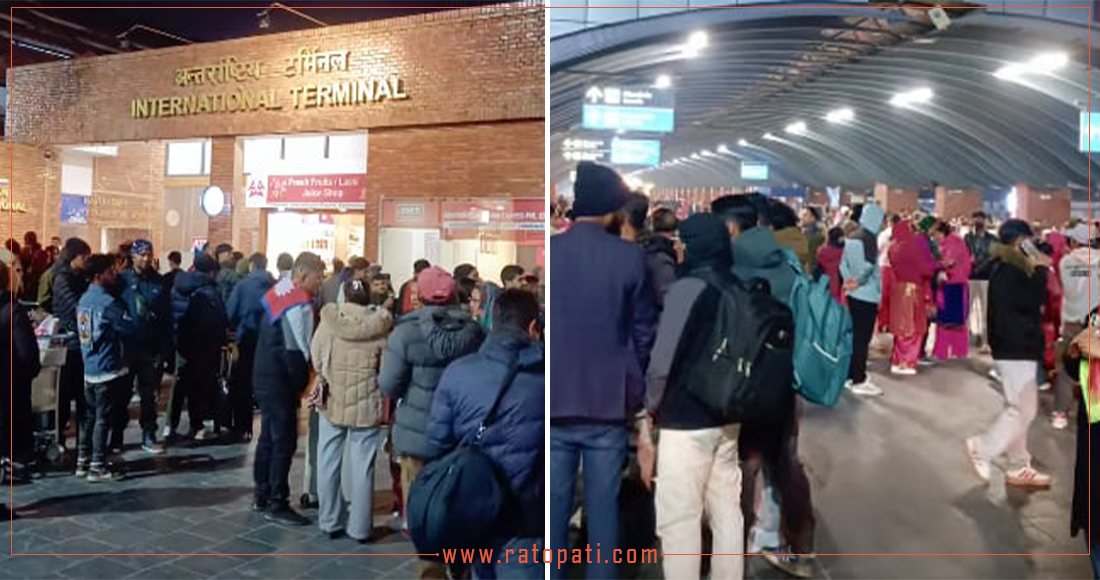
As the election mood surges across the country, the departure lounge at Tribhuvan International Airport continues to see a steady rush of young people leaving for foreign destinations every day.
Two contrasting scenes can be observed at the airport currently. At the domestic terminal, leaders are seen rushing around for election campaigning. At the international terminal, long queues of young people heading abroad for foreign employment or studies are visible daily.
Some youths encountered at the airport stated that they are compelled to go abroad because the election alone cannot sustain their livelihoods.
Bikram Sunar, who worked as an artist and journalist in Kathmandu for a long time, recently left journalism to move to Japan for employment. He mentioned that although he intended to vote in the upcoming election, circumstances forced him to leave the country.
He stated, 'Voting in the election is a natural right of a citizen. Sustaining one's livelihood is a compulsion. Going abroad as elections approach is not by choice but by circumstance. Going abroad is not a sign of dissatisfaction with the election. It is the despair created by the political situation for the youth. If there were opportunities, the plan was to stay within the country and vote. But we voted in past elections, electing leaders, yet nothing was done according to the aspirations of the youth.'
He added that instability in the country is also forcing young people to migrate due to despair.
'I wanted to see change in the country, but I couldn't cast my vote,' said Kumar Ram from Ramechhap, who was headed to Qatar. He mentioned that although he wished to vote for good people, circumstances forced him to travel abroad. 'Elections are coming, leaders are entering villages to seek votes. I also wanted to vote and elect good people, but casting a vote won't light the hearth at home,' he said, 'I have to go abroad to support my family.'
He expressed hope that when those residing in the country vote in hopes of electing good people, an environment might be created within the country for those planning to return. 'We have voted and elected leaders many times, but nothing has changed for us,' he lamented.
Similarly, Sapana Rai, who was preparing to leave for foreign employment, shared a similar sentiment. She stated that for the immediate future, employment is more necessary for her than voting for leaders. She lamented that regardless of how many votes leaders receive, emigration of youth remains the only alternative for them.
She said, 'I intended to study and do something in the country, but I found no opportunities anywhere. Even though I cannot exercise my right to vote in the election, I hope the new leadership coming this time creates an environment where youths like us do not have to go abroad. I hope to be in my own country to vote in the next election.'
Abhishek Sunar, also heading to Japan, shared a similar view. He stated that he is compelled to seek employment abroad due to the lack of an environment conducive to staying in the homeland.
He mentioned that votes were cast in the past two elections, but there have been few tangible plans for employment or youth development in the country. 'Those who chant slogans of change in the country forget about us once they gain power. We, the youth, should be here bringing about change, but compulsion forces us to carry passports. I am going abroad hoping that an environment will soon be created to return and do something within the country.'
Ajay Kumar Rai, General Secretary of the Nepali Trade Union Congress, stated that it is necessary for political parties to create action plans in their manifestos to ensure employment for the youth within the country. He said it is not a good sign for young people to be leaving the country when it is time to vote.
He stated, 'Youths are being forced to go abroad at a time when they should be returning to Nepal. The government coming after the next election must be able to reduce youth migration by creating employment opportunities within the country.'
He added that keeping the youth in the country requires making employment opportunities and social security more effective.
He believes that the compulsion to seek foreign employment will cease if social security is made effective.
He also noted that the next government needs to introduce policies that expand the labor market and ensure their effective implementation.
Despite the widespread election fervor in the country, approximately two thousand Nepalis are still leaving for employment daily. The country runs on the remittances sent by those who go abroad to sell their labor and sweat. Yet, youth emigration is peaking right before the elections.
- 6-Month Data
In the first six months of the current fiscal year 2080/81, the number of Nepalis obtaining labor permits for foreign employment reached 590,718. According to the Department of Foreign Employment, from Shrawan to Poush last, 514,350 males and 76,368 females obtained labor permits, of which 196,042 individuals received re-entry permits.
Looking at the statistics from the last six months, an average of about 98,000 Nepalis have gone abroad for foreign employment every month. In Poush alone, a total of 62,559 people received final labor permits, consisting of 55,541 males and 7,018 females.
- Nature and Destinations of Labor Permits
According to the department's data, 325,407 individuals went for foreign employment through manpower agencies, and 64,262 obtained individual labor permits.
Furthermore, 4,866 people went to Israel, Korea, and the UK through G2G (Government-to-Government) channels. During this six-month period, 141 Nepalis working abroad without proper documentation were legalized. In Israel alone, 608 people went through G2G channels in six months.
Saudi Arabia was the primary destination for Nepali workers in Poush, with 13,327 people obtaining labor permits. This was followed by Qatar with 12,046, UAE with 9,517, Malaysia with 8,532, and Kuwait with 4,311 Nepalis.
Outside the Gulf region, 2,861 Nepalis went to Romania and 909 to Croatia in Europe. The presence of Nepalis in Japan, Oman, and Bahrain is also significant.
This specific news has been automatically translated by AI. As a result, there may be some inaccuracies or language errors.




_Hd6sr8PGgB.jpg)