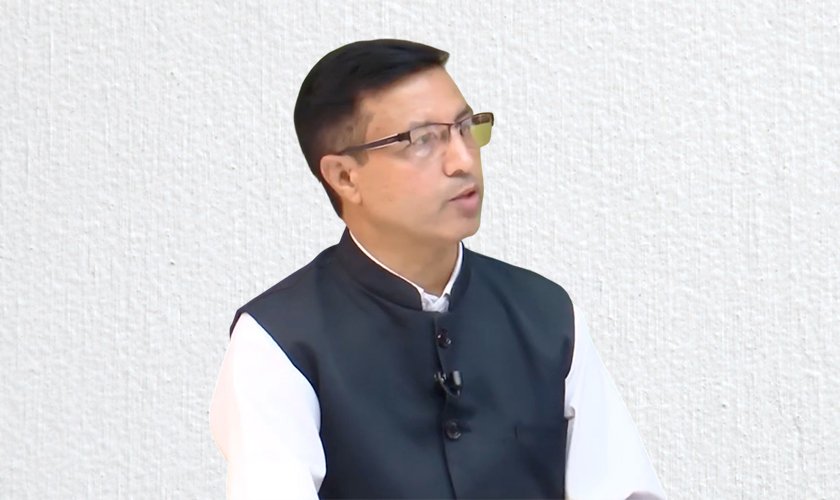
Former Ambassador Dipkumar Upadhyay Discusses Nepal's Foreign Policy Under Balen Shah's Leadership

Following the formation of the government led by Balen Shah, there has been much commentary on geopolitics. Discussions have begun on the increased interference of various powerful nations in Nepal, and the inability to improve relations with neighboring countries.
Issues ranging from border problems to ambassadorial appointments and power balance with neighboring nations have also surfaced. In this situation, Ratopati has interviewed former ambassador Dipkumar Upadhyay regarding how the country's foreign policy will proceed, what the government should do, and what improvements are needed in policy.
Here is the edited excerpt of the interview with former ambassador Upadhyay:
- After the formation of the new government under Balen's leadership, how do you view Nepal's foreign activities and international affairs objectively?
I have always said that due to some of our past weaknesses, a lot of dirt has accumulated under the carpet of diplomacy, which needs to be cleaned. In the past, as soon as a government or prime minister was formed, there was a rush to meet all foreign diplomats and a tendency for haphazard running around. However, I personally find the diplomatic protocol, dignity, and silence adopted by the current Prime Minister Balen Shah to be positive.
Self-discipline is necessary in diplomacy, but I am still waiting to see what results and achievements this silence will bring for the nation's benefit. In some instances, Prime Minister Balen still appears to lack maturity and experience. Perhaps this is also due to not receiving the right advisors and guidance in time. Prime Minister Balen's statement in parliament about the Nepal-India border was not necessary from a diplomatic perspective. It was a very irresponsible statement. Such things should not come from the Prime Minister's position. In diplomacy, one must speak very carefully and with balanced language.
- How do you analyze the relationship with the two neighboring countries, India and China?
Our relations with our two large neighbors must be viewed from a specific perspective based on national interest. Just recently, the Prime Minister had an official meeting with the ADB President as a foreign diplomatic figure. Nepal has formulated diplomatic codes of conduct many times, but they have never been implemented. In the past, prime ministers and foreign ministers themselves used to violate the code of conduct. This time, the government starting to follow the protocol on its own is a good aspect. Our geopolitics is such that there are geographical difficulties to the north. Snow falls in winter, and landslides occur in the monsoon. If tunnels are built under the Himalayas using advanced technology in the future, that's a different matter; otherwise, the northern route alone cannot be our reliable supply route.
We are not self-sufficient in production; we are completely dependent. We are compelled to depend on our neighbors for supply and revenue 365 days a year. In such a situation, diplomatic maturity was lacking in some matters. For example, regarding the visit of India's Foreign Secretary to Nepal, India also tries to show its diplomatic 'ego'. If he was sent with the dignity of the Prime Minister's special envoy, our Prime Minister should have met him and clearly presented Nepal's agenda and expectations. It was a good opportunity that we missed, rather than making comments from the outside. India also made a mistake in diplomatic behavior, and we also missed an opportunity. India, according to its convenience and interests, sometimes rolls out the red carpet and sometimes refuses to meet, which may be in its national interest, but we must be vigilant about our policies.
Today's China has become the world's largest power in terms of strategy, economy, and technology. It will not remain a mere spectator in Nepal's affairs. We talk about the 'One China Policy', but China is always sensitive and vigilant about security and activities of the exiled government connected to Tibet. In the past, when governments and leaders failed to balance geopolitics, the country got caught in the crossfire. My wish is that this government does not fall into the same trap. The West also has its own open interests. In such a situation, while the Prime Minister's strategy of speaking less and maintaining silence is good, when speaking, it is essential to choose extremely balanced, serious, astute, and result-oriented language.
- Not only China and India, but Western countries also have their eyes on Nepal's water resources. What diplomacy is hidden in this?
The 21st century is the century of water and its multiple uses. India has always had a significant interest and eye on Nepal's water resources. We must bring in international capital and technology while securing our rights and interests to utilize water for multiple purposes, benefiting both Nepal and India. Currently, due to a lack of management, water has become a curse of floods and inundation in the monsoon instead of a boon for us. If we can conserve water, it will provide great benefits in areas like green energy, clean drinking water, flood control, tourism, and the environment.
India must also abandon its old ways and operate according to international law and regulations. As the terms of the Kosi and Gandak agreements are nearing their end, it is time to think of new alternatives. Even according to past agreements, Nepali farmers have not received compensation for flood and inundation damage. It is necessary to improve the existing flawed technical structures that cause water scarcity in winter and floods in the monsoon.
- If the government continues in this manner, what impact will it have on our foreign policy and international relations?
This will have a significant impact. Trying to please everyone in diplomacy or losing balance is fatal. We must be vigilant about whether our non-alignment or neutrality is causing inconvenience to our neighbors. Not everything is said openly in diplomacy; one must understand 'body language' and symbolic expressions. We must be able to clearly articulate China's or India's sensitivities and our problems diplomatically.
Regarding border disputes, although Nepal has sent diplomatic notes repeatedly, negotiations have not taken place. Even though statements at the foreign secretary and prime minister levels have mentioned negotiations, the tendency to ignore the problem is not good. India also needs to be serious about this. Only if all political parties and the Nepali people unite internally to form a common national perspective will the international community also respect us.
- Does it seem like the current government is trying to make some modifications or changes to foreign policy?
It is not stated that the policy itself will be modified, but concerns have indeed arisen among the public whether this government is leaning towards the West (American-European) side. The government must prove this through its actions and words, as an imbalance in Nepal's foreign policy is unacceptable to the Nepali people and neighbors. We are a non-aligned nation and should not become part of any military alliance or international power bloc. We must bring clarity within the country and remain in constant dialogue with our neighbors.
When our Foreign Minister visited China, the Chinese Foreign Minister's statement, 'A close neighbor is more useful than a distant relative,' was a very significant symbolic message diplomatically. It has a clear meaning. In diplomacy, eyes, body language, and speech convey a lot. Every word in diplomacy has meaning. The Chinese Foreign Minister's statement carries great significance. It should be understood as clearly conveying the message: 'You are a sovereign country, and it is your right to maintain relations with Western countries for technology or capital investment, but activities contrary to our security and national interest, such as uranium exploration or pro-Tibet movements, should not use Nepal's territory.'
We must conduct mature diplomacy by understanding the security sensitivities of both India and China. The current government's attempt to adhere to codes of conduct and ethics from the Prime Minister and Ministry of Foreign Affairs level is a positive start, but in some sensitive matters, such as passport processes or international contracts, serious thought must be given before intervening. Hasty decisions can raise questions about Nepal's procurement process and image in the international arena.
We interpret MCC and BRI in our own ways, but in international documents and diplomacy, they have their own meanings. China considers loan projects like Pokhara and Bhairahawa airports to be under BRI. Therefore, contradictory statements in international forums are fatal.
- Ambassadorial appointments used to be based on party affiliation, but this time the Ministry of Foreign Affairs has started recruiting ambassadors by issuing advertisements. Some say this is also a break from tradition. What is your understanding of this?
This is indeed a break from tradition, but then again, selection has to be made. We need to see who gets selected and what kind of people are selected. In my opinion, self-respecting individuals are unlikely to apply for these appointments. This is a government formed from the Janatantrik Yuva Morcha (Janajagaran) movement. People have hopes that it will do something. Everyone wishes that this government will do something independently. The government will form an expert committee for selection. However, there is also suspicion that it might revert to the old ways in a roundabout manner. There is also suspicion that even though an advertisement is issued for show, their own people might be appointed. The government must be vigilant about this. The government must not break the people's hopes. I repeat, if the appointments are made in the old style, it will be counterproductive.
- In conclusion, has Nepal become entangled in a major geopolitical game?
Yes, Nepal has become entangled in a geopolitical labyrinth. To escape from this, we need national conscience and political awareness. Nepal has a glorious history of over five thousand years. In the past, even though our ancestors were not as advanced in technology and education as today, they preserved the country's sovereignty. But today, there is confusion about which direction the country is heading.
International power centers want to create political instability in Nepal and establish a base favorable to their interests. Although some recent unimaginable and rapid political upheavals in Nepal have been based on public outrage, foreign strategic well-design and influence are clearly visible in them. Such serious matters may become subjects of national and international investigation in the future. But the main challenge today is to preserve the nation's nationality, sovereignty, and territorial integrity. For this, there is no alternative but for all political parties and the Nepali people to set aside internal differences and stand together.
- There are claims that Western powers are dominant in Nepal now; what is your analysis?
That is clearly visible. Those figures are still present. There are also video recordings of their activities during the Janatantrik Yuva Morcha (Janajagaran) movement. How many current MPs and leaders were involved in that? People who were involved in burning the Supreme Court, Singha Durbar, and the President's Office are in the current government. If we delve into who was involved where in the past, everything will become clear.
This specific news has been automatically translated by AI. As a result, there may be some inaccuracies or language errors.
_Eqo5W0NMVM.jpg)